Engineering Chemistry: Unit III: b. Composites
Anna University Long Questions and Answers
Composites | Engineering Chemistry
Engineering Chemistry : UNIT III : Phase Rule and Composites : Anna University long Questions & Answers
Unit - III
Chapter 4
Composites
Anna University Long Questions & Answers
Part - B
1. What are composites? Explain the constituents of composites.
A composite material may be defined as, “a material system
consisting a mixture of two (or) more micro-constituents, which are mutually
insoluble, differing in form (or) composition and forming distinct phases”.
Composites consist of two important constituents.
(i) Matrix phase (or) Matrix resin
(ii) Dispersed phase (or) Reinforcement.
1. Matrix Phase (or) Matrix resin
Matrix phase is the continuous body constituent, which encloses
the composite. Matrix phase may be metals, ceramics (or) polymers (liquid
resins), composites using these matrix are known as
(i) Metal Matrix Composites (MMC)
(ii) Ceramic Matrix Composites (CMC)
(iii) Polymer Matrix Composites (PMC) respectively.
2. Dispersed Phase (or) Reinforcement
Dispersed phase is the structural constituent, which determines
the internal structure of composite.
Examples : Fibres, Particulates,
Flakes, Whiskers.
1. Fibres
Fibres are long and thin filament of any macromolecular substance
such as polymer, metal (or) ceramic having high length to diameter ratio at
least 100:1.
2. Particulates
Particulates are small pieces of hard solid materials. They may be
metallic (or) non-metallic. Generally distribution of particles in a given
matrix is random, so the resulting composites are usually isotropic. Due to the
inherent hardness, the particles in a composite cause constraints on the
plastic deformation on the matrix.
3. Flakes
Flakes are very thin solid like materials.
Example: Mica flakes
4. Whiskers
Whiskers are thin strong fibre like material made by growing a
crystal.
Example: Graphite, silicon
carbide, silicon nitride
2. What are the advantages of polymer composites? Explain using
FRP as an example. (CBE. A.U. Jan 2009)
1. Polymer composite has very high strength to weight ratio than
the metal.
2. The weight of FRP is 75% lower than the weight of steel, so it
improves performance, reduces energy need, simplifies handling.
3. Using polymer composite devices both capacitance and leakage
current can be reduced.
4. FRP offers better corrosion resistance to a wide range of
chemicals resulting in longer service life, less maintenance and repair down
time.
5. FRP possesses excellent durability and fire resisting
properties.
6. It is ideal for outdoor installation, because it is impervious
to the effect of sunlight, heat, cold and other weather conditions.
7. Specifying the orientation of reinforcing fibres, can increase
the strength and resistance to deformation of the polymer.
8. GRP (glass reinforced polymer) are strongest and most resistive
to deforming forces, when the polymer fibres are parallel to the force being
exerted and are weakest when the fibres are perpendicular.
9. CRP (carbon fibre reinforced polymer) in place of sheet
aluminium in traditional rudded are
(i) 25% reduction in weight.
(ii) 95% reduction in components by combining parts and forming
simpler moulded parts.
3. Write a note on FRP. (Chen. A.U. Jan 2009, June 2009, TNV A.U. Jan 2009, Coim A.U. Jan
2010)
(Or)
Write notes on polymer matrix composites. (Coim. A.U. Jan 2010)
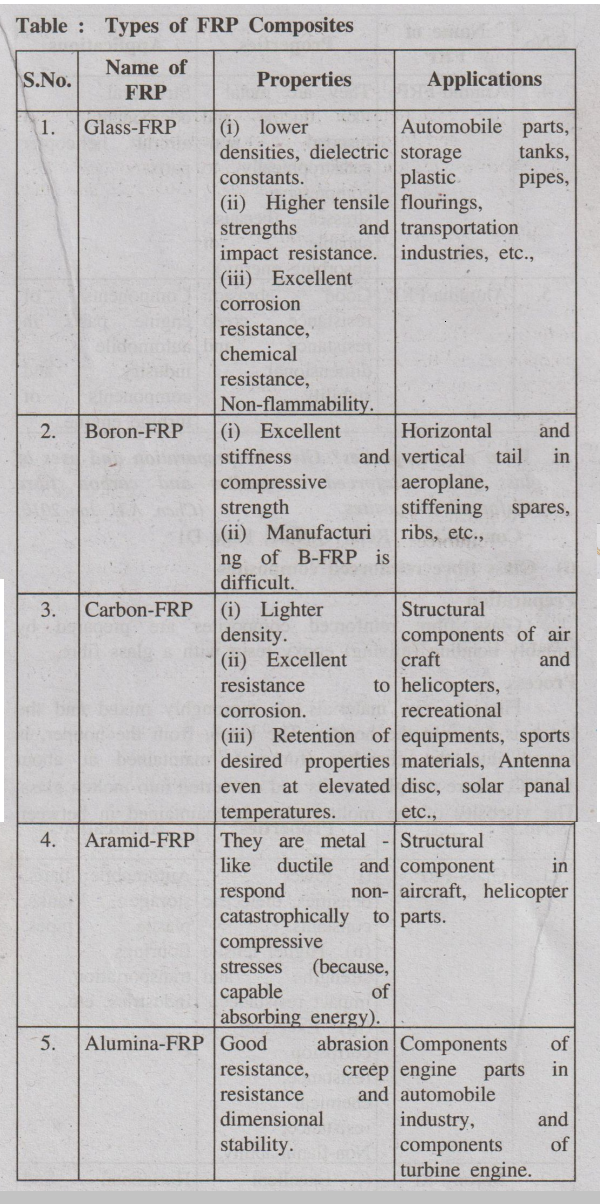
The fibre reinforced polymer composites constitute more than 90%
(by weight) of the total composites used in various industries. The advantages
of using polymer in structural composites is the ease of fabrication of complex
structural shapes. It can be easily manufactured.
Preparation
: . Fibre-reinforced plastics are produced by suitably :bonding a
fibre material with a resin matrix and curing them under pressure and heat. The
main reinforcing agents used in FRP composites are, glass, graphite, alumina,
carbon, boron, etc. The reinforcement material can be in different forms such
as short fibres, continuous filaments (or) woven fabrics.
The resin matrix commonly used in FRP are polyesters, epoxy,
phenolic, silicone, and polyamide polymer resins.
Characteristics (or) Properties of FRP
1. It possess superior properties like higher yield strength,
fracture strength and fatigue life.
2. Since fibre prevents slip and crack propagation, the mechanical
properties of FRP gets increased.
3. It possess high corrosion resistance and heat resistance
property.
4. What are composites? Give the preparation and uses of glass
fibre reinforced composites and carbon fibre reinforced composites. (Chen. A.U. Jan 2010)
Composites:
A composite material may be defined as, “a material system
consisting a mixture of two (or) more micro-constituents, which are mutually
insoluble, differing in form (or) composition and forming distinct phases”.
Composites consist of two important constituents.
(i) Matrix phase (or) Matrix resin
(ii) Dispersed phase (or) Reinforcement.
1. Matrix Phase (or) Matrix resin
Matrix phase is the continuous body constituent, which encloses
the composite. Matrix phase may be metals, ceramics (or) polymers (liquid
resins), composites using these matrix are known as
(i) Metal Matrix Composites (MMC)
(ii) Ceramic Matrix Composites (CMC)
(iii) Polymer Matrix Composites (PMC) respectively.
(i) Glass fibre reinforced
composites
Preparation
Glass fibre reinforced composites are prepared by suitably bonding
(mixing) epoxy resin with a glass fibre.
Process
First the raw materials are thoroughly mixed and the batch is fed
into the hooper. The batch, from the hooper, is forced into the chamber
(furnace), maintained at about 1540°C, where the glass melts and converted into
molten glass. The viscosity of the molten glass is maintained in between 600
and 1000 p.
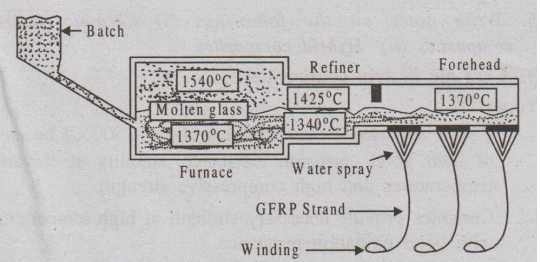
The molten glass, from the chamber, moves to refiner part where
dust and foreign substances are removed and the temperature gets reduced by
30°C. Finally the refined molten glass moves to forehead (criticle part of
glass fibre making Winding part), which draw the molten glass into glass fibre.
Glass fibre is cooled at out let by water spray and GFRP is obtained.
Properties
(i) Lower densities, dielectric constants.
(ii) Higher tensile strengths and impact resistance.
(iii) Excellent corrosion resistance, chemical resistance,
Non-flammability.
Uses :
Automobile parts, storage tanks, plastic pipes, flourings,
transportation industries, etc.
2. Carbon fibre reinforced composites
Preparation
Carbon fibre reinforced composites are prepared by suitably mixing
polyester resin with a carbon fibre as per the above method.
Properties
(i) Lighter density.
(ii) Excellent resistance to corrosion.
(iii) Retention of desired properties even at elevated
temperatures.
Uses
Structural components of aircraft and helicopters, recreational
equipments, sports materials, antenna disc, solar panal etc.
5. Write notes on the followings (i) Ceramic matrix composites
(ii) Hybrid composites
(i) Ceramic matrix composites
Properties
1. CMCs are used at temperatures above 1500°C, because of their
good corrosion resistance, stability at elevated temperatures and high
compressive strength.
2. Ceramics provide necessary strength at high temperature with
good oxidation resistance.
3. The matrixes used are glass, ceramics, carbides, nitrides, oxides
and borides, the reinforcements are Al2O3, B, C, SiC and
SiO2
Uses
They are used in re-entry thermal shields in space vehicles and
tiles, pump seal, round rings, brake linings etc.
(ii). Hybrid composites
Hybrid composites are new class of materials composed of a
suitable polymer matrix reinforced with two different fibres (or) fillers.
Properties
Hybrid composites possess very good properties compared to their
single fibre composites.
1. They possess strong, tough and higher impact resistance.
2. When hybrid composites are stressed in tension, failure does
not occur suddenly.
3. They possess balanced strength and stiffness.
4. They also have balanced thermal distortion stability, reduced
weight, improved fatigue resistance.
5. They exhibit superior mechanical and tribological properties
than other composites.
Uses
1. It is used in light-weight transport (land, water (or) oil) structural
components.
2. It is also used in light weight orthopedic components and
sporting goods.
3. It is used to make furniture like chair, table and bath tubs
4. It is used in railway coach interiors.
5. It is also used in making daily used applications like plates
and spoons.
6. Automobile industry utilizes hybrid composites in many of the
interior and exterior applications.
Engineering Chemistry: Unit III: b. Composites : Tag: Engineering Chemistry : Composites | Engineering Chemistry - Anna University Long Questions and Answers
Related Topics
Related Subjects

Engineering Chemistry
CY3151 1st Semester | 2021 Regulation | 1st Semester Common to all Dept 2021 Regulation