Environmental Sciences and Sustainability: Unit II: Environmental Pollution
Biomedical Waste : Management and Handling Rules
• Bio-medical Waste (Management and Handling) Rules. 1998 were notified by the Ministry of Environment and Forests (MoEF) under the Environment (Protection) Act, 1986. These rules apply to all persons who generate, collect, receive, store, transport, treat, dispose or handle bio-medical waste in any form.
Biomedical Waste : Management and Handling Rules
•
Bio-medical Waste (Management and Handling) Rules. 1998 were notified by the
Ministry of Environment and Forests (MoEF) under the Environment (Protection)
Act, 1986. These rules apply to all persons who generate, collect, receive,
store, transport, treat, dispose or handle bio-medical waste in any form.
•
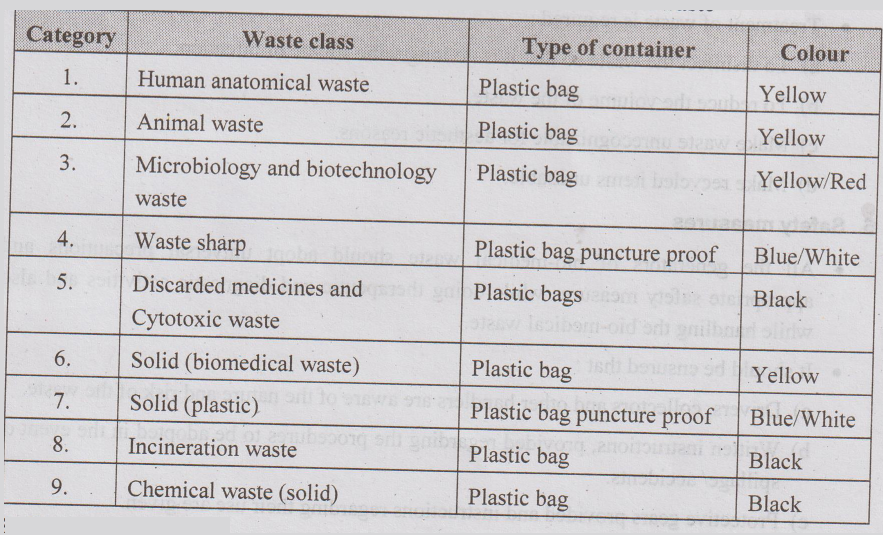
Thus bio medical waste should be segregated into containers/bags at the point
of generation of waste. Thus colour coding and type of containers used for
disposal of waste came into existence which is shown as follows :
Need
For BMW Management
1.
Nosocomial infections in patients from poor infection control practices and
poor waste management.
2.
Drugs which have been disposed of, being repacked and sold off to unsuspecting
buyers.
3.
Risk of air, water and soil pollution directly due to waste, or due to
defective incineration emissions and ash.
4.
Risk of infection outside hospital for waste handlers and scavengers, other
peoples.
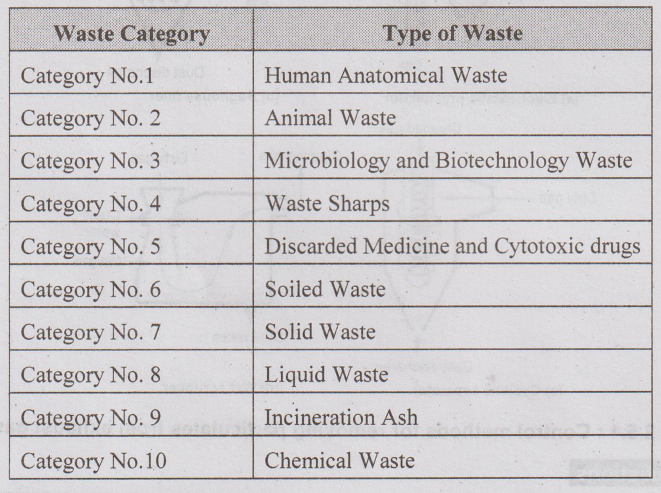
1. Types of Biomedical Wastes
2. Authority for Enforcement
•
The authority for enforcement of the provisions of these rules in respect of
all the health care facilities located in any State/Union Territory is the
respective State Pollution Control Board (SPCB)/ Pollution Control Committee
(PCC) and in case of health care establishments of the Armed Forces under the
Ministry of Defence shall be the Director General, Armed Forces Medical
Services (DGAFMS). This rule consists of six schedules and five forms.
3. Approach for Hospital Waste Management
•
Based on Bio-medical Waste (Management and Handling) Rules 1998, notified under
the Environment Protection Act by the Ministiy of Environment and Forest
(Government of India) following are the ways for hospital waste management.
1.
Segregation of waste
•
Segregation, is the essence of waste management and should be done at the
source of generation of Bio-medical waste e.g. all patient care activity areas,
diagnostic services areas, operation theaters, labour rooms, treatment rooms
etc. The responsibility of segregation should be with the generator of
biomedical waste i.e. doctors, nurses, technicians etc. (medical and
paramedical personnel). The biomedical waste should be segregated as per
categories mentioned in the rules.
2.
Collection of bio-medical waste
•
Collection of bio-medical waste should be done as per Bio-medical waste
(Management and Handling) Rules. At ordinary room temperature the collected
waste should not be stored for more than 24 hours.
Type
of container and colour code for collection of bio-medical waste
3.
Transportation
•
Within hospital, waste routes must be designated to avoid the passage of waste
through patient care areas. Separate time should be earmarked for
transportation of bio-medical waste to reduce chances of its mixing with
general waste. Desiccated wheeled containers, trolleys or carts should be used
to transport the waste/plastic bags to the site of storage/ treatment.
•
Trolleys or carts should be thoroughly cleaned and disinfected in the event of
any spillage. The wheeled containers should be so designed that the waste can
be easily loaded, remains secured during transportation, do not have any sharp
edges and is easy to clean and disinfect.
•
Hazardous biomedical waste needing transport to a long distance should be kept
in containers and should have proper labels. The transport is done through
desiccated vehicles specially constructed for the purpose having fully enclosed
body, lined internally with stainless steel or aluminium to provide smooth and
impervious surface, which can be cleaned.
•
The drivers compartment should be separated from the load compartment with a
bulkhead. The load compartment should be provided with roof vents for
ventilation.
4.
Treatment of hospital waste
•
Treatment of waste is required :
a)
To disinfect the waste so that it is no longer the source of infection.
b)
To reduce the volume of the waste.
c)
Make waste unrecognizable for aesthetic reasons.
d)
Make recycled items unusable.
5.
Safety measures
•
All the generators of bio-medical waste should adopt universal precautions and
appropriate safety measures while doing therapeutic and diagnostic activities
and also while handling the bio-medical waste.
•
It should be ensured that:
a)
Drivers, collectors and other handlers are aware of the nature and risk of the
waste.
b)
Written instructions, provided regarding the procedures to be adopted in the
event of spillage/ accidents.
c)
Protective gears provided and instructions regarding their use are given.
d)
Workers are protected by vaccination against tetanus and hepatitis B.
6.
Measures for waste minimization
•
As far as possible, purchase of reusable items made of glass and metal should
be encouraged. Select non-PVC plastic items. Adopt procedures and policies for
proper management of waste generated, the mainstay of which is segregation to
reduce the quantity of waste to be treated. Establish effective and sound
recycling policy for plastic recycling and get in touch with authorised
manufactures.
4. Biomedical Hazardous Waste Management Rules
•
Hazardous waste is defined as any waste which by reason of any of its physical,
chemical, reactive, toxic, flammable, explosive or corrosive characteristics
causes danger or is likely to cause danger to health or environment, whether
alone or when in contact with other wastes or substances, and shall include
wastes listed in Schedules I, II & III of the Rules.
•
Every person who is engaged in generation, processing, treatment, package,
storage, transportation, use, collection, destruction, conversion, offering
for-sale, transfer or the like of the hazardous waste shall require to obtain
an authorization from the State Pollution Control Board (SPCB).
•
The hazardous waste shall be collected, treated, re-cycled, re-processed,
stored or disposed of only in such facilities as may be authorized by the State
Pollution Control Board for the purpose.
Type
and Nature of HWs
1.
Recyclable - Wastes having potential for recovery of
useful /valuable material e.g. Metal bearing dross, ash, used oil etc.
2.
Incinerable - Wastes having high calorific value,
mainly organic wastes like solvents, tars, off-spec, organic products etc.
3.
Land Disposable - Wastes that can neither be recycled or
incinerated.
Environmental Sciences and Sustainability: Unit II: Environmental Pollution : Tag: : - Biomedical Waste : Management and Handling Rules
Related Topics
Related Subjects
Environmental Sciences and Sustainability
GE3451 ESS 4th Semester | 2021 Regulation | 4th Semester EEE Dept 2021 Regulation