Environmental Sciences and Sustainability: Unit I: Environment and Biodiversity
Conservation of Biodiversity
• Biodiversity is an important tool for sustaining development in any country. Multiple utility of biodiversity in commercial, medical, genetic, aesthetic and ecological field makes it necessary to preserve biodiversity. There is need to educate people to adopt environment friendly practices
Conservation of Biodiversity
•
Biodiversity is an important tool for sustaining development in any country.
Multiple utility of biodiversity in commercial, medical, genetic, aesthetic and
ecological field makes it necessary to preserve biodiversity. There is need to
educate people to adopt environment friendly practices.
1. Advantages of Conservation of Biodiversity
1.
Biodiversity (ecotourism) is a good source of income.
2.
Biodiversity provides various medicinal plants.
3.
It provides life support system on earth.
4.
Biodiversity maintain environmental balance on earth.
5.
Various commercial aspects are related to biodiversity.
2. Factors affecting Biodiversity
1.
Over-exploitation of natural resources.
2.
Degradation of habitat.
3.
Discharge of industrial waste.
4.
Global warming.
5.
Urbanization.
6.
Use of insecticides.
7.
Construction of dam.
8.
Poaching and trade in wildlife species
9.
Extension of agriculture and associated irrigation systems.
10.
Filling up of wetlands
11.
Population explosion
3. Approaches of Biodiversity Conservation
•
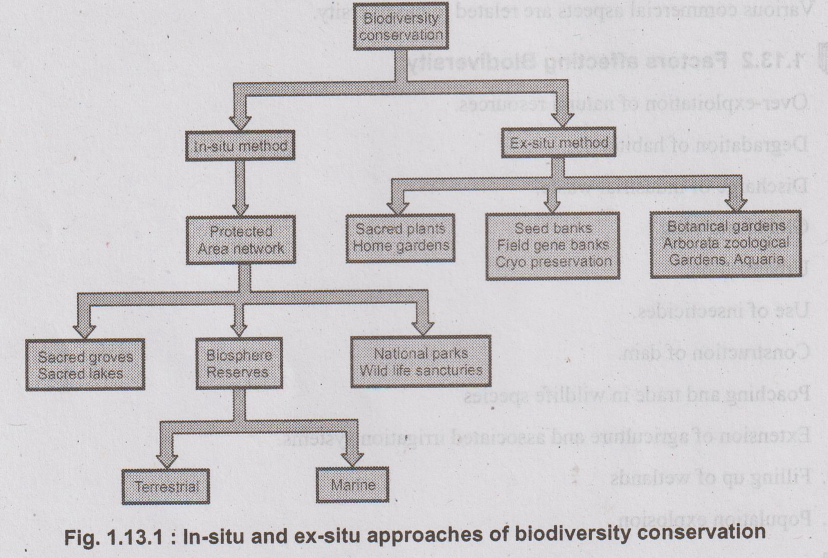
The two basic approaches of biodiversity conservation are :
1.
In-situ conservation (on site method)
2.
Ex-situ conservation (off site method)
4. In-situ Conservation
•
The in-situ conservation of biodiversity involves protection of species, where
they naturally exists. It includes identifying and protecting reserved areas
for biodiversity. These specific areas are national parks, sanctuaries,
forests, lakes, botanical gardens, biosphere reserves where vast number of
species of living organism, exist.
• The natural habitat maintained under in-situ
conservation is called protected areas.
•
Protecting the areas helps not only in conserving individual species but
preserves ecosystem also. In these protected areas - tourism, explosive activities,
poaching, shooting, grazing of domestic animals, cutting of trees are strictly
prohibited.
•
Inspite of these protections, these habitats are facing problem of
encroachment, maintenance and monitoring land management. Also, various
activities which are illegal but profitable for humans are earned out.
Methods of In-situ Conservation
•
Following methods are used for In-situ conservation are used.
1.
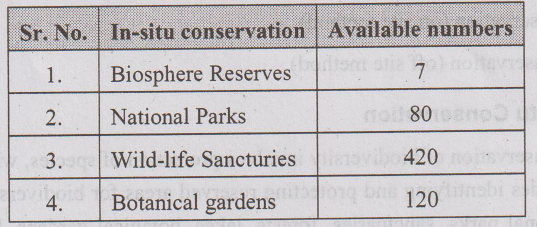
Biosphere reserves :
•
The special category of protected areas in which human population constitutes
an important component are called biosphere reserves.
•
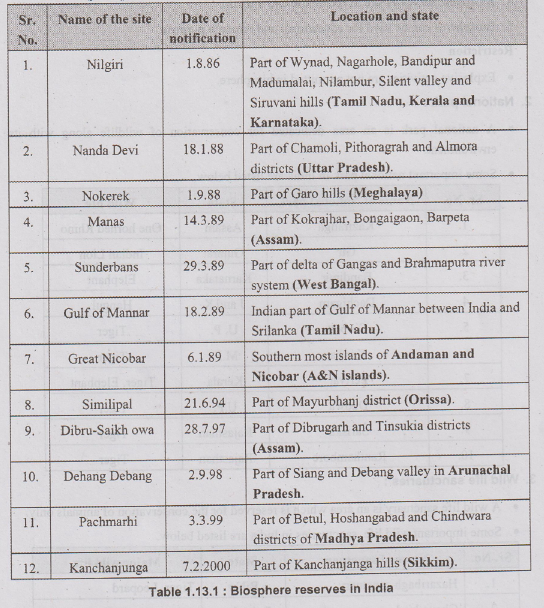
There are about 408 biosphere reserves in 94 countries by the end of 2000 year.
In India following biosphere reserves are identified.
Role
of Biosphere Reserves
1.
Biosphere gives long-term survival of ecosystem.
2.
Biosphere protects endangered species.
3.
Biosphere protects maximum number of species and communities.
4.
Biosphere serves as site of recreation and tourism.
5.
Biospheres can be used for educational and research purpose.
Restriction
•
Explosive activities are not permitted in biosphere..
2.
National park :
•
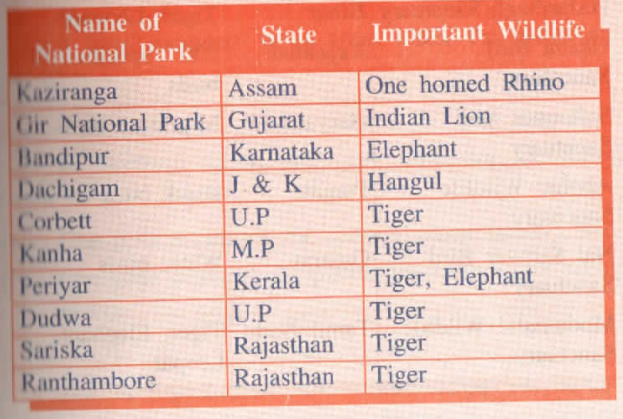
A national park is an area dedicated for conservation of wildlife along with
its environment.
•
Some important national park in India are listed below.
3.
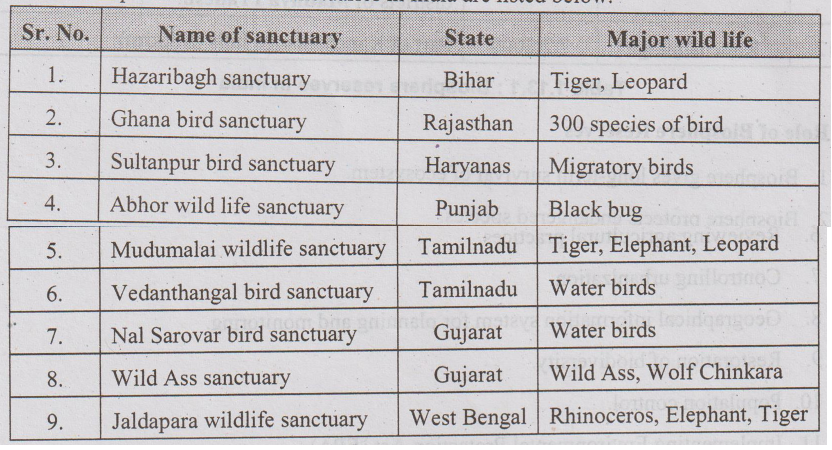
Wild life sanctuaries :
•
A wild life sanctuary is an area which is reserved for the conservation of
animals only.
•
Some important wild life sanctuaries in India are listed below.
5. Ex-situ Conservation
•
The ex-situ conservations of biodiversity involves conservation of biodiversity
under the control of human and outside the natural habitats.
•
The endangered species of plants, and animals are collected in botanical
gardens, zoos, aquariums and their maintenance and breeding is done under
controlled conditions.
•
The biodiversity management in captivity (human control) has certain advantages
and disadvantages.
Advantages
of Ex-situ conservation
1.
The organisms will have longer life span because of assured food, water,
shelter and security.
2.
Because of special care the species endangered may survive longer.
3.
Modem facilities can provide better process of breeding.
Disadvantages
1.
Maintenance and cost of breeding plants and animals are expensive.
2.
Species are habitual to favourable environmental conditions, they can not adapt
to ever changing natural condition.
3.
Freedom of wildlife is lost.
6. Steps of Conservation of Biodiversity
•
Important steps for conservation of biodiversity are as follows -
1.
Biodiversity inventories and assessments - population surveys and assessment.
2.
Identifying and expanding protected areas.
3.
Conserving biodiversity in seed banks and gene banks.
4.
Controlling wild life trade.
5.
Providing environmental education to the people.
6.
Reviewing agricultural practices.
7.
Controlling urbanization.
8.
Geographical information system for planning and monitoring.
9.
Restoration of biodiversity.
10.
Population control.
11.
Implementing Environmental Protection Act (EPA).
12.
Involving more Non-govemment organizations (NGOs).
7. National Biodiversity Act
•
India is party to the Convention on Biological Diversity (CBD) 1992 which
recognizes the sovereign rights of states to use their own biological
resources. In order to help in realizing the objectives of CBD, India has
enacted an umbrella legislation called the biological Diversity Act 2002.
•
The central government has established a body called the National Biodiversity
Authority, on and from the 1st day of October, 2003.
•
The Act aims at the conservation of biological resources and associated
knowledge as well as facilitating access to them in a sustainable manner and
through a just process for purposes of implementing the objects of the Act it
establishes the National Biodiversity Authority in Chennai.
•
The main functions of the authority are :
a)
To lay down procedures and guidelines to govern the activities provided under
section 3, 4, and 6. (Permission to foreigners/NRI's foreign companies)
i)
For obtaining any biological resource (Section -3).
ii)
For transferring the results of any research (Section -4).
iii)
Certain collaborative research projects exempted (Section 5).
b)
To advice the government of India. Specific areas mentioned as per the Act are
the following:
i)
Notifications of threatened species (Section - 38).
ii)
Designate institutions as repositories for different categories of biological
resources (Section - 39).
iii)
Exempt certain biological resources, normally traded as commodities (Section -
40)
c)
To encourage setting up state biodiversity boards
d)
To build up database and documentation system
e)
To create awareness through mass media
i)
Training of personnel
ii)
Necessary measures in the areas of intellectual propriety rights.
Review Questions
1. Explain
biodiversity conservation measures.
2. Explain the
measures of conservation of bio-diversity.
3. Explain in -situ
measures of conversation of biodiversity.
Environmental Sciences and Sustainability: Unit I: Environment and Biodiversity : Tag: : - Conservation of Biodiversity
Related Topics
Related Subjects

Environmental Sciences and Sustainability
GE3451 ESS 4th Semester | 2021 Regulation | 4th Semester EEE Dept 2021 Regulation