Electromagnetic Theory: Solved Paper
EMT Solved Semester Question Paper 2018 Dec (2017 Reg)
3rd Semester EEE Department | Electromagnetic Theory
Electromagnetic Theory: Solved Paper : Regulation - 2017 2021
DECEMBER - 2018
Electromagnetic Theory (25087)
Solved
Paper
Sem
– III [EEE]
Regulation
- 2017
Time
: Three Hours]
[Maximum
Marks : 100
Note
: Answer ALL questions.
PART
A - (10 × 2 = 20 Marks)
Q.1
Convert the given point (2, π/2, π / 3) in spherical coordinates into Cartesian
coordinates.
(Refer
Two Marks Q.55 of Chapter - 1)
Q.2
Determine the electric flux density at a distance of 20 cm due to an infinite
sheet of uniform charge 20 pC/m2 lying on the z = 0 plane.
(Refer
Two Marks Q.25 of Chapter - 3)
Q.3
Why the direction of electric field is always normal to equipotential surface ?
(Refer
Two Marks Q.16 of Chapter - 4)
Q.4
Evaluate the capacitance of a single isolated sphere of 1.5 m diameter in free
space.
(Refer
Two Marks Q.40 of Chapter - 5)
Q.5
Give the force on a current element.
(Refer
Two Marks Q.5 of Chapter - 8)
Q.6
Write down the steps to calculate inductance of various shapes.
(Refer
Two Marks Q.39 of Chapter - 8)
Q.7 How does displacement current different from
conduction current ?
(Refer
Two Marks Q.38 of Chapter - 9)
Q.8
Compare field theory with circuit theory.
(Refer
Two Marks Q.30 of Chapter - 9)
Q.9
Calculate the characteristic impedance of free space.
(Refer Two Marks Q.8 of Chapter - 10)
Q.10 State Poynting theorem.
(Refer
Two Marks Q.48 of Chapter - 10)
PART
B - (5 × 13 = 65 Marks)
Q.11
a) Express the vector  in Cartesian and cylindrical systems. Given
  , then find B at (- 3, 4, 0) and (5, π/2, - 2).
(Refer
example 1.13.3)
OR
b)
i) Write down the expressions for gradient, divergence and curl in three
co-ordinate systems.
(Refer
sections 1.17, 1.16 and 1.18) [9]
ii)
Point charges 5 nC and - 2 nC are located at (2, 0, 4) and (- 3, 0, 5),
respectively. 1) Determine the force on a 1 nC point charge located at (1, - 3,
7) 2) Find the electric field intensity at (1, - 3, 7)
(Refer
example 2.3.3) [4]
Q.12
a) Define the following :
i)
Electric potential and potential difference.
(Refer sections 4.5) [2]
ii)
Uniform and non uniform fields with examples (Refer Two
Marks Q.17 of Chapter - 4) [4]
iii)
Dielectric polarization and dielectric constant (Refer
sections 5.6) [4]
iv)
Capacitance and expression for energy stored in the capacitor (Refer
sections 5.10 and 5.17) [3]
OR
b)
i) State and derive electric boundary condition for (1) a dielectric to dielectric
medium, (2) a conductor to dielectric medium and (3) free space to conductor. (Refer
sections 5.8 and 5.9) [10]
ii)
Obtain Poisson's equation from the point form of Gauss's law in free space. (Refer
section 6.2) [3]
Q.13
a) Show by means of Biot-Savart's law that the flux density produced by an
infinitely long straight wire carrying a current ‘T’ at any point ‘ρ’
normal to the wire is given by µ0µrI
/ 2πρ
OR
b)
Derive the expressions for Biot-Savart law and ampere's circuit law from the
concept of magnetic vector potential and also derive Poisson's equation for
magneto static field.
(Refer
example 7.12.5 and section 7.12.4) [13]
Q.14
a) Derive and explain the Maxwell's equations in integral and differential
forms. (Refer section 9.5) [13]
OR
b)
i) A parallel-plate capacitor with plate area of 5 cm2 and plate
separation of 3 mm has voltage 50 sin 103t V applied to its plates. Calculate
the displacement current assuming Ɛ = 2Ɛ0. (Refer
example 9.3.9)
ii)
Explain how the circuit equation for a series RLC circuit is derived from the
field relations. (Refer section 9.9)
Q.15
a) Define wave. Derive the wave equation in terms of electric and magnetic
fields for a conducting medium.
(Refer
sections 10.1 and 10.2)
OR
b)
A uniform plane wave of a damp soil has σ = 20×10−3 S/m, Ɛ = 2 Ɛ0
is and μ = μ0 having a frequency of
1
MHz.
i)
Test the type of material
ii)
Calculate the following
1)
Attenuation constant
2)
Phase constant
3)
Propagation constant
4)
Intrinsic impedance
5)
Wave length
6)
Velocity of propagation (Refer example 10.6.3) [13]
PART
C - (1 × 15 = 15 Marks)
Q.16 a) Current carrying components in high-voltage power equipment must be cooled to carry away the heat caused by ohmic losses. A means of pumping is based on the force transmitted to the cooling fluid by charges in an electric field. The electro hydrodynamic (EHD) pumping is modelled in Fig. 1.
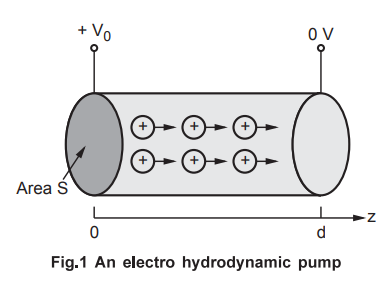
The region between
the electrodes contains a uniform charge ρ0, which is generated at
the left electrode and collected at the right electrode. Calculate the pressure
of the pump if Po = 25 mc/m3 and V0 = 22 kV. [15]
(Refer example 6.4.8)
OR
b)
Verify the divergence theorem for the function  over the surface of a
quarter of a hemisphere defined by 0 < r < 3, 0 <θ < π/2, 0<ϕ <π/2..
(Refer example 1.16.4)
over the surface of a
quarter of a hemisphere defined by 0 < r < 3, 0 <θ < π/2, 0<ϕ <π/2..
(Refer example 1.16.4)
Electromagnetic Theory: Solved Paper : Tag: : 3rd Semester EEE Department | Electromagnetic Theory - EMT Solved Semester Question Paper 2018 Dec (2017 Reg)
Related Topics
Related Subjects

Electromagnetic Theory
EE3301 3rd Semester EEE Dept | 2021 Regulation | 3rd Semester EEE Dept 2021 Regulation