Environmental Sciences and Sustainability: Unit II: Environmental Pollution
Environmental Protection Act
• Environment Protection Act (EPA) is introduced to make provisions for controlling the pollution. In 1980 the Government of India established an independent department.
Environmental Protection Act
•
Environment Protection Act (EPA) is introduced to make provisions for
controlling the pollution. In 1980 the Government of India established an
independent department.
•
The prime function of this department is to generate environmental awareness
amongs the public so as to reduce the environmental pollution.
•
Number of laws are implemented to control pollution and protect environment.
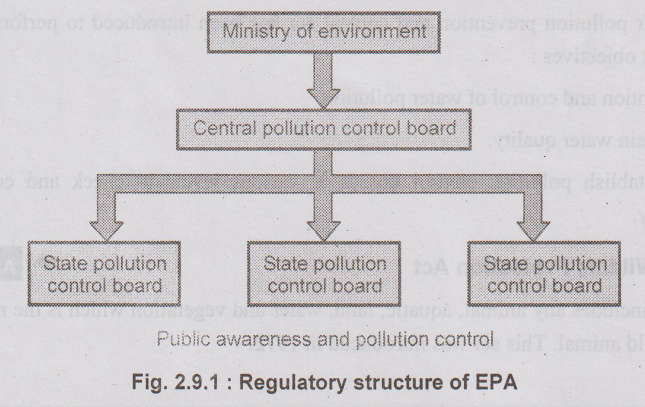
Under the Ministry of Environement and Forest, various pollution control boards
at central and state levels are setup.
•
The regulatory structure and hierarchy of implementing EPA is shown in Fig.
2.9.1.
•
Some important regulations under EPA and the year of implementations are given
below :
1.
The Air (Prevention and control of pollution) Act 1981.
2.
The Water (Prevention and control of pollution) Act 1974.
3.
Wild life protection Act 1972.
4.
Forest conservation Act 1980.
1. Air (Prevention and Control of Pollution) Act
•
Air pollution means presence of any air pollutant in the atmosphere. The air
pollutant can be solid, liquid or gaseous substances.
•
The concentration of such substance when exceeds, it becomes injurious to human
beings or other living creatures. This act was introduced in 1981.
Objectives
of Air Act
•
The air pollution prevention and control act has been introduced to perform
following important objectives :
1.
Prevention and control of air pollution.
2.
Maintain air quality.
3.
To establish pollution control boards at various levels to check and control
air quality.
2. Water (Prevention and Control of Pollution) Act
•
Water pollution is defined as any changes in physical, chemical, biological
properties of water or discharge of waste water which is injurious to
*
Ecological system
*
Public health/safety
*
Domestic or agricultural use.
•
This act was introduced in 1974.
Objectives
of Water Act
•
The water pollution prevention and control act has been introduced to perform
following important objectives :
1.
Prevention and control of water pollution.
2.
Maintain water quality.
3.
To establish pollution control boards at various levels to check and control
water quality.
3. Wildlife Protection Act
•
Wildlife includes any animal, aquatic, land, water and vegetation which is the
natural home of any wild animal. This act was introduced in 1972.
Objectives
of Wildlife Protection Act
•
The objectives of wildlife protection act as follows.
1.
To.maintain essential ecological processes and life supporting systems.
2.
To pressure the biodiversity.
3.
To protect wildlife.
4. Forest Conservation Act
•
Forest is a biotic community composed of trees, shrubs and woody climbers.
Timber, charcoal, oil, resin, lac, gum. Seeds are forest produce.
•
Silk, sandle-wood, rocks and other plants used for Pharmaceutical purpose are
important forest produce. Forest conservation act was introduced in 1972.
Objectives
of Forest Conservation Act
•
The prime objectives of forest conservation act are as follows.
1.
Protection and conservation of forest.
2.To
ensure proper use of forest produce.
5. Environmental Laws
•
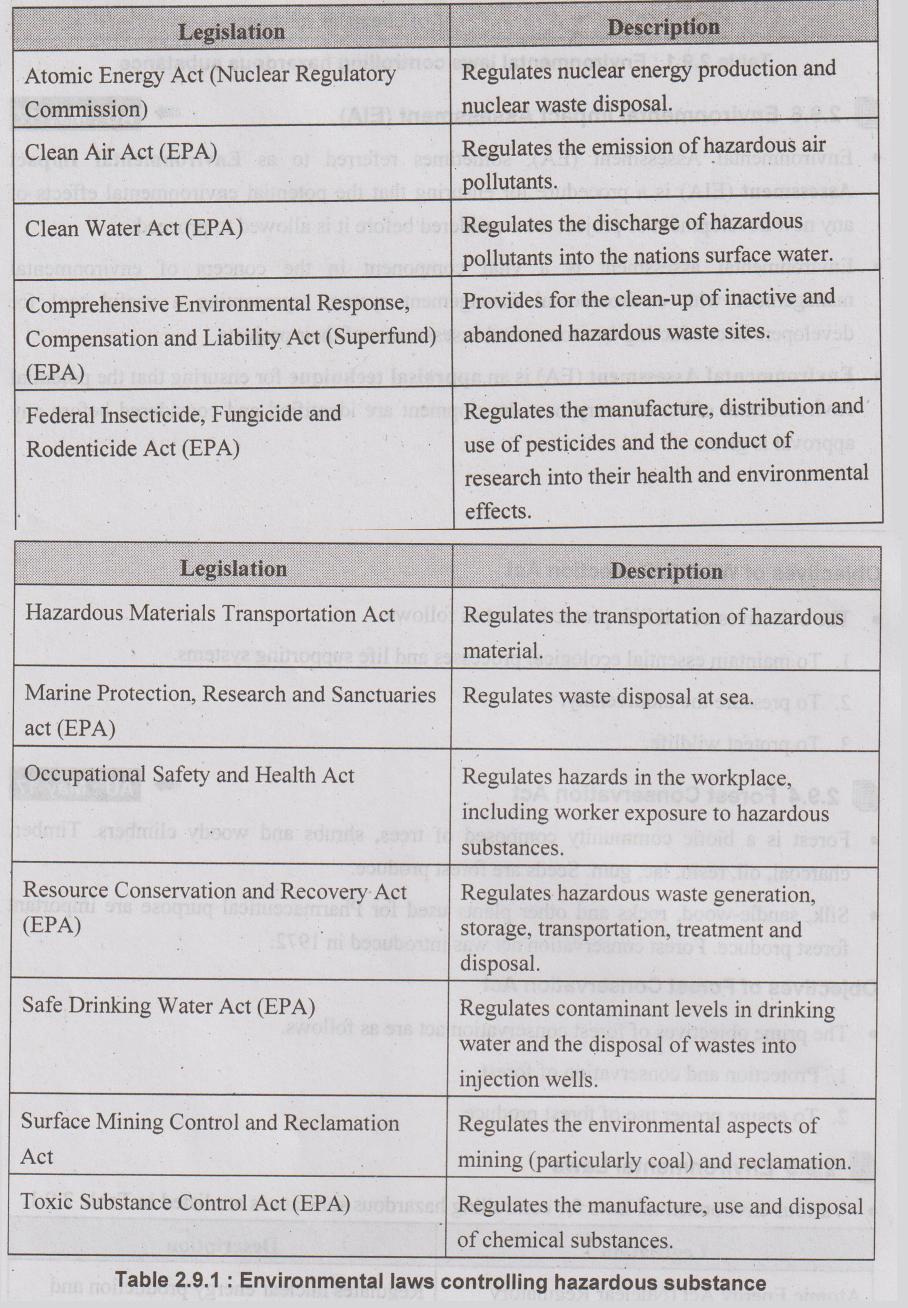
Various environmental laws for controlling hazardous substances are listed in
Table 2.9.1.
6. Environmental Impact Assessment (EIA)
• Environmental Assessment (EA), sometimes
referred to as Environmental Impact Assessment (EIA) is a procedure for
ensuring that the potential environmental effects of any new development or
project are considered before it is allowed to proceed.
•
Environmental assessment is a vital component in the concept of environmental
management with environmental management system representing a useful tool for
developers in conducting environmental assessments of their projects.
•
Environmental Assessment (EA) is an appraisal technique for ensuring that the
potential environmental effect of every new development are identified and
considered before any approval is given.
•
Environmental Assessment (EA) or Environmental Impact Assessment (EIA) as it is
sometimes termed, is essentially the concept and process by which detailed
information addressing the likely environmental effects of a development or
project is gathered and evaluated by the developer or client organisation
before being considered by the planning authority in deciding of planning
permission should be formally granted. The collection of information
documenting the projects potential-environmental effects is the environmental
statement.
a.
Environmental Statement (ES)
•
The Environmental Statement (ES) is a publicly available document submitted to
the planning authority and it accompanies the developer’s planning application.
•
Generation of the environmental statement is the responsibility of the
developer as it is gathering all the information and facts needed for its
development. In practice, it is likely that the developer will employ a
consultant to conduct the detailed investigation and produce the statement.
•
The environmental statement may, depending upon circumstances, be brief and
simple or lengthy and complex but it must provide a clear description of the
projects likely environmental effects on a range of conventional environmental
factors.
b.
Benefits of EIA
•
The benefits of the environmental impact assessment directive to organisations
are that
1.
It provides the basis for better decision making in the procurement of their
projects.
2.
It ensures that the potential environmental effects of their proposals are
fully considered.
3.
It allows the formulation of projects within a framework of greater safeguard
and acceptability.
4.
It promotes greater interaction between the developer and planning and approval
authorities..
5.
It provides the judgemental processes to be administered more systematically
timely and effectively.
•
Environmental assessment is a management function aimed at providing as much
information as possible to allow the most appropriate and best decision to be
reached in the interests of working within the environment.
•
Environmental assessment in practice represents a two tier system of
environmental consideration. Environmental assessment is therefore, in
practical terms, a review and audit of the development process.
c.
Participants to ES
•
The following list represents the principal participants to the environmental
assessment process.
1.
The developer - Responsible for initiating and
undertaking an environmental assessment of proposed development or projects.
2.
Specialist consultants - Appointed by the developer to
conduct the environmental assessment and produce the environmental statement to
support the planning application. Specialist consultants may include; landscape
architect, environmental scientist, design architect, engineer planner, other
construction or life science related specialist.
a)
The planning authority - The public body with
responsibility for considering the environmental effects of a planning
application.
b)
The secretary of state - Involved in the environmental
assessment decision making process in specific situations.
c)
The public - May become involved in environmental
assessment in publically sensitive projects where for example they may raise
issues and objections with the planning authority or to the secretary of state.
d)
Statutory and other consultees - Statutory and non
statutory bodies may be asked to provide advice and information in the
decision-making process. These involve such specialist organisations as the
Countryside Commission, The Nature Conservancy Council, The Historic Building
and Monuments Commission etc.
d.
Role of Environmental Consultant
•
The principal role of the environmental consultant within the environmental
assessment process is to undertake the following.
1.
Liaise with the developer on all aspects of environmental assessment.
2.
Appraise the developer on matters of environmental legislation and regulations.
3.
Liaise with other specialist consultants where required.
4.
Liaise with the planning authority upon matters concerning the environmental
assessment.
5.
Liaise with statutory, non-statutory and other consultees who become involved
in environmental assessment.
6.
Undertake an Environmental Site Survey (ESS) to collect, collate and analyse
the information necessary for the environmental assessment of the proposal.
7.
Provide the environmental statement submitted with the developer’s planning
application to the planning authority.
•
The environmental consultant may be asked by the developer to,
a)
Act in the capacity of environmental consultant during the briefing, design and
procurement phases.
b)
Act as environmental consultant during the construction phase on-site.
e.
Stages of EIA
•
There are seven principal elements in the process of environmental assessment.
These are supported by one further element, essential to the realisation of success
but which is frequently understood. These elements are,
1.
Project description
2.
Screening
3.
Scoping
4.
Baseline studies
5.
Impact prediction / Identifying and evaluating alternatives
6.
Mitigation assessment
7.
Environmental statement
8.
Environmental monitoring.
1.
Project description
•
This is a sufficient and clear description of the project together with details
of its location.
•
Although detailed information is not required at this initial stage, the
developer must provide the planning authority with sufficient information to
judge whether an environmental assessment is necessary.
2.
Screening
•
Screening is the process of determining for a particular project, the need for
an environmental assessment.
3.
Scoping
•
Scoping is connected with directing the environmental assessment towards
aspects of specific importance.
•
Scoping is a vital step in the environmental assessment process as it must
clearly identify those aspects which require detailed study and analysis and
forms the basis for impact prediction of environmental effects.
•
The result of scoping is the development of an environmental assessment
programme or schedule which relates particular attributes of the development
process to environmental aspect.
4.
Baseline studies
•
Baseline studies are concerned with the identification of the significant
environmental impacts that must be assessed.
•
Baseline studies follow on naturally from or even form an inherent part of
scoping. The environmental assessment programme or schedule developed during
scoping will direct the baseline study. This will provide information on -
a)
The detailed description of the project.
b)
The project's environs.
c)
The social dimension.
5. Impact prediction
•
This is concerned with assessing the potential for environmental effect of
those aspects identified during scoping and baseline studies.
•
The focus of this aspects is, by definition, on determining the likely effect
of specific project aspects upon the environment. Naturally it is difficult
frequently impossible, to predict potential environmental effects with any
degree of accuracy.
•
Usually environmental impact prediction is a subjective description of what
will happen, known from experience or what might happen based upon reasoning or
expectation. Strictly, analysis should lead to accurate prediction based on
verifiable information. It should be determined and not based on judgement or
guesswork.
•
In practice, environmental assessment should involve detailed investigation by
experienced consultants and the resulting information presented in clear and
unambiguous form, based on sound common sense reasoning of accurate data.
6.
Mitigation assessment
•
This focuses upon consideration of the measures to be taken to alleviate or
minimise environmental effects.
•
The accent of this section is towards summarising recommendations developed
during the analytical and predictive processor, aimed at mitigating the
environmental effects of the project.
7.
Environmental statement
•
The statement is the mechanism by which the developer places the findings of
the environmental assessment before the planning authority. The extent and
detail of an environmental statement will be determined by the characteristics
and situation of the particular project.
8.
Environmental monitoring
•
Environmental monitoring is concerned with monitoring the environmental effects
of the project, if and when the project is given approval to proceed.
•
Environmental monitoring is essential as a concept, as it provides the sound
base upon which wider principles and practices will undoubtedly advance in the
future.
•
It is rapidly becoming a prerequisite to the wider issues of environmental
regulation and auditing schemes and looks set to play an even more significant
role in the future.
7. Salient Features of the EPA
The
Environment (Protection) Act has been brought into force from November, 1986.
Its salient features are :
(a)
Conferring powers on the Central Government to :
(i)
Take all necessary measures for protecting quality of environment,
(ii)
Co-ordinate actions of States, officers and other authorities under this Act,
(iii)
Plan and execute a nationwide programme for prevention, control and abatement
of environmental pollution,
(iv)
Lay down standards for discharge of environmental pollutants,
(v)
Empower any person to enter, inspect, take samples and test,
(vi)
Establish or recognise environmental laboratories,
(vii)
Appoint or recognise government analysts,
(viii)
lay down standards for quality of environment,
(ix)
Restrict areas in which any industries, operations or processes may not be
carried out subject to certain safeguards,
(x)
Lay down safeguards for prevention of accidents and take remedial measures in
case of such accidents,
(xi)
Lay down procedures and safeguards for handling hazardous substances,
(xii)
Constitute an authority for exercising powers,
(xiii) Issue directions to any person, officer or
authority including the power to direct closure, prohibition or regulation of
any industry, operation or process,
(xiv) Require any person, officer or authority to
furnish any prescribed information and
(xv)
Delegate powers to any officer of a state or authority;
(b)
It confers powers on persons to complain to courts regarding any violation of
the provisions of the Act, after a notice of 60 days to the prescribed
authorities;
(c)
The Act makes it obligatory for the person in charge of a place to inform the
prescribed authorities regarding any accidental discharge of any pollutant in
excess of prescribed standards.
•
The concerned authorities, on receipt of such information, shall take remedial
measures to prevent or mitigate pollution caused by such accidents and expenses
incurred by the authorities in respect of remedial measures are recoverable
with interest from the polluter;
(d)
It prescribes stringent penalties for violation of the provisions of the Act;
and
(e)
Jurisdiction of civil courts is barred under the Act.
•
A comprehensive Environment (Protection) Act came into being in 1986 to remedy
the lacunae noticed in the earlier laws and to serve as a single legislation on
the subject.
Review Questions
1. What are the
salient features of the following acts ?
i) The environment
(Protection) Act 1986.
ii) Water (Prevention
and control of pollution) act 1974.
2. Briefly discuss to
salient features of wildlife protection act.
AU : Dec.-14, Marks 8
3. Explain in brief
about the present regulatory trends in air, waste water and recycling.
AU : May-14, Marks 12
4. Name the laws that
have been framed for environmental protection and mention the objectives for
each act.
5. Name the laws that
have been framed for environmental protection and mention the objectives for
each act.
6. Explain salient
features of water act.
7. Explain a note on
EIA.
Environmental Sciences and Sustainability: Unit II: Environmental Pollution : Tag: : - Environmental Protection Act
Related Topics
Related Subjects
Environmental Sciences and Sustainability
GE3451 ESS 4th Semester | 2021 Regulation | 4th Semester EEE Dept 2021 Regulation