C Programming and Data Structures: Unit II: C Programming – Advanced Features
Pointers
Definition, Syntax, Advantages, Initializing, Example C programs
Pointers to Variables - Advantages of Pointers - Initialization - Accessing Variable through Pointer - Pointer Arithmetic
Pointers
AU:
May-17, Marks 8
1. Pointers to Variables
Definition
: Pointer
is a variable that represents the memory location of some other variable. The purpose
of pointer is to hold the memory location and not the actual value.
In
C declaration if the variable is preceded by asterisk or then it is called pointer
variable.
2. Advantages of Pointers
Following
are some advantages of using pointer that illustrates its significance.
1.
Pointers allow the dynamic memory management.
2.
It helps to return more than one values from the function.
3.
It allows to pass arrays, strings and structures efficiently.
4.
It provides direct access to the memory.
5.
It improves the execution speed of the program.
6.
It reduces the storage space of the program.
7.
Pointers help to build the complex data structures such as linked list, stack,
queues, tree, graphs etc.
3. Initialization
Once
the pointer variable is declared then it can be used further. In the sense we
can assign some value to it. But note that the pointer variable is basically
used to store some address of the variable which is holding some value.
Consider,
Line
1- > int *ptr;
Line
2- > int a,b;
Line
3- > a =10; /* storing some value in a*/
Line
4 - > ptr = &a;/*storing address of a in ptr*/
Line
5- > b=*ptr;/*getting value from address in ptr and storing it in b*/
Here
we have used two important operators * and &. The * means 'contents at the
specified
address' and & means the 'address at'.
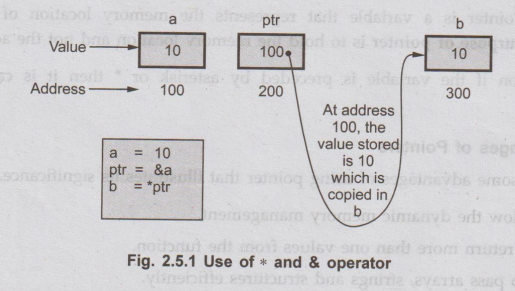
On
Line 1 and Line 2 we have declared the required variables out of which ptr is a
pointer variable and variables a and b are our normal variables. On Line 3 we
have assigned value 10 to variable a. The Line 4 tells us that address of
variable a is stored in a pointer variable ptr. And on Line 4 we have written
that in ptr variable we have stored some address and at that address whatever
value is stored, store that value in variable b. That means at ptr we have
stored address of variable a. Then at the address of a whatever is a value we
have to store that value in variable b. This can be illustrated by following
Fig. 2.5.1.
We
can declare pointer variables of various types such as int, char, double etc.
Consider
the declarations as given below -
int
*iptr;
char
*cptr;
float
*fptr;
The
iptr will store the address of a variable which is of type integer, similarly
cptr will store the address of a variable which is of character type and so on.
Similarly
we cannot initialize the pointer variable in this way-
iptr
= 0XCF00; ……………….. is wrong
Similarly
we cannot assign one variable of some data type to a pointer variable of
different type
For
example,
int
*ptr;
float
a,b;
a=3.14;
b=10.51;
ptr=&a;
/*this is wrong*/
4. Accessing Variable through Pointer
To
understand how to access the variables through pointer let us understand the
program given below -
#include<stdio.h>
#include<conio.h>
void
main( )
{
int
*ptr;
int
a,b;
clrscr();
a=10;
/* storing some value in a*/
ptr=&a;/*storing
address of a in ptr*/
b=*ptr;/*getting
value at ptr in b*/
printf("\n
a= %d", a);/*printing value stored at a*/
printf("\n
ptr= %u",ptr);/*printing address stored at ptr*/
printf("\n
ptr=%d", *ptr); /*Level of indirection at ptr*/
printf("\n
b= %d",b);/*printing the value stored at b*/
getch();
}
Output
a=
10
ptr=
65524
ptr=10
b=
10
Program
Explanation :
In
above program, firstly we have stored 10 in variable a, then we have stored an
address of variable a in variable ptr. For that we have declared ptr as pointer
type. Then on the next line value at the address stored in ptr is 10 which is
been transferred to variable b. Finally we have printed all these values by
some printf statements.
The
following program illustrates the concept of & and * in more detail
#include<stdio.h>
#include<conio.h>
void
main()
{
int
*ptr;
int
a,b;
clrscr();
a=10;
b=20;
}
printf("\n
Originally a=%d b=%d",a,b);
ptr=&a;
b=*ptr;
printf("\n\n
Now the changed values are\n\t
a=
%d, b=%d",a,b);
printf("\n
ptr = %u",ptr);
printf("\n
&ptr = %u", &ptr);
printf("\n
*ptr = %d", *ptr);
printf("\n
*(&ptr) = %u",*(&ptr));
printf("\n
Address of a is &a= %u",&a);
printf("\n
Address of b is &b = %u", &b);
getch();
}
Output
Originally
a=10 b=20
Now
the changed values are
a=10,b=10
ptr
= 65522
&ptr
= 65524
*ptr
= 10
*(&ptr)
= 65522
Address
of a is &a= 65522
Address
of b is &b = 65520
In
above program there are 2 variables and 1 pointer variable. The values stored
in these variables are - Refer Fig. 2.5.2.

Key
Point: Whenever we want to store address of some variable
into another variable, then another variable should be of pointer type.
Ex.
2.5.1
Given
the following declaration :
int
x = 10, y = 10;
int
*p1 = Ɛx, *p2 = Ɛy;
What
is the value of each of the following expressions?
1)
(*p1)++
2)
- - (*p2)
3)
*p1 + (*p2)- -
4)
++(*p2) - *pl
5)
*p1 + *p2
6)
- (*p1) + *p2
Sol.
:
1)
(*p1) ++
Ans:
10
Explanation:
First value at p1 is accessed through p1 and then value is incremented by 1. i.e.
(11).
2)
-- (*p2)
Ans
:
9
Explanation:
First value at (p2) is accessed then it is decremented by one (- -) and then
printed as (- -) is used as predecrement operator.
3)
*p1 + (* p2) -
Ans:
Output 20
Explanation:
Here value at p1 and value at p2 are added and then value at p2 is decremented
by 1.
so*
p2 = 9
4)
++ (*p2) - * p1
Ans:
Output = 1
Explanation:
Value at px is considered, then preincrement operator (++) is applied on that
value i.e. (it will be 11) then value at p1 is considered and then substraction
is performed.
5)
*p1 + *p2ola
Ans.
Output = 20
Value
at p1 is added with value at p2.
6)
- - (*p1) + *p2
Ans:
Output = 19
Explanation:
Value at pl is considered, then it is decremented by 1 and then value at p2 is
added with the result.
Ex.
2.5.2 Explain the effect of the following statements:
i)
int p, *p;
ii)
int q, *p = Ɛ q;
iii)
int (* p) ++;
iv)
int p++;
v)
char *p;
vi)
int a = p+5; *
Sol.
:
i)
int p, *p: This statement will cause a compiler error for
multiple declarations of variable p.
ii)
int q, *p = & q: The variable p will act as an interger
pointer and will hold the address of q. Hence the result of q and *p will be
the same.
iii)
int (* p) ++: The (*p)++ means increment the value of
p by 1. But at the declaration, if we try to increment *p then it will generate
syntax declaration error.
iv)
int p + + : The p++ means increment the value of p
by 1, but during declaration we cannot increment the value of variable. A
declaration syntax error will be generated.
v)
char *p;: The *p will be a character pointer that means it
will store the address of character variable.
vi)
int a = *p + 5; : If *p will store some value then
variable a will store the value of *p + 5.
1)
Due to use of pointers the execution of the programs become fast.
2)
Pointers are used for dynamic memory allocation. We allocate a block of memory
to an array and it can be accessed using a single pointer.
3)
Functions can be handled using pointers.
4)
Using pointers the wastage of memory can be avoided.
5)
The pointer can be used as a scalar data type as well as the derived data type.
Ex.
2.5.3 Given the following declarations: int m = 50, n = 50, int *p1 = Ɛ m, *p2
= Ɛ n; What is the value of each of the following expressions?
i)
(* p1) ++;
ii)
-- (* p2);
iii)
*p1 + (*p2) --;
iv)
++ (*p2) - *pl
i)
(*p1) ++ gives 50:
Explanation:
The value at pl is accessed first. The post increment operator is given. Hence
value will be incremented latter.
ii)
- - (*p2) gives 49
Explanation:
The -- is a predecrement operator. Hence value at p2 i.e. 50 is decremented
first and then displayed
iii)
*p1 + (*p2) -- gives 100
Explanation:
Here value at p1 and value at p2 are added and then decremented by 1.
iv)
++ (*p2) - *p1 gives 1
Explanation:
The value at p2 is preincremented which becomes equal to 51 which value at p1
i.e. 50 is subtracted. Hence is the output.
5. Pointer Arithmetic
Basic
Concept: Pointer arithmetic is a method of calculating the
address of an object with the help of arithmetic operations on pointers.
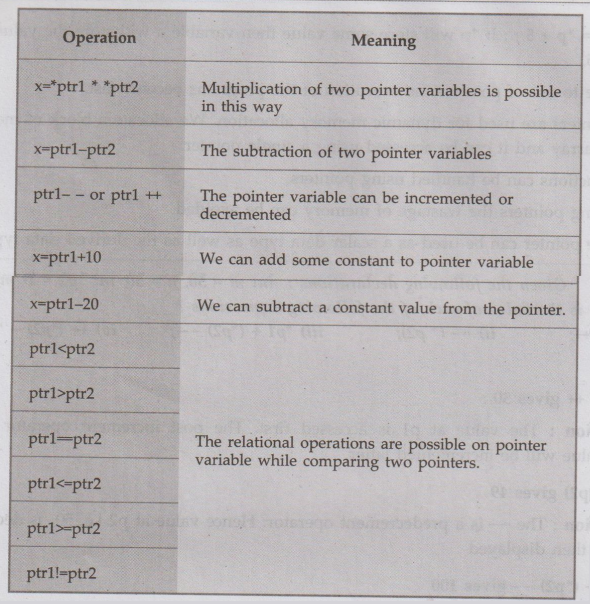
Various
operations can be performed using pointer variables as follows -
Let
int
*ptr1,*ptr2;
int
x;
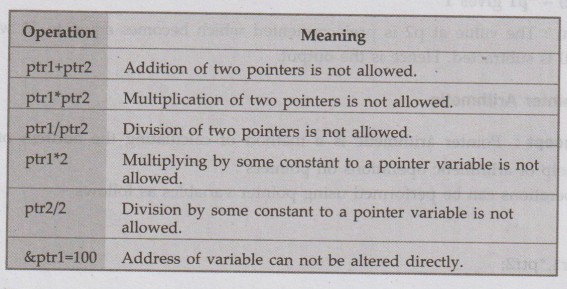
But
here is a list of some invalid operations. These operations are not allowed in
any C program -
Now
consider
int
*ptr;
This
is a pointer variable which is of integer type. This allocates the memory of 2
bytes for each such variable. If there are 10 integer pointers then total 20
bytes of memory block will be reserved.
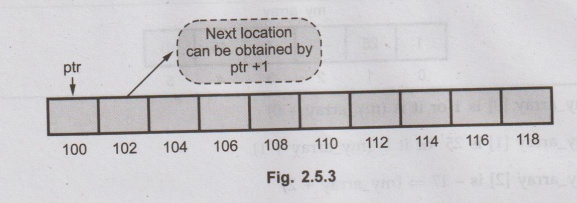
Consider
a block in memory consisting of ten integers in a row. That is, 20 bytes of
memory are set aside to hold 10 integers.
Now,
let's say we point our integer pointer ptr at the first of these integers.
Furthermore lets say that integer is located at memory location 100 (decimal).
What happens when we write :
ptr
+ 1;
it
points to an integer it adds 2 to ptr instead of 1, so the pointer "points
to" the next integer, at memory location 102. The same goes for other data
types such as floats, doubles, or even user defined data types such as
structures. This is obviously not the same kind of "addition" that we
normally think of. In C it is referred to as addition using "pointer
arithmetic".
The
ptr++ or ++ptr is equivalent to ptr+1
As
a block of 10 integers in a contiguous fashion is similar to the concept of
array we will now discuss an interesting relationship between arrays and
pointers.
Consider
the following:
int
my_array[ ] = {1,23,17,4,-5,100};
Here
we have an array containing 6 integers. We refer to each of these integers with
the help of subscript of my_array, i.e. using my_array[0] through
my_array[5]. Alternatively, we can also access them via a pointer as
follows:
int
*ptr;
/* point out pointer at the first integer in
our array */
ptr
= &my_array[0];
my_array
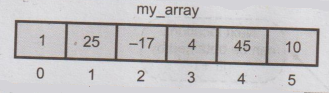
my_array
[0] is 1 or it is (my_array + 0)
my_array
[1] is 25 or it is (my_array + 1) ant
my_array
[2] is - 17⇒
(my_array + 2)
my_array
[3] is 4 ⇒
(my_array + 3)
my_array
[4] is 45 ⇒
(my_array + 4)
my_array
[5] is 10 ⇒(my_array
+ 5)
Fig.
2.5.4 Method 1 for accessing elements of an array
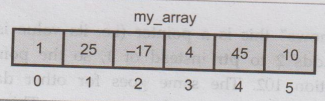
ptr
= & my_array [0] i.e. location 0th in array
then
* ptr will contain 1 i.e. my-array [0] value
*
(Ptr + 1) ⇒
a[1] i.e. 25
*
(Ptr + 2) ⇒
a[2] i.e. - 17
*
(Ptr + 3) ⇒ a[3]
i.e. 4
*(Ptr
+ 4) ⇒ a[4] i.e. 45
*
(Ptr + 5) ⇒
a[5] i.e. 10
Fig.
2.5.5 Method 2 for accessing array elements
then
* ptr will contain 1 i.e. my_array [0] value
Thus
there are two ways by which array element can be accessed -
1.
Using the array subscript
2.
Using the pointer to array
Then
we can print all the elements of an array. This is illustrated by following
program -
#include
<stdio.h>
int
my_array[] = {1,25,-17,4,45,10};
int
*ptr;
int
main(void)
{
int
i;
ptr
= &my_array[0]; /* point our pointer to the first element of the array */
printf("\n\n");
for
(i = 0; i < 6; i++)
{
printf("\nUsing
1st Method: my_array[%d] = %d",i,my_array[i]); /*<-- A */
printf("\nUsing
2nd Method: ptr + %d %d\n",i,
*(ptr
+ i)); /* < -- B*/
}
return
0;
}
Compile
and run the above program and carefully note lines A and B and that the program
prints out the same values in either case. Also observe how we dereferenced our
pointer in line B, i.e. we first added i to it and then dereferenced the new
pointer. Thus the output will be -
Output
Using
1st Method: my_array[0] = 1
Using
2nd Method: ptr + 0 = 1
Using
1st Method: my_array[1] = 25
Using
2nd Method: ptr + 1 = 25
Using
1st Method: my_array[2] = - 17
Using
2nd Method: ptr + 2 = - 17.
Using
1st Method: my_array[3] = 4
Using
2nd Method: ptr + 3 = 4
Using
1st Method: my_array[4] = 45
Using
2nd Method: ptr + 4 = 45
Using
1st Method: my_array[5] = 10
Using
2nd Method: ptr + 5 = 10
Now,
Change line B to:
printf("ptr
+ %d %d\n",i, *ptr++);
and
run it again...you will get the same result.
Now,
change it to :
printf("ptr
+ %d %d\n",i, *(++ptr));
Try
once more. Each time try and predict the outcome and carefully look at the
actual outcome. Again the same result will be achieved.
In
C, instead of
ptr
= &my_array[0];
we
can write :
ptr
= my_array;
to
achieve the same result. This means that the name of an array is a pointer.
Key
Point: "The name of the array is the address of first
element in the array". Using pointer arithmetic (increment or decrement
operator) we can access the subsequent elements of the array.
Ex.
2.5.4 Write a C program using pointer for searching the desired element from
the array.
Sol.
:
#include<stdio.h>
#include<conio.h>
void
main( )
{
int
a[10],i, n,*ptr,key;
clrscr(
);
printf("\n
How Many elements are there in an array?");
scanf("%d",&n);
printf("\n
Enter the elements in an array");
for(i=0;i<n;i++)
scanf("%d",&a[i]);
ptr=&a[0];/*copying
the base address in ptr */
printf("\n
Enter the Key element");
scanf("%d",
&key);
for(i=0;i<n;i++)
{
if(*ptr==key)
{
printf("\n
The element is present");
break;
}
else
ptr++;
/*pointing to next element in the array*/
/*Or
write ptr=ptr+i*/
}
getch(
);
}
Output
How
many elements are there in an array?5
Enter
the elements in an array
10
20
30
40
50
Enter
the Key element40
The
element is present
Ex.
2.5.5 Write a program using pointer to compute the sum of all elements stored
in any array.
Sol.
:
#include<stdio.h>
void
main()
{
int
a[ ]={10,20,30,40,50};
int
sum=0;
int
n=5;
for(int
i=0;i<5;i++)
}
{
sum=sum+(*(a+i));
}
printf("%d",
sum);
}
Ex.
2.5.6 If we declare an array a [i] [j] and p is pointer to first row find out
i)
Pointer to ith row
ii)
Pointer to first element in the ith row
iii)
Pointer to jth element in ith the row
iv)
Value store in the cell a [i][j]
Sol.
:
i)
void
main( )
{
int
a[][3]={{10,20,30}, {40,50,60}};
int
*ptr;
for(int
j=0;j<3;j++)
{
ptr=&a[0][j];
printf("%d",
*ptr);
}
}
ii)
void
main( )
{
}
int
a[][3]={{10,20,30}, {40,50,60}};
int
*ptr;
ptr=&a[0][0];
printf("%d",
*ptr);
}
iii)
void
main( )
{
int
a[3][3]={{10,20,30}, {40,50,60}};
int
*ptr;
ptr=&a[1][2];
printf("%d",
*ptr);
}
iv)
{
void
main( )
{
int
a[3][3]={{10,20,30}, {40,50,60}};
int
*ptr;
for(int
i=0;i<2;i++)
{
for(int
j=0;j<3;j++)
{
ptr=&a[i][j];
printf("%d",
*ptr);
}
printf("\n");
}
}
Ex.
2.5.7 Write the output for the following code:
1)
int t[3][2][4]={2,4,3,6,1,6,7,9,8,2,1,1,2,3,7,3,1,6,2, 4,0,7,9,5};
printf("%d",
*(*(*(t+2)+1)+3));
2)
char *cp;
int
*ip;
cp=(char
*)0×100;
ip=(int
*)cp;
ip++;
cp++;
printf("cp=%x
ip=%x", cp, ip)'
Sol.
:
1)
The output is 5 because, the elements are arranged in two rows and four columns.
And there will be 3 such blocks. The arrangement of elements will be
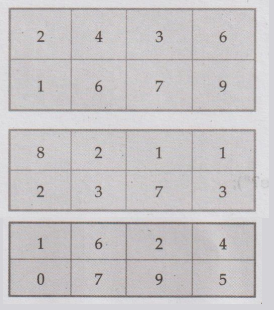
*(t
+ 2) = {{1, 6, 2, 4}, {0, 7, 9, 5}}
*(*(t
+ 2) + 1) = {0, 7, 9,.5}
*(*(*(t+2)+1)+3)
= 5.
2)
The address assigned to cp variable is 100. The same base address i.e. 100 is
assigned to ip. The cp represents character pointer and ip represents interger
pointer. The size of character variable is 1 byte and size of interger variable
is 2 bytes.
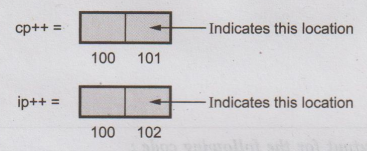
Hence
output is cp = 101 and ip = 102.
C Programming and Data Structures: Unit II: C Programming – Advanced Features : Tag: : Definition, Syntax, Advantages, Initializing, Example C programs - Pointers
Related Topics
Related Subjects
C Programming and Data Structures
CS3353 3rd Semester EEE, ECE Dept | 2021 Regulation | 3rd Semester EEE Dept 2021 Regulation