Electrical Machines II: UNIT II: Synchronous Motor
Principle of Working
Synchronous Motor
Synchronous motor works on the principle of the magnetic locking.
Principle of Working AU
: Dec.-07, 17
Synchronous
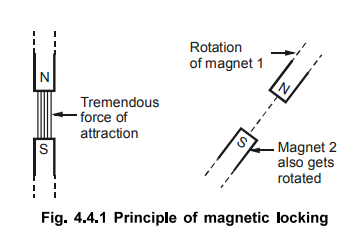
motor works on the principle of the magnetic locking. When two unlike poles are
brought near each other, if the magnets are strong, there exists a tremendous
force of attraction between those two poles. In such condition the two magnets
are said to be magnetically locked.
If
now one of the two magnets is rotated, the other also rotates in the same
direction, with the same speed due to the force of attraction i.e. due to
magnetic locking condition. The principle is shown schematically in the Fig.
4.4.1.
So
to have the magnetic locking condition, there must exist two unlike poles and
magnetic axes of two must be brought very close to each other. Let us see the
application of this principle in case of synchronous motor.
Consider
a three phase synchronous motor, whose stator is wound for 2 poles. The two
magnetic fields are produced in the synchronous motor by exciting both the
windings, stator and rotor with three phase a.c. supply and d.c. supply
respectively. When three phase winding is excited by a three phase a.c. supply
then the flux produced by the three phase winding is always of rotating type,
which is already discussed in the section 4.2. Such a magnetic flux rotates in
space at a speed called synchronous speed. This magnetic field is called
rotating magnetic field. The rotating magnetic field creates the effect similar
to the physical rotation of magnets in space with a synchronous speed. So
stator of the synchronous motor produces one magnet which is as good as
rotating in space with the synchronous speed. The synchronous speed of a stator
rotating magnetic field depends on the supply frequency and the number of poles
for which stator winding is wound. If the frequency of the a.c. supply is f Hz
and stator is wound for P number of poles, then the speed of the rotating
magnetic field is synchronous given by,
Ns
= (120 f / P) r.p.m.
In
this case, as stator is wound for say 2 poles, with 50 Hz supply, the speed of
the rotating magnetic field will be 3000 r.p.m. This effect is similar to the
physical rotation of two poles with a speed of Ns r.p.m. For
simplicity of understanding let us assume that the stator poles are N1
and S2 which are rotating at a speed of Ns. The direction
of rotation of rotating magnetic field is say clockwise.
When
the field winding on rotor is excited by a d.c. supply, it also produces two
poles, assuming rotor construction to be two pole, salient type. Let these
poles be N2 and S2.
Now
one magnet is rotating at Ns having poles N1 and S1
while at start rotor is stationary i.e. second magnet is stationary having
poles N2 and S2. If somehow the unlike poles N1
and S2 or S1 and N2 are brought near each
other, the magnetic locking may get established between stator and rotor poles.
As stator poles are rotating, due to magnetic locking rotor will also rotate in
the same direction as that of stator poles i.e. in the direction of rotating
magnetic field, with the same speed i.e. Ns. Hence synchronous motor
rotates at one and only one speed i.e. synchronous speed. But this all depends
on existence of magnetic locking between stator and rotor poles. Practically it
is not possible for stator poles to pull the rotor poles from their stationary
position into magnetic locking condition. Hence synchronous motors are not self
starting. Let us see the reason behind this in detail.
Review Question
1. Explain the working
principle of synchronous motor.
Electrical Machines II: UNIT II: Synchronous Motor : Tag: Engineering Electrical Machines - II : Synchronous Motor - Principle of Working
Related Topics
Related Subjects
Electrical Machines II
EE3405 Machine 2 EM 2 4th Semester EEE Dept | 2021 Regulation | 4th Semester EEE Dept 2021 Regulation