Electron Devices and Circuits: Unit V: (a) Feedback Amplifiers
Two Marks Questions with Answers
Feedback Amplifiers | Electron Devices and Circuits
Electron Devices and Circuits: Unit V: (a) Feedback Amplifiers : Two Marks Questions with Answers
Two Marks Questions with Answers
Q.1
What is meant by feedback ?
Ans.
: Feedback
is a part of output is sampled and fed back to the input of the amplifier.
Q.2
Giue the different types of feedbacks used in amplifier circuits.
Ans.
: 1.
Positive feedback 2. Negative feedback.
Q.3
Define the positive feedback.
Ans.
:
When input signal and part of output signal are in phase, the feedback is
called positive feedback.
Q.4
Define the negative feedback.
Ans.
:
When input signal and part of output signal are in out of phase, the feedback
is called negative feedback.
Q.5
What type of feedback is used in oscillator ?
Ans.
:
Positive.
Q.6
Give classification of amplifiers.
Ans.
:
The amplifiers can be classified into four broad categories : voltage, current, transconductance and
transresistance amplifiers.
Q.7
Draw the typical feedback connection around a basic amplifier. (Refer Fig.
9.3.1)
Q.8
Mention the three networks that are connected around the basic amplifier to
implement feedback concept.
Ans.
:
Sampling network, feedback network and mixer network.
Q.9
What is node sampling ?
Ans.
:
When the output voltage is sampled by connecting the feedback network in shunt
across the output, the connection is referred to as voltage or node sampling.
Q.10
What is loop sampling ?
Ans.
:
When the output current is sampled by connecting the feedback network in series
with the output, the connection is referred to as current, or loop sampling.
Q.11
Define feedback factor or feedback ratio.
AU
: ECE : Hay-12
Ans.
:
The ratio of the feedback voltage to output voltage is known as feedback factor
or feedback ratio.
Q.12
What is the purpose of mixer network in feedback amplifier ?
Ans.
:
The mixer network is used to combine feedback signal and input signal at input
of an amplifier.
Q.13
Draw the schematic representation of negative feedback amplifier. (Refer Fig.
9.3.4)
Q.14
What are the advantages of introducing negative feedback ? (Refer section 9.4)
Q.15
What is the disadvantage of introducing negative feedback ?
Ans.
:
Negative feedback reduces the gain of the amplifier.
Q.16
List the four basic feedback topologies.
Ans.
:
•
Voltage amplifier with voltage series feedback
•
Transconductance amplifier with current series feedback
•
Current amplifier with current-shunt feedback
•
Transresistance amplifier with voltage shunt feedback
Q.
17 Give the expression for gain of an amplifier with feedback.
Ans.
:
Avf
= Av / 1 + Av
β
Q.18
What is loop gain or return ratio ?
AU
: ECE : May-11, Dec.-ll
Ans.
:
A path of a signal from input terminals through basic amplifier, through the
feedback network and back to the input terminals forms a loop. The gain of this
loop is the product -Ap. This gain is known as loop gain or return ratio.
Q.19
What is sensitivity of the transfer gain ?
Ans.
:
The fractional change in amplification with feedback divided by the fractional
change without feedback is called the sensitivity of the transfer gain.
Q.20
What is desensitivity ?
Ans.
:
The reciprocal of the sensitivity is called the desensitivity D. It is given as
D
= 1 + βA
Q.21
What is the effect of lower cut-off frequency with negative feedback ?
Ans.
:
Lower cut-off frequency with feedback is less than lower cut-off frequency
without feedback by factor (1 + Amid p
Q.22
What is the effect of upper cut-off frequency with negative feedback ?
Ans.
:
Upper cut-off frequency with feedback is greater than upper cut-off frequency
without feedback by factor (1 + Amid β)
Q.23
What is the effect of negative feedback on bandwidth ?
Ans.
:
Bandwidth of amplifier with feedback is greater than bandwidth of amplifier
without feedback.
Q.24
Why gain bandwidth product remains constant with the introduction of negative
feedback ?
Ans.
:
Since bandwidth with negative feedback increases by factor (1 + AP) and gain
decreases by same factor, the gain-bandwidth product of an amplifier does not
altered, when negative feedback is introduced.
Q.25
What is the effect of negative feedback on frequency distortion ?
Ans.
:
The frequency distortion is reduced with the negative feedback.
Q.26
What is the effect of negative feedback on noise ?
Ans.
:
The noise is reduced with the negative feedback.
Q.27
What is the effect of negative feedback on non linear distortion ?
Ans.
:
The linear distortion is reduced with the negative feedback.
Q.28
What are the type of distortions in an amplifier ?
Ans.
: 1)
Frequency 2) Non linear
Q.29
What type of feedback is employed in emitter follower amplifier ?
Ans.
:
Voltage series feedback.
Q.30
Draw the equivalent circuit of transconductance amplifier. (Refer Fig. 9.2.3)
AU
: ECE : Dec.-03, Hay-05
Q.30
Draw the equivalent circuit of transconductance amplifier. (Refer Fig. 9.2.3)
AU
: ECE : Dec.-03, Hay-05
Q.
31 Derive using a block diagram the closed loop forward transfer ratio, Af of a
feedback system.
(Refer
Fig 9.6.2)
Q.
32 What are the advantages of negative feedback in amplifiers ?
(Refer
Fig 9.4)
Q.
33 Draw the equivalent circuit of a voltage amplifier.
(Refer
Fig 9.2.1)
Q.34
What are the effects of negative feedback on gain and input impedance of an
amplifier ? (Refer sections 9.6 and 9.9.1)
Q.35
Identify the type of feedback in the circuit.
AU
: ECE : May-06
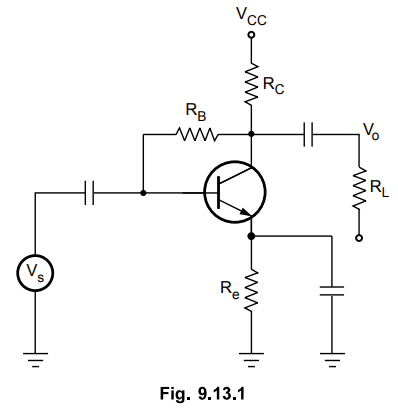
Ans
: Voltage
shunt feedback
Q.36
Draw a block diagram of voltage shunt feedback amplifier and give its input and
output resistance. (Refer section 9.9)
Q.37
Identify the type of feedback of the circuit shown :
AU
: ECE : Dec.-09
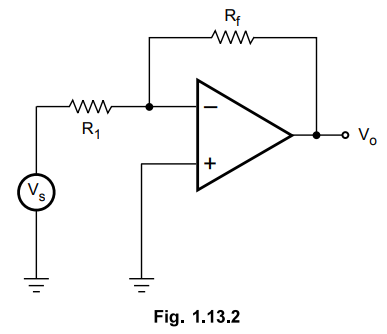
Ans
:
Voltage shunt feedback.
Q.
38 Compare the input abd output resistance for a voltage and current shunt
feedback amplifier?
(Refer
Table 9.11.1)
Q.
39 What happens to the input resistance based on type of feedback in an
amplifier?
(Refer
Table 9.11.1)
Q.40 What are the steps to be carried out for complete analysis of a feedback ampl ifier ?
(Refer section 9.12)
Q.41
Why gain bandwidth product remains constant with the introduction of negative
feedback ?
Ans.
:
Since bandwidth with negative feedback increases by factor (1+AP) and gain
decreases by same factor, the gain-bandwidth product of an amplifier does not
altered, when negative feedback
is
introduced.
Q.42
Which is the most commonly used feedback arrangement in cascaded amplifiers and
why ?
Ans.
:
Voltage series feedback is the most commonly used feedback arrangement in
cascaded amplifiers. Voltage series feedback increases input resistance and
decreases output resistance. Increase in input resistance reduces the loading
effect of previous stage and the decrease in output resistance reduces the
loading effect of amplifier itself for driving the next stage.
Q.43
State the effect on output resistance and on input resistance of amplifier when
current shunt feedback is employed. (Refer section 9.10)
Q.44
What is the effect on input and output impedance of an amplifier if it employs
voltage series negative feedback ? (Refer section 9.10)
Q.45
State the Nyquist criterion for stability of feedback amplifiers.
Ans.
:
•
The amplifier is unstable if the curve encloses the point -1 + jO. The system
is called unstable system.
•
The amplifier is stable if the curve encloses the point -1 + jO. That system is
called stable system.
Q.46
What is Nyquist diagram ?
Ans.
:
The plot which shows the relationship between gain and phase-shift as a
function of frequency is called Nyquist diagram.
Q.47
List-out the advantages of negative feedback.
[Refer
section 9.4]
Q.48
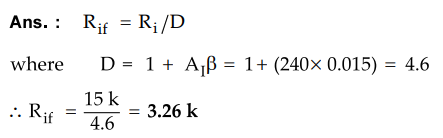
An amplifier has a current gain of 240 and input impedance of 15 kΩ without
feedback. If negative current feedback (current attenuation = 0.015) is
applied, what will be the input impedance of the amplifier ?
Ans.
:
Electron Devices and Circuits: Unit V: (a) Feedback Amplifiers : Tag: : Feedback Amplifiers | Electron Devices and Circuits - Two Marks Questions with Answers
Related Topics
Related Subjects

Electron Devices and Circuits
EC3301 3rd Semester EEE Dept | 2021 Regulation | 3rd Semester EEE Dept 2021 Regulation