Electromagnetic Theory: Unit II: (c) Poissons and Laplaces Equations
Uniqueness Theorem
• The boundary value problems can be solved by number of methods such as analytical, graphical, experimental etc. Thus there is a question that, is the solution of Laplace's equation solved by any method, unique?
Uniqueness Theorem
•
The boundary value problems can be solved by number of methods such as
analytical, graphical, experimental etc. Thus there is a question that, is the
solution of Laplace's equation solved by any method, unique? The answer to
this question is the uniqueness theorem, which is proved by contradiction
method.
•
Assume that the Laplace's equation has two solutions say Vi and V2, both are
function of the co-ordinates of the system used. These solutions must satisfy
Laplace's equation. So we can write,

•
Both the solutions must satisfy the boundary conditions as well. At the
boundary, the potentials at different points are same due to equipotential
surface then,
V1
= V2 ... (6.3.2)
•
Let the difference between the two solutions is Vd.
Vd
= V2 – V1 ...
(6.3.3)
•
Using Laplace’s equation for the difference X

•
On the boundary Vd = 0 from the equations (6.3.2) and (6.3.3).
•
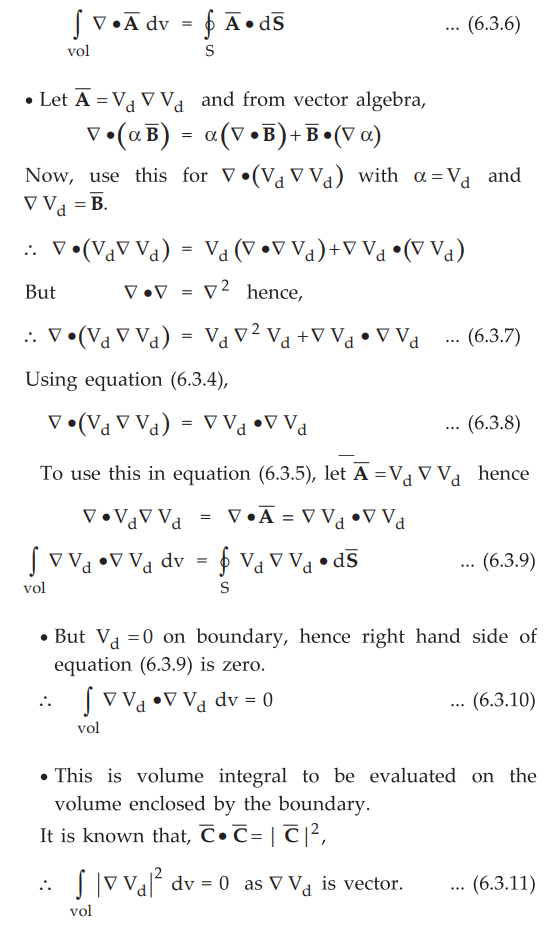
Now the divergence theorem states that,
•
Now integration can be zero under two conditions,
i)
The quantity under integral sign is zero.
ii)
The quantity is positive in some regions and negative in other regions by equal
amount and hence zero.
•
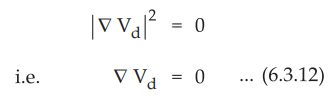
But square term cannot be negative in any region hence, quantity under integral
must be zero.
•
As the gradient of Vd = V2 – V1 is zero means V2
– V1 is constant and not changing with any co-ordinates. But
considering boundary it can be proved that V2 V2 – V1 =
Constant = Zero.
V2
– V1... (6.3.13)
•
This proves that both the solutions are equal and can not be different.
•
Thus Uniqueness Theorem can be stated as :
•
If the solution of Laplace's equation satisfies the boundary condition then
that solution is unique, by whatever method it is obtained.
•
The solution of Laplace's equation gives the field which is unique, satisfying
the same boundary conditions, in a given region.
Review Question
1. State and explain uniqueness theorem.
AU : Dec.-14, Marks 8
Electromagnetic Theory: Unit II: (c) Poissons and Laplaces Equations : Tag: : - Uniqueness Theorem
Related Topics
Related Subjects

Electromagnetic Theory
EE3301 3rd Semester EEE Dept | 2021 Regulation | 3rd Semester EEE Dept 2021 Regulation