Electrical Machines II: UNIT I: b. Armature Reaction and Regulation of Alternators
Voltage Equation of an Alternator
The voltage available to the load is called terminal voltage.
Voltage Equation of an Alternator
In
d.c. generators, we have seen that due to the armature resistance drop and
brush drop it is not possible to have all the induced e.m.f. available across
the load. The voltage available to the load is called terminal voltage. The
concept is same in case of alternators. The entire induced e.m.f. can not be
made available to the load due to the various internal voltage drops. So the
voltage available to the load is called terminal voltage denoted as Vph. In
case of three phase alternators as all the phases are identical, the equations
and the phasor diagrams are expressed on per phase basis.
So
if Eph is the induced e.m.f. per phase in the alternator, there are
following voltage drops occur in an alternator.
i)
The drop across armature resistance IaRa both Ia
and Ra are per phase values.
ii)
The drop across synchronous reactance IaXs, both Ia
and Xs are per phase values.
After
supplying these drops, the remaining voltage of Eph is available as
the terminal voltage Vph.
Key Point : Now drop Ia
Ra is always in phase with Ia due to a resistive drop
while current Ia lags by 90° with respect to drop IaXs
as it is a drop across purely inductive reactance.
Hence
all these quantities can not be added or subtracted algebraically but must be
added or subtracted vectorially considering their individual phases. But we can
write a voltage equation in its phasor form as,
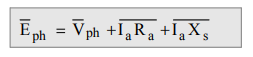
This
is called voltage equation of an alternator.
From
this voltage equation, we can draw the phasor diagrams for various load power
factor conditions and establish the relationship between Eph and Vph,
in terms of armature current i.e. load current and the power factor cos (ϕ).
Review Questions
1. State and explain the voltage equation of an alternator.
2. Is it possible to have the full load terminal voltage greater
than the no load terminal voltage ?
Explain. Why does the armature terminals voltage changes as it
is loaded ?
Electrical Machines II: UNIT I: b. Armature Reaction and Regulation of Alternators : Tag: Engineering Electrical Machines - II : - Voltage Equation of an Alternator
Related Topics
Related Subjects
Electrical Machines II
EE3405 Machine 2 EM 2 4th Semester EEE Dept | 2021 Regulation | 4th Semester EEE Dept 2021 Regulation