Electric Circuit Analysis: Unit I: b. Basic circuits analysis
Worked examples: AC circuits by nodal analysis
Electric Circuit Analysis: Unit I: Basic circuits analysis : Worked examples
WORKED EXAMPLES
AC CIRCUITS BY NODAL
ANALYSIS
Example
13 Determine the real power output of the source in the circuit shown in
figure, by nodal analysis and verify the results by using loop analysis.
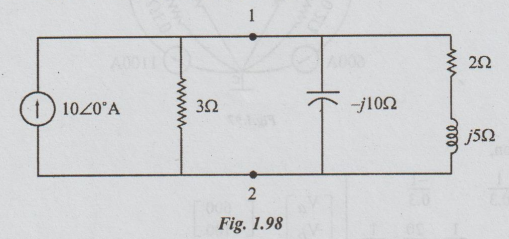
Solution:
Nodal Method
There are two nodes 1 and 2. Let the node 2 be the reference one. Then applying KCL at node 1 we get the following equation:
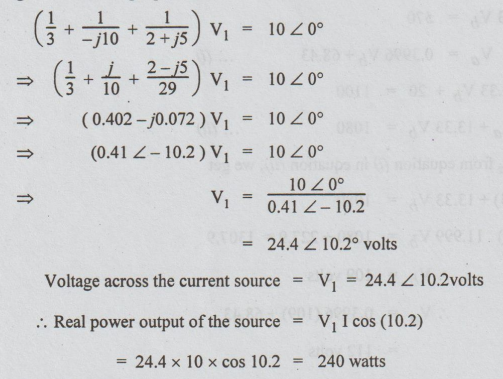
Loop Current Method :
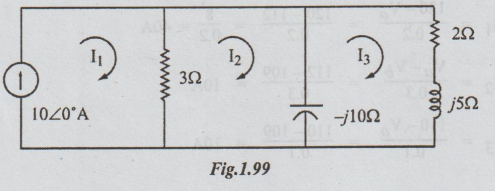
Let
the loop currents be as shown
I1=10A....(i)
Applying
KVL to loop 2, we get

It
is the same answer as in the nodal method. Thus the solution is verified.
Example
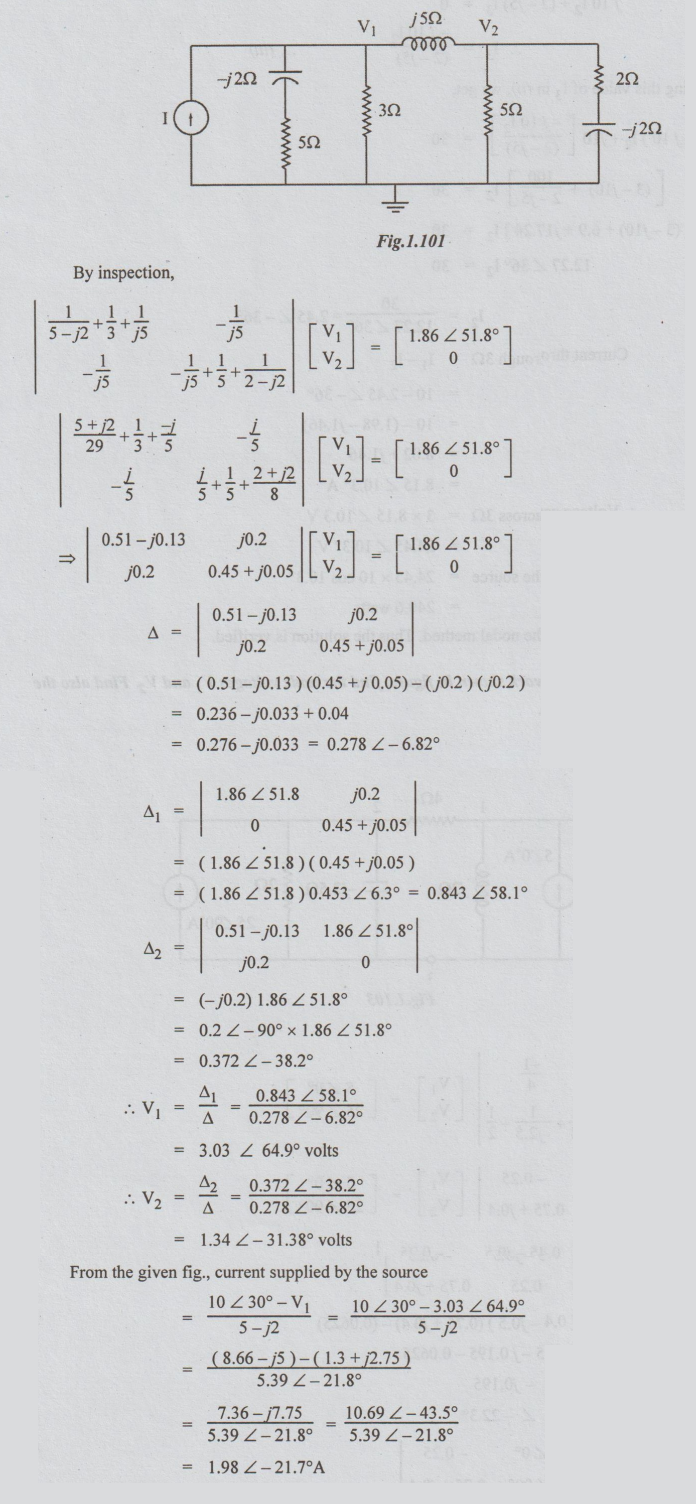
14 In the network shown in figure, find the node voltages V1 and V2.
Find also the current supplied by the source.
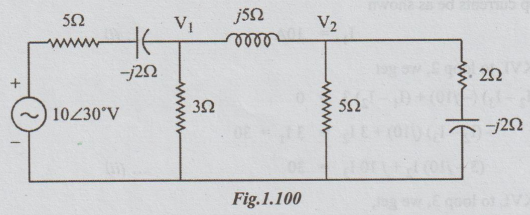
Solution:
The above circuit is re-drawn as below after converting the voltage source into
its equivalent current source.
Example
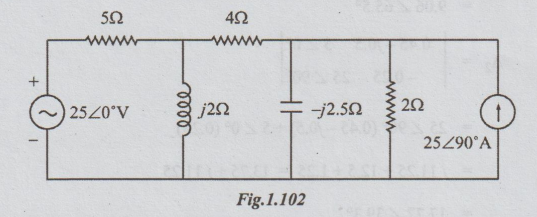
15 Using nodal analysis, find the current through the 4 ohm resistor in the
circuit shown in figure.
Solution:
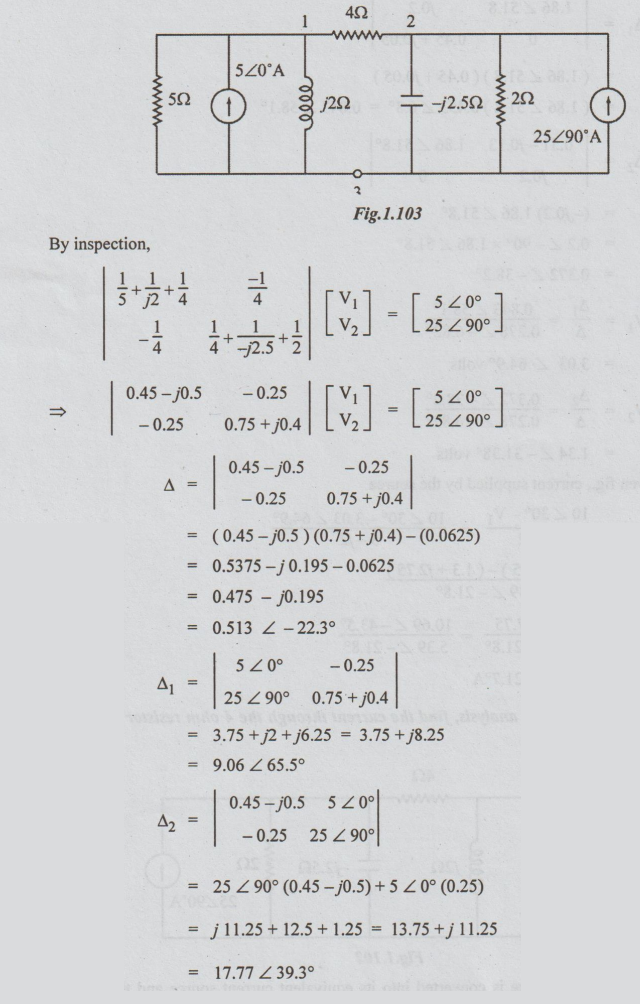
The voltage source is converted into its equivalent current source and the
network is drawn below:
V1
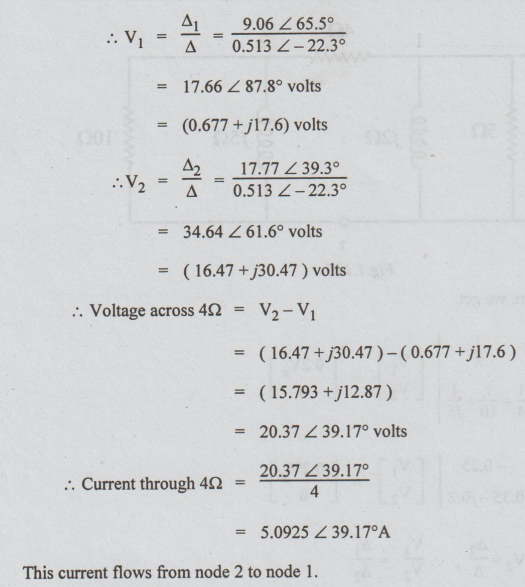
= Δ1/Δ = 9.06 ∠
65.5° / 0.513 ∠ 22.3°
=
17.66 ∠Δ 87.8° volts
= (0.677 + j17.6) volts
V2
= Δ2/Δ = 17.77 ∠
39.3° / 0.513 ∠ 22.3°
=
34.64 ∠ 61.6° volts
=
(16.47+ j30.47) volts
Voltage across 4Ω = V2 - V1
=
(16.47 + j30.47) - (0.677 + j17.6)
=
(15.793 + j12.87)
=
20.37 ∠ 39.17° volts
Current through 4 Ω = 20.37 ∠39.17o / 4
=
5.0925 ∠ 39.17°A
This
current flows from node 2 to node 1.
Example
16 Given the nodes 1 and 2 in network of figure find the ratio of node voltage V1/V2
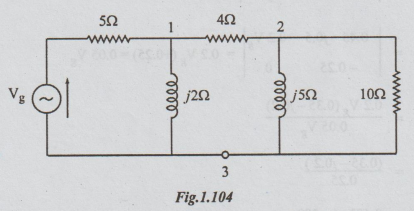
Solution:
The network is re-drawn as below after converting the voltage source into
current source:
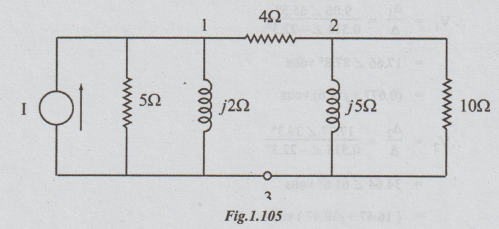
Putting
in the matrix form, we get
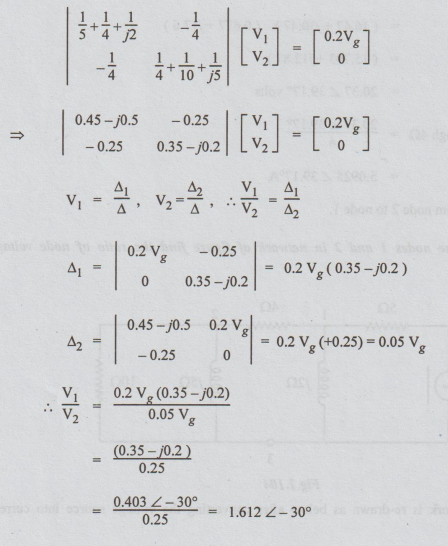
V1
/ V2 = 0.2 Vg
(0.35 – j0.2) / 0.05vg
=(0.35
- j0.2) / 0.25
=
(0.35 - j0.2) / 0.25
=
0.403 ∠ -30° / 0.25
= 1.612 ∠ -30°
Electric Circuit Analysis: Unit I: b. Basic circuits analysis : Tag: : - Worked examples: AC circuits by nodal analysis
Related Topics
Related Subjects
Electric Circuit Analysis
EE3251 2nd Semester 2021 Regulation | 2nd Semester EEE Dept 2021 Regulation