Electron Devices and Circuits: Unit V: (b) Oscillators
A General Form of LC Oscillator Circuit
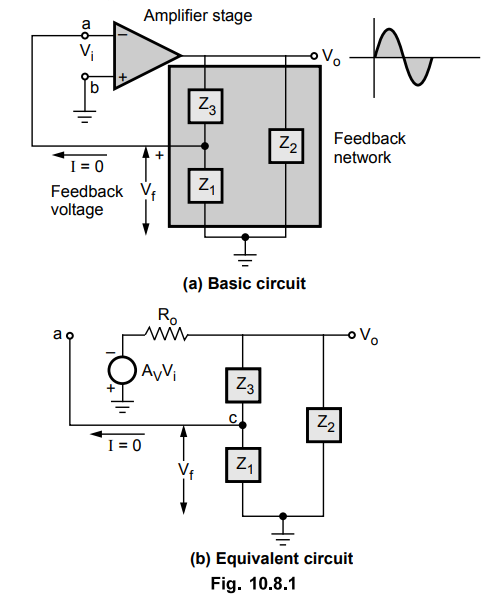
• An amplifier stage provides 180° phase shift while the feedback network contributes additional 180° phase shift to satisfy Barkhausen condition.
A General Form of LC Oscillator Circuit
•
It uses BJT, FET or op-amp in its amplifier stage, with gain of amplifier stage
as Av.
•
The feedback network uses three impedances Z v Z2 and Z3.
•
An amplifier stage provides 180° phase shift while the feedback network
contributes additional 180° phase shift to satisfy Barkhausen condition.
•
The Fig. 10.8.1 (a) shows the basic form of LC oscillator while the Fig. 10.8.1
0?) shows the equivalent circuit assuming infinite input impedance of an
amplifier stage.
Analysis
of amplifier stage :
•
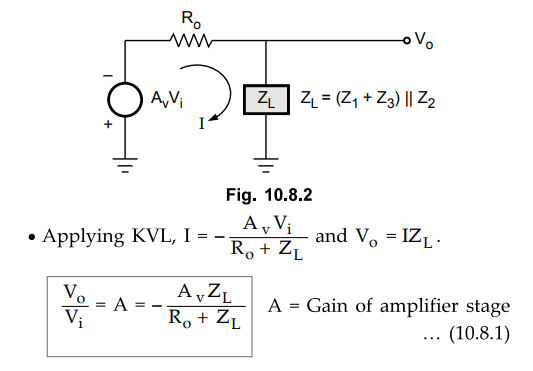
Let Ro be the output impedance of the amplifier stage.
•
As I = 0 due to infinite input impedance, Z1 and Z3
appear in series and the combination in parallel with Z2 as shown in
the Fig. 10.8.2.
Analysis
of feedback stage :
•
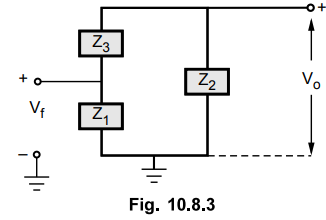
To calculate β, consider feedback stage as shown in the Fig. 10.8.3.
•
By voltage division in parallel circuit,

•
But as feedback network introduces 180° phase shift, use negative sign.

Expression of the loop gain :
•
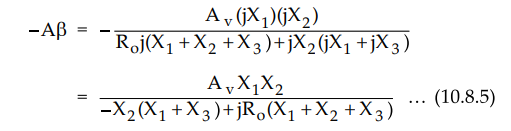
According to Barkhausen condition loop gain –Aβ is,
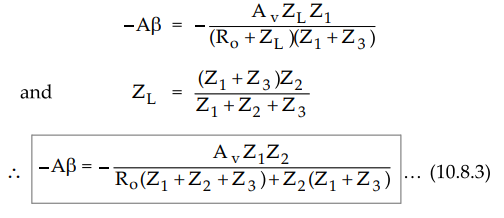
The impedances Z1 Z2, Z3 are pure reactive elements either L or C.

Thus
the loop gain becomes,
•
To have 0° phase shift for the loop gain, the imaginary part must be zero.

•
According to Barkhausen condition loop gain
-Aβ must be positive and greater than equal to 1. As AV is
positive, -Aβ will be positive only when X1 and X2 have
same sign.
•
Thus X1 and X2 must be of same type, either inductive or
capacitive. And as X1 + X3 = -X2 i.e. X3
= -(X1 + X2) the element
X3 must be opposite type of reactance to X1 and X2.
1. Types of LC Oscillators
•
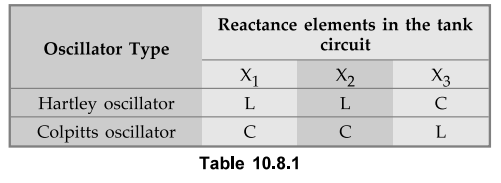
In LC oscillators, if X1 and X2 are inductive, X3
must be capacitive and if X1 and X2 are capacitive, then
X3 must be inductive. This decides the two types of LC oscillators
as,
Review Question
1. Discuss and explain the basic circuit of an LC oscillator and
derive the condition for the oscillations.
Electron Devices and Circuits: Unit V: (b) Oscillators : Tag: : - A General Form of LC Oscillator Circuit
Electron Devices and Circuits: Unit V: (b) Oscillators
Under Subject
Electron Devices and Circuits
EC3301 3rd Semester EEE Dept | 2021 Regulation | 3rd Semester EEE Dept 2021 Regulation
Electronic Devices and Circuits
EE25C05 3rd Semester EEE Dept | 2025 Regulation | 3rd Semester 2025 Regulation
Electronic Circuits and Analysis
EC25C05 3rd Semester ECE - Electronics and Communication Engineering Department | 2025 Regulation | 3rd Semester 2025 Regulation
Related Subjects
Probability and complex function
MA3303 3rd Semester EEE Dept | 2021 Regulation | 3rd Semester EEE Dept 2021 Regulation

Electromagnetic Theory
EE3301 3rd Semester EEE Dept | 2021 Regulation | 3rd Semester EEE Dept 2021 Regulation
Digital Logic Circuits
EE3302 3rd Semester EEE Dept | 2021 Regulation | 3rd Semester EEE Dept 2021 Regulation
Electron Devices and Circuits
EC3301 3rd Semester EEE Dept | 2021 Regulation | 3rd Semester EEE Dept 2021 Regulation

Electrical Machines I
EE3303 EM 1 3rd Semester EEE Dept | 2021 Regulation | 3rd Semester EEE Dept 2021 Regulation
C Programming and Data Structures
CS3353 3rd Semester EEE, ECE Dept | 2021 Regulation | 3rd Semester EEE Dept 2021 Regulation