Basic Civil & Mechanical Engineering: UNIT II: e. Determination of areas
Calculation of area by offsets from base line
Determination of areas | Surveying
This method is convenient to determine the area between a base line and a long irregular boundary. The area can be determined by the following Rules:
CALCULATION OF AREA BY OFFSETS FROM BASE LINE
This method is convenient to determine the area between a base line and a long irregular boundary. The area can be determined by the following
RULES:
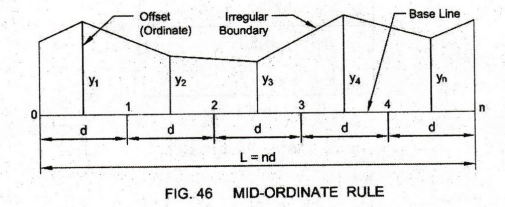
1. RULE I: MID-ORDINATE RULE
See
Fig. 46.
In
this method, the Base Line is divided into a number of equal divisions (n) of
length (d).
It
is assumed that the boundary between successive Offsets (Ordinates) is a
straight line.
Ordinates
(offsets) yı, y2, y3, ... . Yn are measured from the middle point of each
division.
Total
length of the base line = L = nd
Area
= Average Ordinate Length × Length of the Base Line
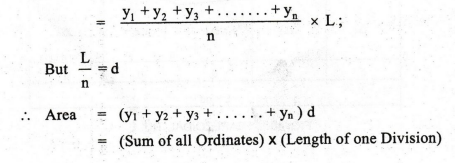
(Sum of all Ordinates) × (Length of one Division)
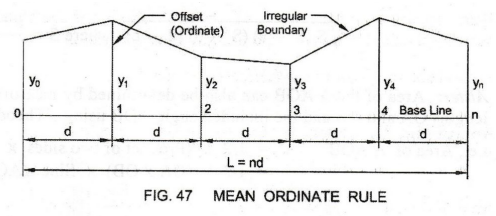
2. RULE II: MEAN ORDINATE RULE or AVERAGE ORDINATE RULE
See
Fig. 47.
This
method makes the same assumption as the previous method.
In
this method, the Ordinates (Perpendicular Offsets) yo, y1, y2, .... Yn are
drawn at each point of the division of the base line.
Total
length of the base line = L = nd; where n is the Number of divisions into which
the base line is divided and d is the Length of each division
Total
Number of Ordinates (Offsets) = n +1
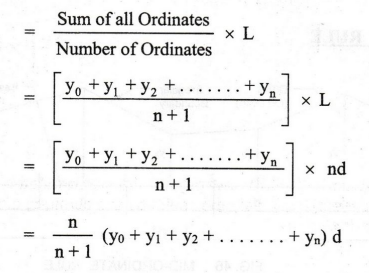
Area
= Average Ordinate Length × Length of the Base Line
The
above two methods are not accurate. More accurate methods are given below.
3. RULE III: TRAPEZOIDAL RULE
See
Fig. 48.
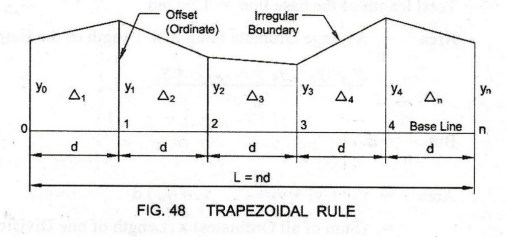
In
this method, the area between the boundary and the base line is assumed to
consist a number of Trapeziums.
On
this assumption, the area between the boundary and the base line is calculated.
The
rule is more accurate than the previous two rules which are the approximate
versions of the trapezoidal rule.
Total
length of the base line = L = nd; where n is the Number of divisions into which
the base line is divided and d is the Length of each division
Total
Number of Ordinates (Offsets) = n + 1
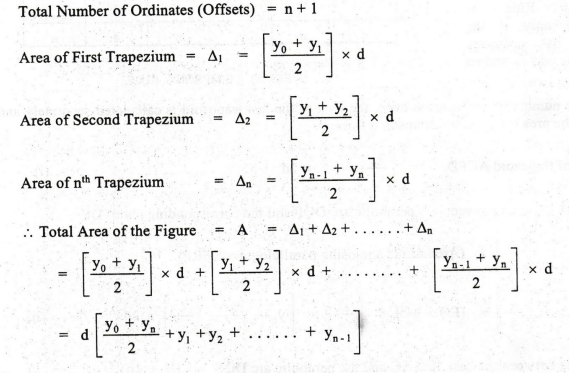
Thus,
the Trapezoidal Rule is stated as: "Add the average of the end ordinates
(offsets) to the sum of the intermediate ordinates (offsets). Multiply the
result by the common distance between the ordinates (offsets) to get the
required area."
4. RULE IV: SIMPSON'S RULE
Simpson's
Rule assumes that the short lengths of the boundary between the ordinates are
curved lines and are considered as portions of parabolic arcs.
See
Fig. 49.
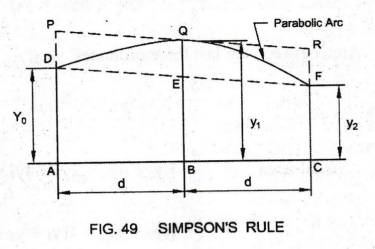
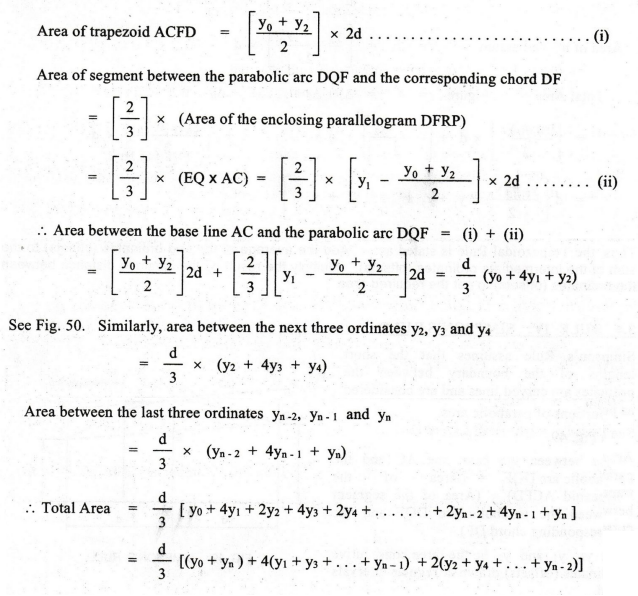
Area
between the baseline AC and the vil parabolic arc DQF = (Area of the trapezoid
ACFD) + (Area of the segment between the parabolic arc DQF and the
corresponding chord DF). Let yo, yı and y2 be the three consecutive ordinates
(offsets) drawn at regular intervals of d.
Through
Q draw a line PR parallel to the chord DF to cut the ordinates yo and y2
produced at the points P and R.
Simpson's
Rule is applicable only if the number of ordinates (offsets) is odd as shown in
Fig. 50.
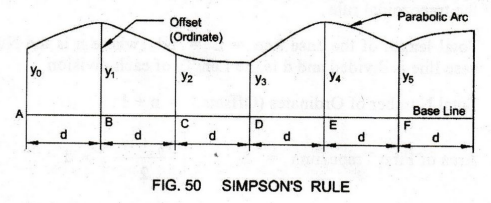
But,
if the number of ordinates is even, the area of the last trapezoid is
calculated separately and added to the area obtained by Simpson's Rule.
Thus,
Simpson's Rule is stated as follows:
Total
Area = d/3 [(First Ordinate + Last Ordinate) + 4(Sum of Odd Ordinates) + 2(Sum
of Even Ordinates)]
Note
1.
If the number of ordinates is even, say, 8, then the area A, for the first
seven ordinates only is obtained using Simpson's Rule.
A1
= d/3 [(y0 + y6) + 4(y1 + y2 + y3)
+ 2(y2 + y4)]
and
A2 = Area of Last Trapezoid = 1/2
(y6 + y7) d;
Total
Area A = A1 + A2
2.
Interval between ordinates (offsets) should be equal.
3.
If yo or yn is equal to zero, that is also included in the Simpson's Rule.
Comparison
of Rules
1.
Results obtained by Simpson's Rule are more accurate than by Trapezoidal Rule.
2.
Results obtained by Simpson's Rule are greater or less than by Trapezoidal
Rule, according as the curve of the boundary is concave or convex towards the
base line.
PROBLEM
1
The
following perpendicular offsets in meters were taken at 10 meter intervals from
a survey line to an irregular boundary line: 0, 4, 7, 9, 12, 15, 14, 8 and 3.
Determine the area enclosed between the chain line and the boundary line by.
(i) Mean Ordinate Rule, (ii) Trapezoidal Rule and (iii) Simpson's Rule. (UQ)
Solution
(i)
Area by Mean Ordinate Rule
Area
= n / n+1 (y0 + y1 + y2 …… + yn )
d; In this, Number of Ordinates = 9,
Number
of Divisions = n = 8 and Length of each Division = d = 10 m
Sum
of all the 9 Ordinates = 0 + 4 + 7 + 9 + 12 + 15 + 14 + 8 + 3 = 72 meters
Area
= (8/9) (72 × 10) m2 = 640 m2
(ii)
Area by Trapezoidal Rule
Area
= d [y0 + yn / 2 + y1 + y2 …… + yn-1
]
=
10 [ 0+3 / 2 + 4 + 7 + 9 + 12 + 15+ 14 + 8] m2 = 10 × 70.5 m2
= 705 m2
(iii)
Area by Simpson's Rule: (Number of Ordinates/Offsets is 9,
that is Odd.)
Total
Area = d/3 (First Ordinate + Last Ordinate) + 4(Sum of Odd Ordinates) + 2(Sum
of Even Ordinates)]; In this, d= 10, First Ordinate = 0, Last Ordinate = 3, Odd
Ordinates = 4, 9, 15,8 and Even Ordinates = 7, 12, 14.
Total
Area = 10/3 [(0 + 3) + 4(4 + 9 + 15 + 8) + 2(7 + 12 + 14)] m2
=
10/3 [3 + 4(36) + 2(33)] m2 = 710 m2
PROBLEM
2
The
following series of perpendicular offsets were taken from a chain line to a
curved boundary line at 5 meter intervals: 0, 3.25, 4.10, 6.45, 8.90, 5.75,
8.50 and 0. Determine the area enclosed between the survey line and the boundary
line by (i) Trapezoidal Rule and (ii) Simpson's Rule. (UQ)
Solution
(i)
Area by Trapezoidal Rule
Area
= d [ y0 + y n / 2 + y1 + y2 + …. +
yn-1]
In
this, d = 5 m, Number of Ordinates = 8, Number of Divisions = n = 7,
Area
= 5 [ 0 + 0 / 2 + 3.25 +4.10 + 6.45 + 8.90 +5.75 + 8.50 ]
=
5 [ 0 + 0 / 2 + 3.25 + 4.10 + 6.45 + 8.90 + 5.75 + 8.50]
=
5 × 36.95 = 184.75 m2
(ii)
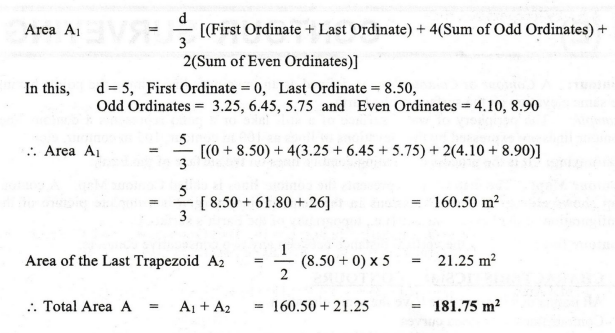
Area by Simpson's Rule
Number
of Ordinates/Offsets is 8, i.e., Even. Simpson's Rule can be applied, only if
the number of ordinates is odd. Therefore, in this problem, the last
ordinate/offset (0) is ignored to calculate the area A1. Then, the
area A2 of the trapezium between the last two ordinates is
calculated.
PROBLEM
3
The
following perpendicular offsets were taken at 10 meters intervals from a survey
line to an irregular boundary line:
3.25,
5.60, 4.20, 6.65, 8.75, 6.20, 3.25, 4.20 and 5.65.
Calculate
the area enclosed between the survey line, the irregular boundary line and the
first and last offsets, by the application of (i) Average Ordinate Rule, (ii)
Trapezoidal Rule and (iii) Simpson's Rule. (UQ)
Results
(i)
Average Ordinate Rule: 424.44 sq m = 4.2444 ares.
(ii)
Trapezoidal Rule : 433 sq m = 4.33 ares.
(iii)
Simpson's Rule : 439.67 sq m = 4.3967 ares.
PROBLEM
4
A
series of offsets were taken from a chain line to a curved boundary line at
intervals of 15 meters in the following order:
0,
2.65, 3.80, 3.75, 4.65, 3.60, 4.95 and 5.85.
Compute
the area between the chain line, the curved boundary and the end offsets by (i)
Average Ordinate Rule, (ii) Trapezoidal Rule and (iii) Simpson's Rule. (UR)
Results
(i)
Average Ordinate Rule: 383.91 sq m
(ii)
Trapezoidal Rule : 394.87 sq m
(iii)
Simpson's Rule : 309.25 + 81.0 = 3.8391 ares. = 3.9487 ares. = 390.25 sq m
=
3.9025 ares.
Basic Civil & Mechanical Engineering: UNIT II: e. Determination of areas : Tag: : Determination of areas | Surveying - Calculation of area by offsets from base line
Basic Civil & Mechanical Engineering: UNIT II: e. Determination of areas
Under Subject

Basic Civil and Mechanical Engineering
BE3255 2nd Semester 2021 Regulation | 2nd Semester EEE Dept 2021 Regulation
Related Subjects

Professional English II
HS3251 2nd Semester 2021 Regulation | 2nd Semester Common to all Dept 2021 Regulation
Statistics and Numerical Methods
MA3251 2nd Semester 2021 Regulation M2 Engineering Mathematics 2 | 2nd Semester Common to all Dept 2021 Regulation

Engineering Graphics
GE3251 eg 2nd semester | 2021 Regulation | 2nd Semester Common to all Dept 2021 Regulation

Physics for Electrical Engineering
PH3202 2nd Semester 2021 Regulation | 2nd Semester EEE Dept 2021 Regulation
Basic Civil and Mechanical Engineering
BE3255 2nd Semester 2021 Regulation | 2nd Semester EEE Dept 2021 Regulation
Electric Circuit Analysis
EE3251 2nd Semester 2021 Regulation | 2nd Semester EEE Dept 2021 Regulation

Physics for Electronics Engineering
PH3254 - Physics II - 2nd Semester - ECE Department - 2021 Regulation | 2nd Semester ECE Dept 2021 Regulation

Electrical and Instrumentation Engineering
BE3254 - 2nd Semester - ECE Dept - 2021 Regulation | 2nd Semester ECE Dept 2021 Regulation
Circuit Analysis
EC3251 - 2nd Semester - ECE Dept - 2021 Regulation | 2nd Semester ECE Dept 2021 Regulation

Materials Science
PH3251 2nd semester Mechanical Dept | 2021 Regulation | 2nd Semester Mechanical Dept 2021 Regulation

Basic Electrical and Electronics Engineering
BE3251 2nd semester Mechanical Dept | 2021 Regulation | 2nd Semester Mechanical Dept 2021 Regulation

Physics for Civil Engineering
PH3201 2021 Regulation | 2nd Semester Civil Dept 2021 Regulation

Basic Electrical, Electronics and Instrumentation Engineering
BE3252 2021 Regulation | 2nd Semester Civil Dept 2021 Regulation

Physics for Information Science
PH3256 2nd Semester CSE Dept | 2021 Regulation | 2nd Semester CSE Dept 2021 Regulation

Basic Electrical and Electronics Engineering
BE3251 2nd Semester CSE Dept 2021 | Regulation | 2nd Semester CSE Dept 2021 Regulation

Programming in C
CS3251 2nd Semester CSE Dept 2021 | Regulation | 2nd Semester CSE Dept 2021 Regulation