Environmental Sciences and Sustainability: Unit V: Sustainability Practices
Circular Economy
Graph Diagram, Principles, Benefits
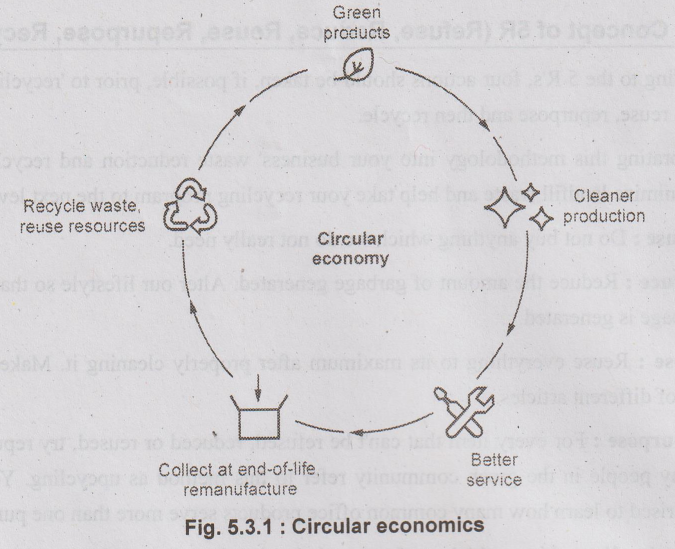
The circular economy is a systems solution framework that tackles global challenges like climate change, biodiversity loss, waste and pollution.
Circular Economy
•
The circular economy is a systems solution framework that tackles global
challenges like climate change, biodiversity loss, waste and pollution.
•
In circular economy, products are designed for durability, reuse and
recyclability and materials for new products come from old products.
•
Circular economy is a new production and consumption model that ensures
sustainable growth over time. With the circular economy, we can drive the
optimization of resources, reduce the consumption of raw materials and recover
waste by recycling or giving it a second life as a new product.
•
The circular economy is important as it promotes sustainable development. It
advocates using waste as an input for producing new finished goods.
•
The circular economy supports creating reserves of raw materials and adopting
innovative methods to eliminate any steps that reduce the cost and time to make
new finished goods.
1. Linear Economy Versus Linear Economy
•
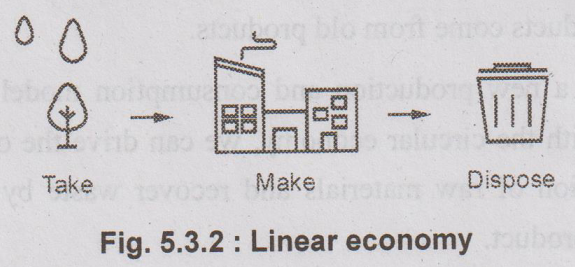
In a linear economy, materials flow in a straight line from resource
extraction, to manufacturing and then to landfill.
•
Value is created by producing and selling as many products as possible. This
model is characterized by wasted resources and excessive pollution, causing
ecosystem degradation, wealth concentrations and social inequities.
•
A circular economy model, on the other hand, aims to redefine growth to benefit
people and the planet. It entails gradually decoupling economic activity from
the consumption of finite resources and designing waste out of the system.
•
Underpinned by a transition to renewable energy sources, the circular business
model builds economic, natural and social capital.
2. Principles of Circular Economy
•
The circular economy is based on three principles, driven by design :
1.
Eliminate waste and pollution
2.
Circulate products and materials (at their highest value)
3.
Regenerate nature
3. Benefits of Circular Economy
1.
It reduces waste as it promotes the recycling of finished goods.
2.
It offsets any potential price rise of the commodity.
3.
Its adoption helps achieve efficiency and effectiveness as resources are
recycled to get new products.
4.
It promotes the rental business by advocating to reuse of an economic entity
rather than purchasing a new entity.
Environmental Sciences and Sustainability: Unit V: Sustainability Practices : Tag: : Graph Diagram, Principles, Benefits - Circular Economy
Environmental Sciences and Sustainability: Unit V: Sustainability Practices
Under Subject
Environmental Sciences and Sustainability
GE3451 ESS 4th Semester | 2021 Regulation | 4th Semester EEE Dept 2021 Regulation
Related Subjects
Environmental Sciences and Sustainability
GE3451 ESS 4th Semester | 2021 Regulation | 4th Semester EEE Dept 2021 Regulation
Transmission and Distribution
EE3401 TD 4th Semester EEE Dept | 2021 Regulation | 4th Semester EEE Dept 2021 Regulation
Linear Integrated Circuits
EE3402 Lic Operational Amplifiers 4th Semester EEE Dept | 2021 Regulation | 4th Semester EEE Dept 2021 Regulation
Measurements and Instrumentation
EE3403 MI 4th Semester EEE Dept | 2021 Regulation | 4th Semester EEE Dept 2021 Regulation
Microprocessor and Microcontroller
EE3404 MCU 4th Semester EEE Dept | 2021 Regulation | 4th Semester EEE Dept 2021 Regulation
Electrical Machines II
EE3405 Machine 2 EM 2 4th Semester EEE Dept | 2021 Regulation | 4th Semester EEE Dept 2021 Regulation