Basic Civil & Mechanical Engineering: UNIT II: h. Bricks
Classification of bricks
A first class brick should be free from cracks or lumps. It should be of standard shape and size with sharp, straight and smooth edges.
CLASSIFICATION OF BRICKS
1. BASED ON THE METHOD OF MANUFACTURING
1.
Sun-dried or Un-burnt or Katcha Bricks: The bricks are dried
in sun light after moulding. These bricks have low crushing strength. Hence,
these are used in the temporary structures.
2.
Burnt or Pucca Bricks: Burnt bricks are burnt in kilns or
clamps. These bricks have high crushing strength. Hence, these are used for all
construction works.
2. BASED ON THE QUALITY OF BRICKS
1.
First Class Bricks
These
bricks are table-moulded and burnt in kilns. A first class brick should be free
from cracks or lumps. It should be of standard shape and size with sharp,
straight and smooth edges. It should be so hard that finger nails should not be
able to make any impression on its surface when scratched. These are used for
superior works.
2.
Second Class Bricks
These
bricks are ground-moulded and burnt in kilns. These bricks are slightly
irregular in shape, rough, chipped or may have surface cracks.
3.
Third Class Bricks
These
bricks are ground-moulded and burnt in clamps. These are not hard. They have
rough surfaces with irregular edges. These give a dull sound when struck with
each other. These bricks are used in temporary constructions.
4.
Fourth Class Bricks
These
bricks are over-burnt bricks with irregular shape and dark in colour. These are
used as aggregate for concrete in foundations, floors, etc.
3. SPECIAL TYPES OF BRICKS
1.
Pressed Bricks: Pressed bricks are made by pressing the
clay to a high pressure. They do not require drying and can be burnt directly.
The oil used in the process gives the bricks a glazed surface.
These
bricks are stronger and have sharp and regular edges with smooth surfaces.
These are used for decorative and very high quality works.
2.
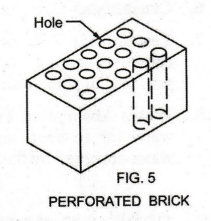
Perforated Bricks: See Fig. 5. Perforated bricks contain perforations,
i.e., small cylindrical holes. These bricks are light in weight. Heat
insulation capacity is high but, sound insulation capacity is low. These are
used for heat insulation purposes. Cavity
3.
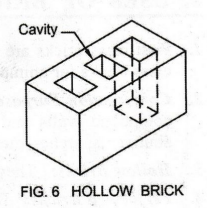
Hollow Bricks: See Fig. 6. Hollow bricks have
cavities. These bricks have high insulation against heat, sound and damp. These
are light in weight. These can be laid faster than ordinary bricks. These
bricks are used for building hollow walls.
4.
Paving Bricks: Paving bricks are made from rock clay. Paving
bricks are used in roads and are able to resist the abrasive action of traffic.
5.
Sand-Lime Bricks: These are made from a mixture of sand
and lime (CaO). These bricks are hard and strong, uniform in colour and
texture. It presents a clean appearance and hence plastering is not necessary.
It is used for ornamental works.
6.
Refractory Fire Bricks: These bricks are manufactured from
fire clay. Fire brick contains Alumina and Silica. After drying, these are
burnt in kilns at temperatures ranging from 1400 - 1900°C. These bricks are
yellowish white in colour.
These
bricks withstand very high temperature without melting. Hence, these are used
for lining the interiors of fire places, chimneys, furnaces, boilers, etc.
Basic Civil & Mechanical Engineering: UNIT II: h. Bricks : Tag: : - Classification of bricks
Basic Civil & Mechanical Engineering: UNIT II: h. Bricks
Under Subject
Basic Civil and Mechanical Engineering
BE3255 2nd Semester 2021 Regulation | 2nd Semester EEE Dept 2021 Regulation
Introduction to Civil Engineering
CE25C01 1st Semester Civil, Agri Departments | 2025 Regulation | 1st Semester 2025 Regulation
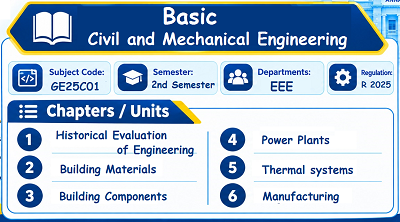
Basic Civil and Mechanical Engineering
GE25C01 2nd Semester EEE Dept | 2025 Regulation | 2nd Semester 2025 Regulation
Related Subjects

Professional English II
HS3251 2nd Semester 2021 Regulation | 2nd Semester Common to all Dept 2021 Regulation
Statistics and Numerical Methods
MA3251 2nd Semester 2021 Regulation M2 Engineering Mathematics 2 | 2nd Semester Common to all Dept 2021 Regulation
Engineering Graphics
GE3251 eg 2nd semester | 2021 Regulation | 2nd Semester Common to all Dept 2021 Regulation
Physics for Electrical Engineering
PH3202 2nd Semester 2021 Regulation | 2nd Semester EEE Dept 2021 Regulation
Basic Civil and Mechanical Engineering
BE3255 2nd Semester 2021 Regulation | 2nd Semester EEE Dept 2021 Regulation
Electric Circuit Analysis
EE3251 2nd Semester 2021 Regulation | 2nd Semester EEE Dept 2021 Regulation

Physics for Electronics Engineering
PH3254 - Physics II - 2nd Semester - ECE Department - 2021 Regulation | 2nd Semester ECE Dept 2021 Regulation
Electrical and Instrumentation Engineering
BE3254 - 2nd Semester - ECE Dept - 2021 Regulation | 2nd Semester ECE Dept 2021 Regulation
Circuit Analysis
EC3251 - 2nd Semester - ECE Dept - 2021 Regulation | 2nd Semester ECE Dept 2021 Regulation

Materials Science
PH3251 2nd semester Mechanical Dept | 2021 Regulation | 2nd Semester Mechanical Dept 2021 Regulation

Basic Electrical and Electronics Engineering
BE3251 2nd semester Mechanical Dept | 2021 Regulation | 2nd Semester Mechanical Dept 2021 Regulation
Physics for Civil Engineering
PH3201 2021 Regulation | 2nd Semester Civil Dept 2021 Regulation

Basic Electrical, Electronics and Instrumentation Engineering
BE3252 2021 Regulation | 2nd Semester Civil Dept 2021 Regulation
Physics for Information Science
PH3256 2nd Semester CSE Dept | 2021 Regulation | 2nd Semester CSE Dept 2021 Regulation

Basic Electrical and Electronics Engineering
BE3251 2nd Semester CSE Dept 2021 | Regulation | 2nd Semester CSE Dept 2021 Regulation
Programming in C
CS3251 2nd Semester CSE Dept 2021 | Regulation | 2nd Semester CSE Dept 2021 Regulation