Basic Civil & Mechanical Engineering: UNIT IV: b. Boilers
Cochran boiler
Working Principle, Layout Diagram, Advantages, Disadvantages
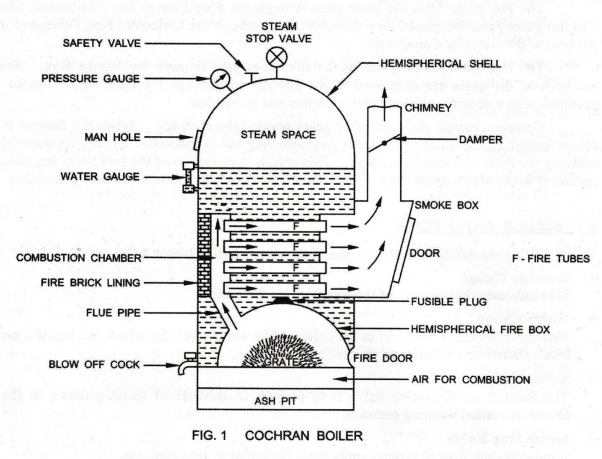
Cochran Boiler is a vertical, multi-tubular, internally fired, fire tube boiler having a number of horizontal fire tubes. Maximum evaporative capacity is 4000 kg of steam per hour. Maximum pressure of steam is 10 bar.
COCHRAN BOILER
DESCRIPTION
[Fig. 1]
Cochran
Boiler is a vertical, multi-tubular, internally fired, fire tube boiler having
a number of horizontal fire tubes. Maximum evaporative capacity is 4000 kg of
steam per hour. Maximum pressure of steam is 10 bar. Cochran boiler consists
of:
1.
Cylindrical Shell
2.
Grate and Ashpit
3.
Fire Box (Furnace)
4.
Flue Pipe
5.
Fire Tubes or Flue Tubes
6.
Combustion Chamber
7.
Chimney
8.
Manhole
9.
Damper
1.
Cylindrical Shell: The Cylindrical Shell is vertical. It
is hemispherical on the top, which forms the steam space.
2.
Grate and Ashpit: Grate is placed at the bottom of the
furnace where coal is burnt. Ashpit is provided below the grate for the
collection of ash.
3.
Fire Box (Furnace): It is also dome-shaped like the shell
so that the gases can be deflected back till they are passed out through the
flue pipe to the combustion chamber.
4.
Flue Pipe: It is a short passage connecting the
fire box with the combustion chamber.
5.
Fire Tubes or Flue Tubes (F): A number of horizontal
fire tubes are provided, thereby the heating surface is increased.
6.
Combustion Chamber: It is lined with fire bricks to prevent
overheating of the boiler. Hot gases enter the fire tubes from the flue pipe
through the combustion chamber.
7.
Chimney: Chimney is provided for the exit of the flue gases
to the atmosphere.
8.
Manhole: It is provided for inspection and repair of the interior
of the boiler shell.
9.
Damper: Damper is provided in the chimney.
WORKING
Coal
is fed into the Grate through the Fire Hole and burnt. Ash formed during
burning is collected in the ashpit, provided just below the grate. The ash is
then removed manually.
The
hot gases from the grate pass through the Flue Pipe to the Combustion Chamber.
The hot gases from the combustion chamber flow through the horizontal Fire
Tubes and transfer the heat to the water by Convection.
The
flue gases coming out of the fire tubes pass through the Smoke Box. From the
smoke box, the gases are exhausted to the atmosphere through the Chimney. Smoke
box is provided with a door for cleaning the fire tubes and smoke box.
Damper
controls the waste flue gases leaving the chimney. When the damper is partly
closed manually, the quantity of waste gases flowing out is reduced. Hence, the
quantity of air entering the grate will also be reduced. This results in
reduction of the fuel burnt and consequent reduction in the steam generation. Thus,
the damper controls the rate of steam generation.
1. BOILER MOUNTINGS
The
following mountings are fitted to the boiler as per Indian Boiler Act:
1.
Pressure Gauge
This
indicates the pressure of the steam inside the boiler.
2.
Water Gauge
This
indicates the water level in the boiler. The water level should not fall below
a particular level, otherwise the boiler tubes may burn out.
3.
Safety Valve
The
function of the safety valve is to prevent an increase of steam pressure in the
boiler above its normal working pressure.
4.
Steam Stop Valve
It
regulates the flow of steam supply from the boiler to requirements.
5.
Blow-off Cock
It
is located at the bottom of the boiler. When the blow-off cock is opened during
the running of the boiler, the steam pressure acting on the water surface
pushes (drains) out the impurities like mud, etc., in the water collected at
the bottom.
6.
Fusible Plug
It
protects fire tubes from burning when water level falls abnormally low.
2. ADVANTAGES
1.
The dome shape of the furnace causes the hot gases to deflect back and pass
through the flue. The un-burnt fuel if any will also be deflected back.
2.
Spherical shape of the top of the shell and the fire box gives higher area by
volume ratio.
3.
It occupies less floor area and is very compact. Construction cost is low.
4.
It is well suited for small capacity requirements.
3. DISADVANTAGE
1.
Capacity is less because of the vertical design.
Basic Civil & Mechanical Engineering: UNIT IV: b. Boilers : Tag: : Working Principle, Layout Diagram, Advantages, Disadvantages - Cochran boiler
Basic Civil & Mechanical Engineering: UNIT IV: b. Boilers
Under Subject
Basic Civil and Mechanical Engineering
BE3255 2nd Semester 2021 Regulation | 2nd Semester EEE Dept 2021 Regulation
Basic Civil and Mechanical Engineering
GE25C01 2nd Semester EEE Dept | 2025 Regulation | 2nd Semester 2025 Regulation
Related Subjects
Professional English II
HS3251 2nd Semester 2021 Regulation | 2nd Semester Common to all Dept 2021 Regulation
Statistics and Numerical Methods
MA3251 2nd Semester 2021 Regulation M2 Engineering Mathematics 2 | 2nd Semester Common to all Dept 2021 Regulation
Engineering Graphics
GE3251 eg 2nd semester | 2021 Regulation | 2nd Semester Common to all Dept 2021 Regulation
Physics for Electrical Engineering
PH3202 2nd Semester 2021 Regulation | 2nd Semester EEE Dept 2021 Regulation
Basic Civil and Mechanical Engineering
BE3255 2nd Semester 2021 Regulation | 2nd Semester EEE Dept 2021 Regulation
Electric Circuit Analysis
EE3251 2nd Semester 2021 Regulation | 2nd Semester EEE Dept 2021 Regulation
Physics for Electronics Engineering
PH3254 - Physics II - 2nd Semester - ECE Department - 2021 Regulation | 2nd Semester ECE Dept 2021 Regulation
Electrical and Instrumentation Engineering
BE3254 - 2nd Semester - ECE Dept - 2021 Regulation | 2nd Semester ECE Dept 2021 Regulation
Circuit Analysis
EC3251 - 2nd Semester - ECE Dept - 2021 Regulation | 2nd Semester ECE Dept 2021 Regulation
Materials Science
PH3251 2nd semester Mechanical Dept | 2021 Regulation | 2nd Semester Mechanical Dept 2021 Regulation
Basic Electrical and Electronics Engineering
BE3251 2nd semester Mechanical Dept | 2021 Regulation | 2nd Semester Mechanical Dept 2021 Regulation
Physics for Civil Engineering
PH3201 2021 Regulation | 2nd Semester Civil Dept 2021 Regulation
Basic Electrical, Electronics and Instrumentation Engineering
BE3252 2021 Regulation | 2nd Semester Civil Dept 2021 Regulation
Physics for Information Science
PH3256 2nd Semester CSE Dept | 2021 Regulation | 2nd Semester CSE Dept 2021 Regulation
Basic Electrical and Electronics Engineering
BE3251 2nd Semester CSE Dept 2021 | Regulation | 2nd Semester CSE Dept 2021 Regulation
Programming in C
CS3251 2nd Semester CSE Dept 2021 | Regulation | 2nd Semester CSE Dept 2021 Regulation