Basic Civil & Mechanical Engineering: UNIT III: a. Foundations
Components of a building
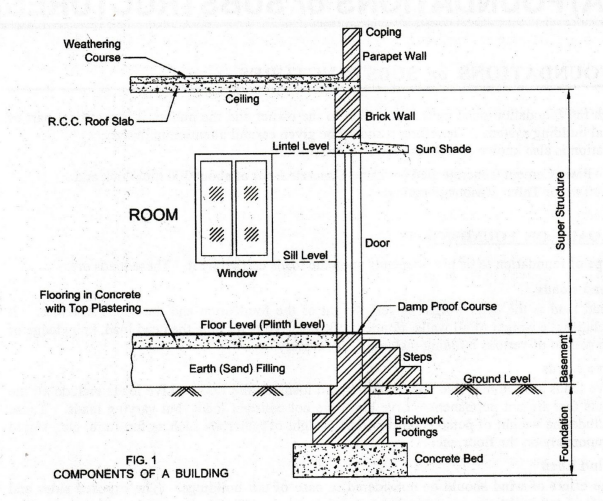
A building structure consists of Foundation or Substructure, Basement and Superstructure. Fig. 1 shows the different components of a single storey building with R.C.C. flat roof.
COMPONENTS OF A BUILDING
A
building structure consists of Foundation or Substructure, Basement and
Superstructure. Fig. 1 shows the different components of a single storey
building with R.C.C. flat roof.
1.
Foundation: Foundation is the portion of a building
below the Ground Level (G.L.). It transmits the load coming from the
superstructure to the soil.
2.
Footings: Footings are stepped courses in the foundation. These
are constructed in brick or stone (Random Rubble / Course Rubble) masonry or
concrete under the base of the wall or column. Footings distribute the load of
the superstructure over a larger area.
3.
Basement: Basement is in-between Ground Level and Plinth Level.
There will be one or two masonry footings in the basement. Space between the
floor and ground is filled with sand.
Note:
The floor constructed below the ground level is known as Basement Floor. The
above explanation of basement is valid only where there is no basement floor.
Basement
provides a raised platform for the floor. It serves as a base for laying the
floor. The exterior wall in the basement retains the earth filling.
4.
Super Structure: Super Structure is the portion of the
building above the plinth (floor) level to the roof. It includes: (i) Plinth,
Flooring and Damp Proof Course, (ii) Masonry Walls, (iii) Doors, Windows and
Ventilators (iv) Lintels and Sunshades, (v) R.C.C. Roof Slab including Weathering
Course and (vi) Parapet Wall and Coping.
5.
Flooring: It forms part of the basement. The top level of
flooring is called Floor Level. It coincides with Plinth Level. Flooring will
be in plain cement concrete (P.C.C.) of 1:4:8 mix of about 130 mm thick. It is
plastered with cement mortar of 1:3 mix of 20 mm thick.
Floor
Area: Floor Area of a building is the total area of the
floor in-between walls. It consists of areas of rooms, verandah, staircase,
entrance hall, stores, toilets, sit-out, etc.
Floor
Area
= Total Area of the floor in between the walls = Plinth Area – Area occupied by
walls. Area occupied by the walls may be 10 to 15% of plinth area.
Carpet
Area: Carpet Area of a building is the useful area or
livable area. It is the floor area, excluding entrance hall, verandah,
passages, kitchen, etc.
Plinth
Area: Plinth Area is the built-up covered area of a
building, measured at floor level of any storey. It is calculated by measuring
the external dimensions of the building at the floor level. Open areas,
balconies, etc., projections are not included in the plinth area.
6.
Damp Proof Course (D.P.C.): It is a layer of an impervious
material provided at the plinth level to check dampness in walls and to prevent
moisture from getting through the foundation.
7.
Masonry Walls: Masonry walls are of brick or stone.
8.
Sill: It is the bottom horizontal frame of a window or
door.
9.
Lintel: Lintel is a horizontal member placed over the
openings such as door or window, to support the structure above the openings.
It is made of either R.C.C., wood or stone.
10.
Sunshade: It is a projection from the wall provided above the
window or door.
11.
R.C.C. Roof Slab: It is a flat or inclined structure
provided as a cover to the building. R.C.C. roof slab is used to protect the
building from weathering conditions, viz., rain, sun, wind, etc. Generally,
roof slab is constructed of R.C.C. of about 125 mm thick.
12.
Ceiling: The lower level of the roof slab exposed to the
room is known as Ceiling. The height of all rooms for human habitation shall
not be less than 2750 mm measured from the surface of the floor to the bottom
of the roof.
13.
Weathering Course: It is 100 mm thick brick jelly lime
concrete. It is laid over the roof slab. It protects the roof from weathering
actions of sunshine, rain, wind, etc.
14.
Parapet Wall: It is a short wall of about 450 mm to
600 mm built over the roof all around the building. It prevents anybody,
especially, children, from falling from the top of the roof of the building.
Also, it fulfills the architectural requirement of the building.
15.
Coping: It is a projection of the top of the parapet wall
on outside or both sides.
16.
Steps: Steps are in brick-work in cement mortar 1:5 laid
on P.C.C. base.
Basic Civil & Mechanical Engineering: UNIT III: a. Foundations : Tag: : - Components of a building
Basic Civil & Mechanical Engineering: UNIT III: a. Foundations
Under Subject
Basic Civil and Mechanical Engineering
BE3255 2nd Semester 2021 Regulation | 2nd Semester EEE Dept 2021 Regulation
Related Subjects
Professional English II
HS3251 2nd Semester 2021 Regulation | 2nd Semester Common to all Dept 2021 Regulation
Statistics and Numerical Methods
MA3251 2nd Semester 2021 Regulation M2 Engineering Mathematics 2 | 2nd Semester Common to all Dept 2021 Regulation
Engineering Graphics
GE3251 eg 2nd semester | 2021 Regulation | 2nd Semester Common to all Dept 2021 Regulation

Physics for Electrical Engineering
PH3202 2nd Semester 2021 Regulation | 2nd Semester EEE Dept 2021 Regulation
Basic Civil and Mechanical Engineering
BE3255 2nd Semester 2021 Regulation | 2nd Semester EEE Dept 2021 Regulation
Electric Circuit Analysis
EE3251 2nd Semester 2021 Regulation | 2nd Semester EEE Dept 2021 Regulation

Physics for Electronics Engineering
PH3254 - Physics II - 2nd Semester - ECE Department - 2021 Regulation | 2nd Semester ECE Dept 2021 Regulation
Electrical and Instrumentation Engineering
BE3254 - 2nd Semester - ECE Dept - 2021 Regulation | 2nd Semester ECE Dept 2021 Regulation
Circuit Analysis
EC3251 - 2nd Semester - ECE Dept - 2021 Regulation | 2nd Semester ECE Dept 2021 Regulation

Materials Science
PH3251 2nd semester Mechanical Dept | 2021 Regulation | 2nd Semester Mechanical Dept 2021 Regulation

Basic Electrical and Electronics Engineering
BE3251 2nd semester Mechanical Dept | 2021 Regulation | 2nd Semester Mechanical Dept 2021 Regulation
Physics for Civil Engineering
PH3201 2021 Regulation | 2nd Semester Civil Dept 2021 Regulation
Basic Electrical, Electronics and Instrumentation Engineering
BE3252 2021 Regulation | 2nd Semester Civil Dept 2021 Regulation
Physics for Information Science
PH3256 2nd Semester CSE Dept | 2021 Regulation | 2nd Semester CSE Dept 2021 Regulation
Basic Electrical and Electronics Engineering
BE3251 2nd Semester CSE Dept 2021 | Regulation | 2nd Semester CSE Dept 2021 Regulation
Programming in C
CS3251 2nd Semester CSE Dept 2021 | Regulation | 2nd Semester CSE Dept 2021 Regulation