Electromagnetic Theory: Unit II: (b) Conductors, Dielectrics and Capacitance
Concept of Capacitance
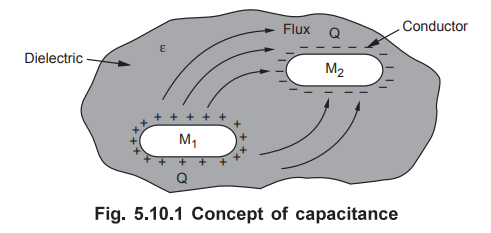
• Consider two conducting materials M1 and M2 which are placed in a dielectric medium having permittivity Ɛ. The material M1 carries a positive charge Q while the material M2 carries a negative charge, equal in magnitude as Q.
Concept of Capacitance
• Consider two conducting materials M1 and M2 which are placed in a dielectric medium having permittivity Ɛ. The material M1 carries a positive charge Q while the material M2 carries a negative charge, equal in magnitude as Q. There are no other charges present and total charge of the system is zero. In conductors, charge cannot reside within the conductor and it resides only on the surface. Thus for Mi and M2, charges + Q and - Q reside on the surfaces of M- and M2 respectively. This is shown in the Fig. 5.10.1.
• Such a system which has two conducting
surfaces carrying equal and opposite charges, separated by a dielectric is
called capacitive system giving rise to a capacitance.
•
The property of a capacitor to store an electrical energy in the form of static
charges is called its capacitance.
•
The electric field is normal to the conductor surface and the electric flux is
directed from M- towards M2 in such a system. There exists a potential
difference between the two surfaces of M- and M2. Let this potential is V^. The
ratio of the magnitudes of the total charge on any one of the two conductors
and potential difference between the conductors is called the capacitance of
the two conductor system denoted as C.
C
= Q / V12
In
general, C = Q / V
where Q = Charge in coulombs
V
= Potential difference in volts
The
capacitance is measured in farads (F) and
1
farad = 1 Coulomb / 1 volt
•
As charge Q resides only on the surface of the conductor, it can be obtained
from the Gauss's law as,

•
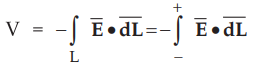
While V is the work done in moving unit positive charge from negative to the
positive surface and can be obtained as,
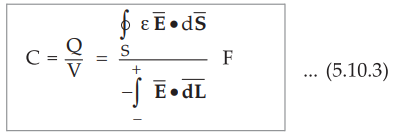
Hence
capacitance can be expressed as,
•
If the charge Q is increased, then  get increased by same factor.
The voltage V also increases by same factor. Thus the ratio Q to V remains
constant as C. Hence capacitance is not the function of charge, field
intensity, flux density and potential difference.
get increased by same factor.
The voltage V also increases by same factor. Thus the ratio Q to V remains
constant as C. Hence capacitance is not the function of charge, field
intensity, flux density and potential difference.
Key
Point : The capacitance depends on the physical dimensions
of the system and the properties of the dielectric such as permittivity of the
dielectric.
Review Question
1. Explain the capacitance and derive its basic expression.
2. Define capacitance.
Electromagnetic Theory: Unit II: (b) Conductors, Dielectrics and Capacitance : Tag: : - Concept of Capacitance
Related Topics
Related Subjects

Electromagnetic Theory
EE3301 3rd Semester EEE Dept | 2021 Regulation | 3rd Semester EEE Dept 2021 Regulation