Electrical Machines II: UNIT I: c. Synchronization and Parallel Operation of Alternators
Determination of Xd and Xq using Slip Test
Alternators
The method used to determine Xd and Xq, the direct and quadrature axis reactances is called slip test.
Determination of Xd and Xq using Slip Test
The
method used to determine Xd and Xq, the direct and
quadrature axis reactances is called slip test.
In
an alternator we apply excitation to the field winding and voltage gets induced
in the armature. But in the slip test, a three phase supply is applied to the
armature, having voltage much less than the rated voltage while n the field
winding circuit is kept open. The circuit diagram is shown in the Fig. 3.11.1.

The
alternator is run at a speed close to synchronous but little less than
synchronous value.
The
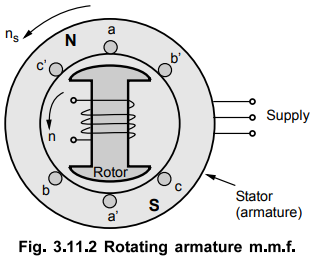
three phase currents drawn by the armature from a three phase supply produce a
rotating flux. Thus the armature m.m.f. wave is rotating at synchronous speed
as shown in the Fig. 3.11.2.
Note
that the armature is stationary, but the flux and hence m.m.f. wave produced by
three phase armature currents is rotating. This is similar to the rotating
magnetic field existing in an induction motor.
The
rotor is made to rotate at a speed little less than the synchronous speed. Thus
armature m.m.f. having synchronous speed, moves slowly past the field poles at
a slip speed (ng - n) where n is actual speed of rotor. This causes
an e.m.f. to be induced in the field circuit.
When
the stator m.m.f. is aligned with the d-axis of field poles then flux (d per
pole is set up and the effective reactance offered by the alternator is Xd.
When
the stator m.m.f. is aligned with the q-axis of field poles then flux ( per
pole is set up and the effective reactance offered by the alternator is Xq.
As
the air gap is nonuniform, the reactance offered also varies and hence current
drawn by the armature also varies cyclically at twice the slip frequency.
The
r.m.s. current is minimum when machine reactance is Xd and it is
maximum when machine reactance is Xq. As the reactance offered
varies due to nonuniform air gap, the voltage drops also varies cyclically.
Hence the impedance of the alternator also varies cyclically. The terminal
voltage also varies cyclically. The voltage at terminals is maximum when
current and various drops are minimum while voltage at terminals is minimum
when current and various drops are maximum.
The
waveforms of voltage induced in rotor, terminal voltage and current drawn by
armature are shown in the Fig. 3.11.3.
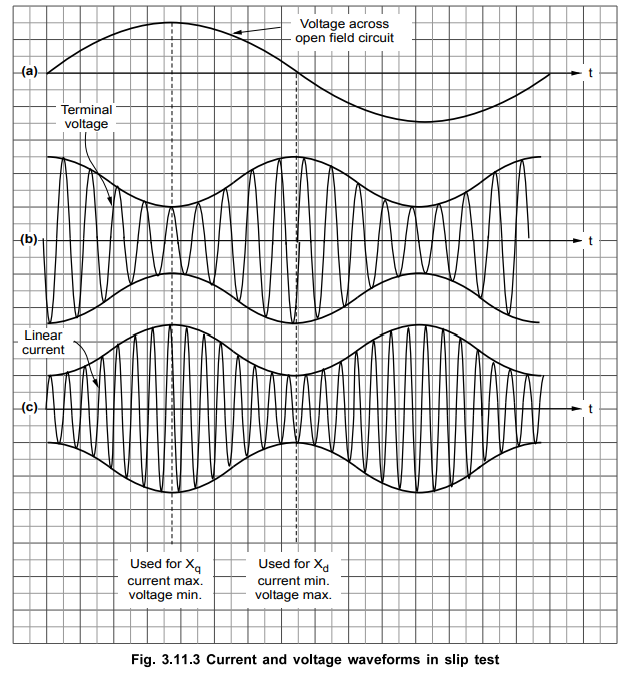
It can be observed that when rotor field is
aligned with the armature its flux
linkages
are maximum, but the rate of change of flux is zero. Hence voltage induced in
field goes through zero at this instant. This is the position where alternator
offers reactance Xd. While when rate of change of flux associated
with rotor is maximum, voltage induced in field goes through its maximum. This
is the position where alternator offers reactance Xq.
The
reactances can be calculated as,

Example
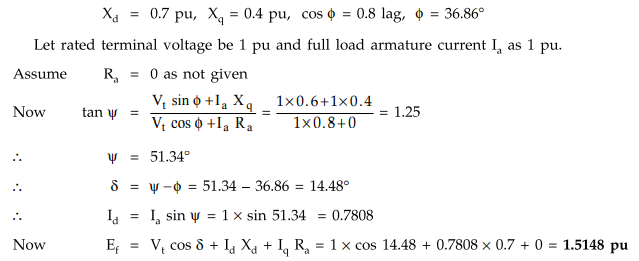
3.11.1 An alternator has a direct axis synchronous
reactance of 0.7 per unit and a quadrature axis synchronous reactance of 0.4
per unit. It is used to supply full load at rated voltage at 0.8 pf. Find the
total induced e.m.f. on open circuit.
Solution
:
The given values are,
Example
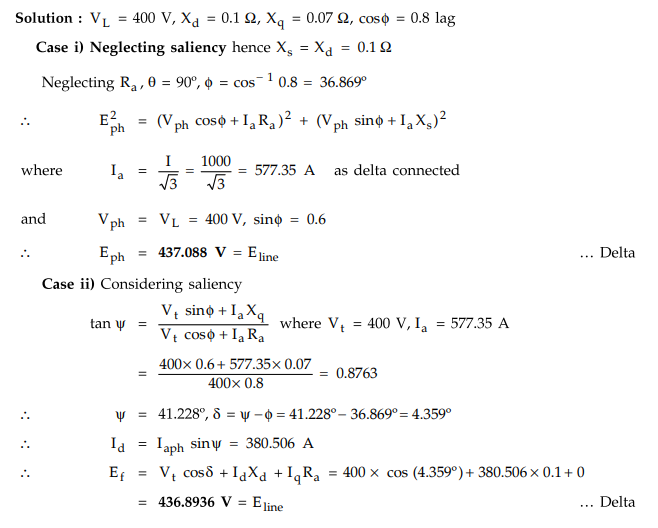
3.11.2. A 400 V, 50 Hz delta connected alternator has a
direct axis reactance of 0.1 Q and a quadrature axis reactance of 0.07 Q per
phase. The armature resistance is negligible. The alternator is supplying 1000
A at 0.8 pf. lagging pf. i) Find the excitation emf neglecting saliency and
assuming Xs = Xd; ii) Find the excitation e.m.f. taking
into account the saliency.
Solution
:
Example
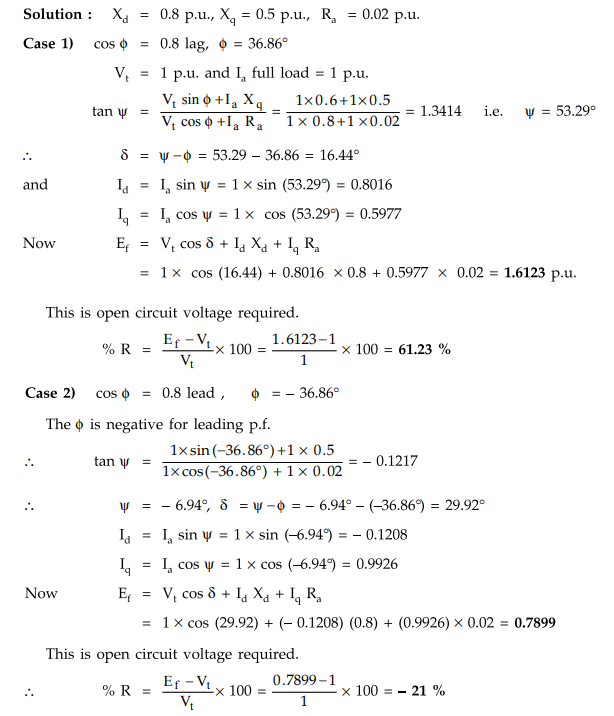
3.11.3. A salient pole alternator has direct axis and
quadrature axis reactances of 0.8 p.u. and 0.5 p.u. respectively. The effective
resistance is 0.02 p.u. Compute percentage regulation when the generator is
delivering rated load at 0.8 pf. lag and lead. Assume rated voltage and rated
current as one per unit.
Example
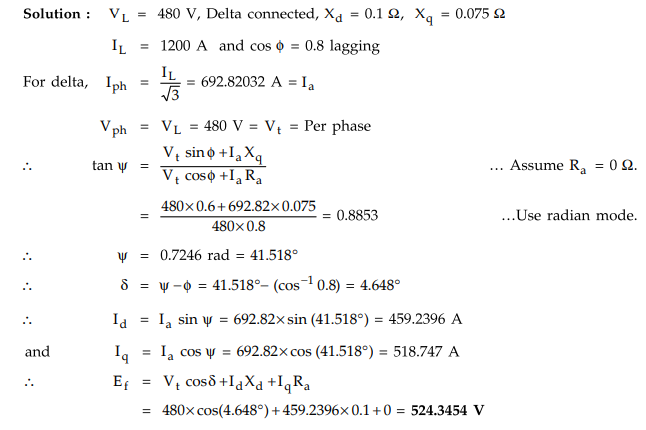
3.11.4. A 50 Hz, 3-phase, 480 V, delta connected salient
pole synchronous generator has Xd = 0.1 ohm and Xq =
0.075 ohm. The generator is supplying 1200 A at 0.8 p.f. lagging. Find the
excitation e.m.f. Neglect armature resistance.
Solution
:
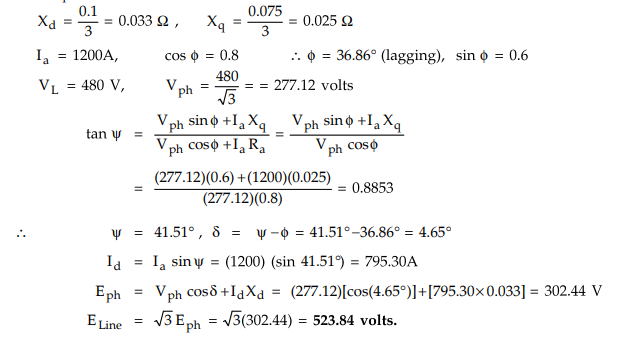
Alternate
solution :
The
problem can also be solved on equivalent star basis. So converting values of Xd
and Xq from delta into star.
Example
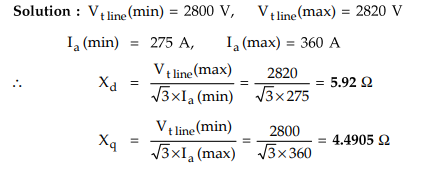
3.11.5. A 3-phase star-connected salient pole
synchronous generator is driven at a speed near synchronous with the field
circuit open and the stator is supplied from a balanced 3-phase supply.
Voltmeter connected across the line gave minimum and maximum readings of 2800
volts and 2820 volts. The line current fluctuated between 360 A and 275 A. Find
the direct and quadrature-axis reactances per phase. Neglect armature
resistance.
Solution
:
Examples
for Practice
Example
3.11.6 A 230 V, 3 phase, 5 kVA star connected salient
pole alternator with Xd = 12 Ω and = 7 V delivers full load current at unity
power factor. Calculate the excitation voltage neglecting resistance.
[Ans.:
Ef = 193.842 V]
Example
3.11.7 A synchronous generator has a direct axis
synchronous reactance of 0.8 per unit and a quadrature axis synchronous
reactance of 0.5 per unit. It is supplying full load at rated voltage at 0.8
p.f. lagging. Find the open circuit voltage.
[Ans.:
Ef = 1.602 pu]
Example
3.11.8 A 3 phase star connected synchronous generator
supplies current of 10 A having phase angle of 20° lagging at 400 V. Find the
load angle and components of armature current Ia and Iq
if Xd = 10 Ω and Xq = 6,5 Ω.
Assume armature resistance to be negligible.
[Ans.:
8.23o, Id = 4.7301 A, Iq = 8.8105 A]
Example
3.11.9 Two identical round rotor alternators supply
inductive load of 1.414 p.u. at 0.707 p.f. lagging and at rated voltage p.u.
synchronous reactance of each is 0.6. Find e.m.f. and power angle. State
assumptions made.
[Ans.:
0.8573 p.u., 16.58 °]
Review Question
1. Explain the determination of direct and quadrature axis
synchronous reactance using the slip test. AU
: May-06, 11, 13, 14, Dec.-ll, 17 Marks 8
Electrical Machines II: UNIT I: c. Synchronization and Parallel Operation of Alternators : Tag: Engineering Electrical Machines - II : Alternators - Determination of Xd and Xq using Slip Test
Related Topics
Related Subjects
Electrical Machines II
EE3405 Machine 2 EM 2 4th Semester EEE Dept | 2021 Regulation | 4th Semester EEE Dept 2021 Regulation