Electrical Machines II: UNIT I: c. Synchronization and Parallel Operation of Alternators
Effect of Change in Excitation
Alternator on No Load
Let us consider the effect of change in excitation on alternator with and without load.
Effect of Change in Excitation
In
case of alternators a field rheostat may be used to change the excitation or
its field current. If alternators are running in parallel, a change in the
field current will not change the active power shared significantly but will
change the operating power factor. With change in the excitation the armature
current will change which will change the active power by a small amount. Let
us consider the effect of change in excitation on alternator with and without
load.
1. Alternator on No Load
Consider
two alternators on no load and working in parallel. If their excitations are
adjusted properly then the e.m.f.s E1, and E2 will be
equal. Thus there will not be any current in local circuit.
Now
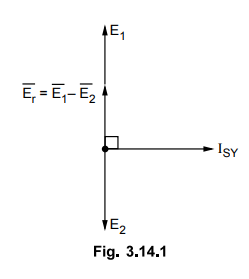
say excitation of alternator 1 is increased then magnitude of E1
will be more than that of E2. This will cause resultant voltage  that will appear in the local circuit. This can be shown in the phasor diagram
shown in the Fig. 3.14.1.
that will appear in the local circuit. This can be shown in the phasor diagram
shown in the Fig. 3.14.1.
This
resulting voltage will set up a synchronizing current ISY in the
local circuit and since the synchronizing impedances are mainly reactive, this
current lags Er by approximately 90°.
For
alternator 1, I SY lags behind E1 by 90°. This lagging current will
produce demagnetizing effect and will try to reduce the generated e.m.f. Alternately
for other alternator, I SY leads E2 by 90°. There will be
leading current which will produce magnetizing effect and the field will be
strengthened which will try to increase the generated e.m.f. Thus E1
will be reduced whereas E2 will be increased. Hence the circulating
current will try to make the two generated e.m.f.s equal at no load whereas the
power angle δ will remain at zero degrees.
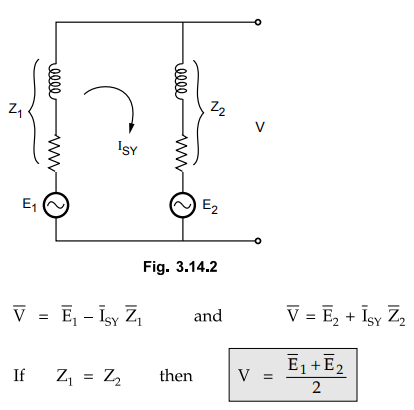
From
the Fig. 3.14.2.
Electrical Machines II: UNIT I: c. Synchronization and Parallel Operation of Alternators : Tag: Engineering Electrical Machines - II : Alternator on No Load - Effect of Change in Excitation
Electrical Machines II: UNIT I: c. Synchronization and Parallel Operation of Alternators
Under Subject
Electrical Machines II
EE3405 Machine 2 EM 2 4th Semester EEE Dept | 2021 Regulation | 4th Semester EEE Dept 2021 Regulation
Related Subjects

Environmental Sciences and Sustainability
GE3451 ESS 4th Semester | 2021 Regulation | 4th Semester EEE Dept 2021 Regulation
Transmission and Distribution
EE3401 TD 4th Semester EEE Dept | 2021 Regulation | 4th Semester EEE Dept 2021 Regulation
Linear Integrated Circuits
EE3402 Lic Operational Amplifiers 4th Semester EEE Dept | 2021 Regulation | 4th Semester EEE Dept 2021 Regulation

Measurements and Instrumentation
EE3403 MI 4th Semester EEE Dept | 2021 Regulation | 4th Semester EEE Dept 2021 Regulation

Microprocessor and Microcontroller
EE3404 MCU 4th Semester EEE Dept | 2021 Regulation | 4th Semester EEE Dept 2021 Regulation
Electrical Machines II
EE3405 Machine 2 EM 2 4th Semester EEE Dept | 2021 Regulation | 4th Semester EEE Dept 2021 Regulation