Electromagnetic Theory: Unit II: (b) Conductors, Dielectrics and Capacitance
Energy Stored in a Capacitor
Energy Density | Solved Example Problems
• It is seen that capacitor can store the energy. Let us fin d the expression for the energy stored in a capacitor.
Energy Stored in a Capacitor
AU
: May-96, 04, 05, 06, 08,13, Dec.-03, 14, 17, 18
•
It is seen that capacitor can store the energy. Let us fin d the expression for
the energy stored in a capacitor.
•
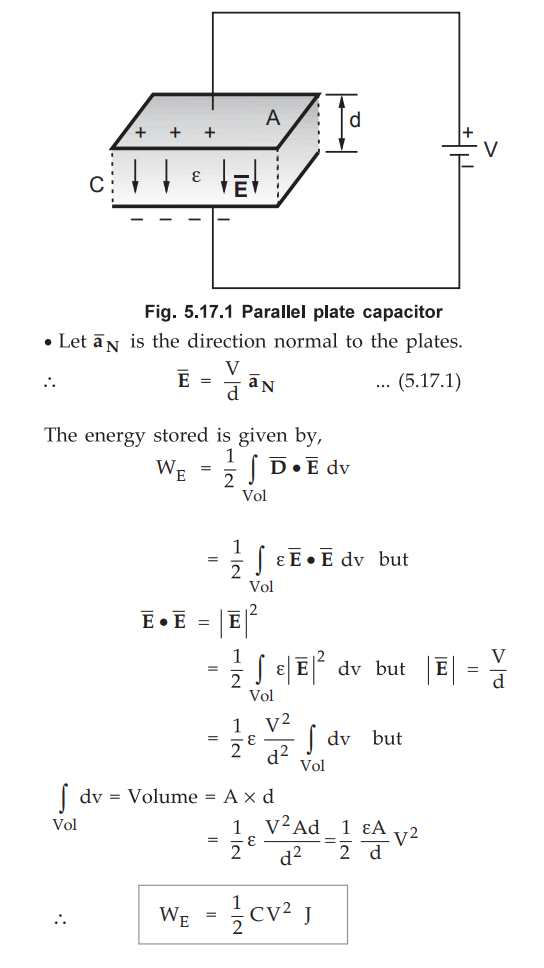
Consider a parallel plate capacitor as shown in the Fig. 5.17.1. It is supplied
with the voltage V.
•
If the dielectric is free space then there is increase in the stored energy if
free space is replaced by other dielectric having Ɛr >
1 .
1. Energy Density
•
As seen in earlier chapter, energy density is the energy stored per unit volume
as volume tends to zero.

Ex.
5.17.1 Let A = 120 cm2, d = 5 mm and ƐR = 12 for a
parallel plate capacitor -
a)
Calculate the capacitance.
b)
After connecting a 40 V battery across the capacitor, calculate E, D, Q and the
total stored energy.
c)
The source is now removed and the dielectric is carefully withdrawn from
between the plates. Again calculate E, D, Q and the energy.
d)
What is voltage between the plates ?

c)
Though source and dielectric is removed, Q on the surface remains same.
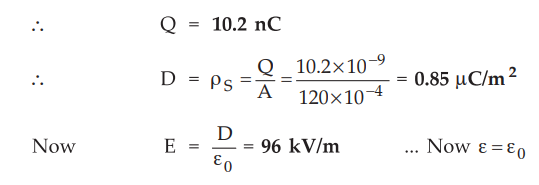
and
as V is now not same across the plates, calculate WE as,
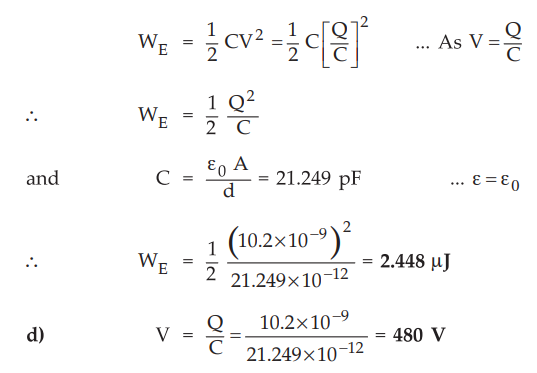
Ex.
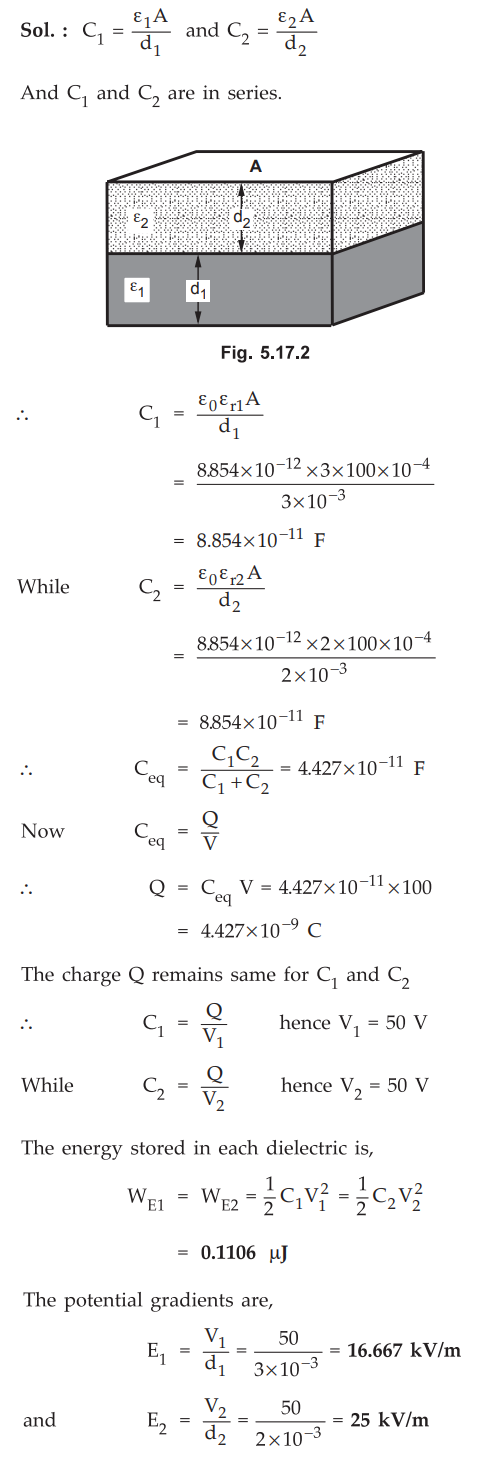
5.17.2 A capacitor with two dielectrics is as follows : Plate area 100 cm ,
Dielectric 1 thickness = 3 mm, Ɛr1 = 3, Dielectric 2 thickness = 2
mm, Ɛr2 = 2. If a potential of 100 V is applied across the plates
find the energy stored in each dielectric and potential gradient in each
dielectric.
AU
: May-96, 04, Marks 10
Sol.
:
Ex.
5.17.3 A 4 mF capacitor is charged by connecting it across 100 V/d.c. The
supply is disconnected and another uncharged 2 mF capacitor is connected across
it. If leakage charge is negligible, determine the potential between the
plates.
AU
: May-05, Marks 6
Sol.
:
The arrangement is shown in the Fig. 5.17.3.
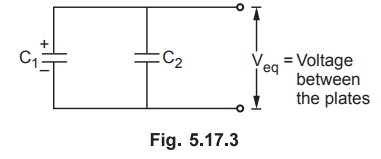
Initially
when Ci is charged to 100 V d.c., the energy stored is,

This
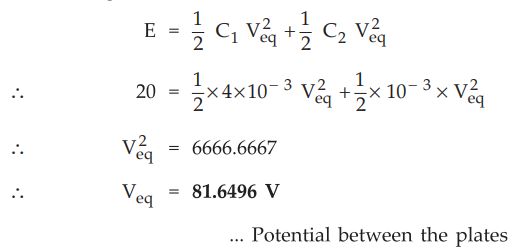
energy must remain same while voltage across the two must be same as Veq.
So total energy in the new arrangement is,
Ex.
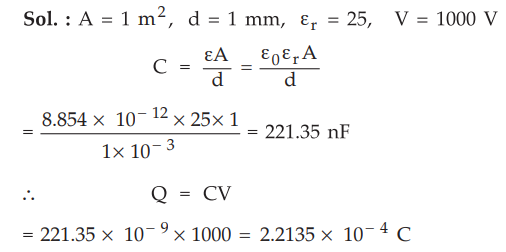
5.17.4 Parallel plate capacitor is of area 1 m2 and has a separation of 1 mm.
The space between the plates is filled with dielectric of Ɛr = 25. If 1000 V is
applied, find the force squeezing the plates together.
AU
: May-08, Marks 6
Sol.
:
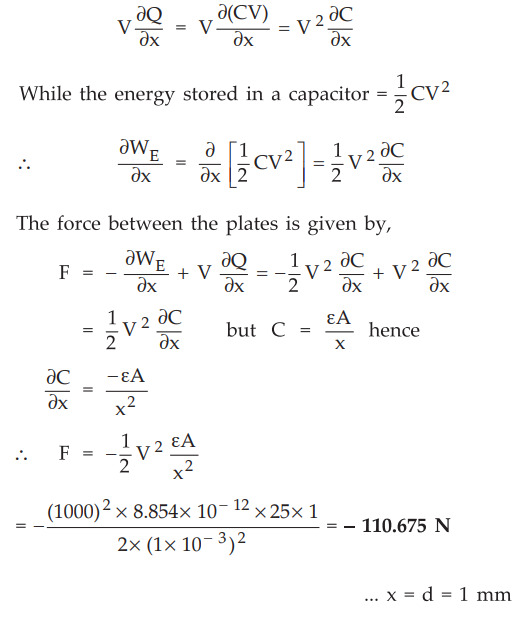
For
the plate separation 'x', the capacitor is C = ƐA / x
For the fixed voltage V across the plates,
Ex. 5.17.5 Find the value of capacitance of a capacitor consisting of two parallel metal plates 30 cm × 30 cm surface area, separated by 5 mm in air. What is the total energy stored by the capacitor if the capacitor is charged to a potential differnece of 1000 V ? What is the energy density ?
AU
: May-13, Marks 8
Sol.
:
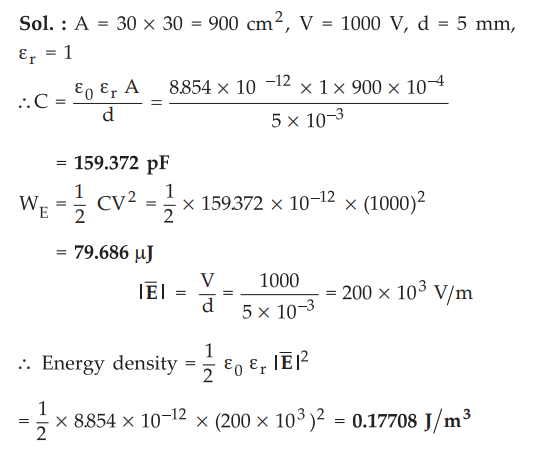
Ex.
5.17.6 A capacitor consists of two parallel metal plates 30 cm × 30 cm surface
area, separated by 5 mm in air. Determine its capacitance. Find the total energy
stored by the capacitor and the energy density if the capacitor is charged to a
potential difference of 500 V ?
AU
: Dec.-14, Marks 8
Sol.
: Refer Example 5.17.5 for the procedure and verify the answer as :
C
= 159.372 pF, WE = 19.9215 µJ
Energy
density = 0.04427 J/m3
Examples
for Practice
Ex.
5.17.7 A parallel plate capacitor of width 'W
separation of plates 'd' and length 'L' is partially filled with a dielectric
slab of permittivity Ɛr. Prove that the force acting on the dielectric is, 
Ex.
5.17.8 A 2 pF capacitor is charged by
connecting it across a 100 V d.c. supply. It is now disconnected and then it is
connected across another 2µF capacitor. Assuming no leakage, determine the p.d.
between the plates of each capacitor and energy stored.
[Ans.:
70.7106 V]
Ex.
5.17.9 A pair of 200 mm long concentric
cylindrical conductors of radii 50 mm and 100 mm, is filled with a dielectric
with Ɛ = 10 Ɛ0. A voltage is applied between the conductors which establishes  Calculate :
a)
Capacitance b) Voltage applied c) Energy stored.
[Ans.:
a) 160.518 pi, b) 693.1471 kV, c) 38.5606 J]
Ex.
5.17.10 An air capacitor consists of a parallel square
plates of 50 cm side and is charged to a potential difference of 250 V, when
plates are 1 mm apart. Find the work done in seperating the plates from 1 to 3
mm. Assume perfect insulation.
[Ans.:
138.34 µJ]
Review Questions
1. Prove that the energy required to charge a capacitor C by a
voltage V is W = 1/2 CV2
AU : Dec.-03,18, May-06, Marks 8
2. Derive the energy density of capacitance.
AU : Dec.-17, Marks 7
Electromagnetic Theory: Unit II: (b) Conductors, Dielectrics and Capacitance : Tag: : Energy Density | Solved Example Problems - Energy Stored in a Capacitor
Related Topics
Related Subjects

Electromagnetic Theory
EE3301 3rd Semester EEE Dept | 2021 Regulation | 3rd Semester EEE Dept 2021 Regulation