Transmission and Distribution: Unit V: (a) Distribution Systems
Introduction to Distribution Systems
General Aspects of a Good Distribution System
Question : 1. What are the requirements of a good distributed system ?
Introduction to
Distribution Systems
It is well known that the electrical
power is now a days generated in a.c. form. It is transmitted and distributed
with the help of transformers, transmission lines, feeders, distributors and
service mains. The transformers are used to step up and step down the voltage
levels as per the requirement at various service stages. The lines which
transmit an mains electrical power from the generating station to the different
substations are feeders. There are no tappings on feeders. The electrical power
is distributed from the substations with the help of distributors. The
distributors can have number of tappings. The small cables which are used to
supply consumer from the distributor are called service mains. The Fig. 7.4.1
shows a general distribution scheme showing feeders, distributors and service
mains.
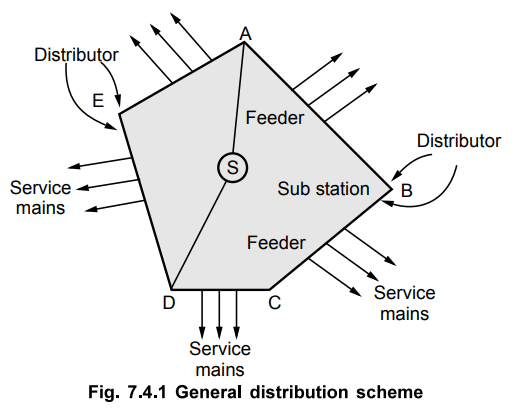
The feeders are lines of large current
carrying capacity. These are feeding to the substation. The size of the feeder
is determined by the required current carrying capacity of the feeder. The
voltage drop along the feeder is compensated by compounding the generators.
The distributors allow the tappings. The
Fig. 7.4.1 shows the distributors AB, BC, DC, DE and EA. The voltage drop along
the distributors is the main criterion to design the distributors.
1. General Aspects of a Good Distribution System
The necessary requirements of a good
distribution system are,
1. The continuity in the power supply
must be ensured. Thus system should be reliable.
2. The specified consumer voltage must
not vary more than the prescribed limits. As per Indian Electricity Rules, the
variation must not be beyond ± 5 % of the specified voltage.
3. The efficiency of the lines must be
as high as possible.
4. The system should be safe from
consumer point of view. There should not be leakage.
5. The lines should not be overloaded.
6. The layout should not affect the
appearance of the site or locality.
7. The system should be economical.
Though the a.c. transmission and distribution
is used, still for certain applications such as d.c. motors, electro-chemical
work, batteries, electric traction etc. the d.c. supply is must. Hence along
with a.c., d.c. distribution is also equally important. In a d.c. distribution,
d.c. generators are used in the generating stations or a.c. is converted to
d.c. using the converters like mercury arc rectifiers, rotary converters etc.
at the substations. Then the d.c. supply is distributed to the consumers as per
the requirement.
In this chapter both d.c. as well as
a.c. distribution systems are discussed in detail.
Review Question
1. What are the requirements of a good distributed system ?
Transmission and Distribution: Unit V: (a) Distribution Systems : Tag: : General Aspects of a Good Distribution System - Introduction to Distribution Systems
Transmission and Distribution: Unit V: (a) Distribution Systems
Under Subject
Transmission and Distribution
EE3401 TD 4th Semester EEE Dept | 2021 Regulation | 4th Semester EEE Dept 2021 Regulation
Transmission and Distribution
EE25401 4th Semester EEE Department | 2025 Regulation | 4th Semester 2025 Regulation
Related Subjects
Environmental Sciences and Sustainability
GE3451 ESS 4th Semester | 2021 Regulation | 4th Semester EEE Dept 2021 Regulation
Transmission and Distribution
EE3401 TD 4th Semester EEE Dept | 2021 Regulation | 4th Semester EEE Dept 2021 Regulation
Linear Integrated Circuits
EE3402 Lic Operational Amplifiers 4th Semester EEE Dept | 2021 Regulation | 4th Semester EEE Dept 2021 Regulation
Measurements and Instrumentation
EE3403 MI 4th Semester EEE Dept | 2021 Regulation | 4th Semester EEE Dept 2021 Regulation
Microprocessor and Microcontroller
EE3404 MCU 4th Semester EEE Dept | 2021 Regulation | 4th Semester EEE Dept 2021 Regulation
Electrical Machines II
EE3405 Machine 2 EM 2 4th Semester EEE Dept | 2021 Regulation | 4th Semester EEE Dept 2021 Regulation