Engineering Chemistry: Unit IV: a. Fuels
Leaded Petrol (Anti-Knock Agent)
Meaning, Mechanism, Disadvantages
The anti-knock properties of a gasoline can be improved by the addition of suitable additives.
LEADED PETROL (ANTI-KNOCK AGENT)
The anti-knock properties of a gasoline can be improved by the
addition of suitable additives. Tetra Ethyl Lead (TEL) (C2H5)4
Pb is an important additive added to petrol. Thus the petrol containing tetra
ethyl lead is called leaded petrol.
Mechanism of knocking
TEL reduces the knocking tendency of hydrocarbon. Knocking follows
a free radical mechanism, leading to a chain growth which results in an
explosion. If the chains are terminated before their growth, knocking will
cease. TEL decomposes thermally to form ethyl free radicals which combine with
the growing free radicals of knocking process and thus the chain growth is
stopped.
Disadvantages of using TEL
When the leaded petrol is used as a fuel, the TEL is converted to
lead oxide and metallic lead. This lead deposits on the spark plug and on
cylinder walls which is harmful to engine life. To avoid this, small amount of
ethylene dibromide is added along with TEL. This ethylene dibromide reacts with
Pb and PbO to give volatile lead bromide, which goes out along with exhaust
gases.
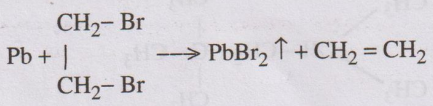
But this creates atmospheric pollution. So now a days aromatic
phosphates are used instead of TEL.
Engineering Chemistry: Unit IV: a. Fuels : Tag: Engineering Chemistry : Meaning, Mechanism, Disadvantages - Leaded Petrol (Anti-Knock Agent)
Engineering Chemistry: Unit IV: a. Fuels
Under Subject
Engineering Chemistry
CY3151 1st Semester | 2021 Regulation | 1st Semester Common to all Dept 2021 Regulation
Related Subjects
Professional English I
HS3151 1st semester | 2021 Regulation | 1st Semester Common to all Dept 2021 Regulation
Matrices and Calculus
MA3151 1st semester | 2021 Regulation | 1st Semester Common to all Dept 2021 Regulation
Engineering Physics
PH3151 1st semester | 2021 Regulation | 1st Semester Common to all Dept 2021 Regulation
Engineering Chemistry
CY3151 1st Semester | 2021 Regulation | 1st Semester Common to all Dept 2021 Regulation
Problem Solving and Python Programming
GE3151 1st Semester | 2021 Regulation | 1st Semester Common to all Dept 2021 Regulation
Physics and Chemistry Laboratory
BS3171 Practical Experiment 2021 Regulation | 1st Semester Common to all Dept 2021 Regulation