Basic Civil & Mechanical Engineering: UNIT III: f. Beams, columns and lintels
Lintels
Functions, Classification, Effective Load
Width of the lintel is equal to the width of the wall.
LINTELS
Lintel:
Lintel is a short beam with its ends built into a wall. It is a horizontal
structural member placed over small openings of the wall for door, window,
ventilator, cupboard, etc.
Note:
Width of the lintel is equal to the width of the wall.
Bearing
of the lintel provided on the supporting wall is equal to the height of the
lintel.
Functions:
Lintel carries the weight or load of the masonry wall constructed above it.
transmits the same to the supporting walls on its either side.
1. CLASSIFICATION OF LINTELS
1. Timber Lintel: It is made of hard wood like Teak. It is embedded into the masonry wall at its ends. These lintels are poor in strength, non-fire resistant and liable to be attacked by white ants. Cost of timber is also high. Therefore, these lintels are not used.
2.
Stone Lintel: It consists of chisel-dressed stone
slabs either a single piece or more than a piece. It is not suitable for large
spans, since it is very heavy. It is used in stone masonry structures such as
temple, etc.
3.
Brick Lintels (Fig. 1) ,
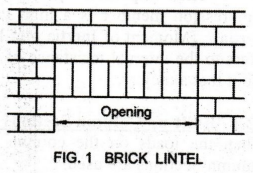
Brick
Lintels consist of bricks placed on end or on edge. Brick lintels are weak in
strength. Hence, they can be used for light loads and for small openings or spans
of up to 1 meter only.
4.
Steel Lintels (Fig. 2)
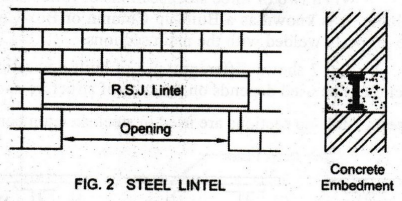
Steel
Lintels use Rolled Steel Joists or Channel Şections. Steel lintels are used for
large openings and heavy loads.
Rolled
steel joists are embedded in concrete to (i) increase its width to match with
the width of the wall and (ii) protect from rust and corrosion.
5.
Reinforced Cement Concrete Lintels (R.C.C. Lintels)
Advantages:
R.C.C. Lintels are highly durable, strong, rigid, easy to form and fire-proof.
These are economical and simple in construction.
Uses:
R.C.C. Lintels are used for any span length of openings and for carrying any
load. These are commonly used now-a-days, replacing practically all other
materials for lintel.
(i)
R.C.C. Lintel over Interior Door Opening
Fig.
3 shows a lintel provided over the door opening in an Interior Wall. The lintel
is designed as a small rectangular beam, resting on masonry wall at its ends.
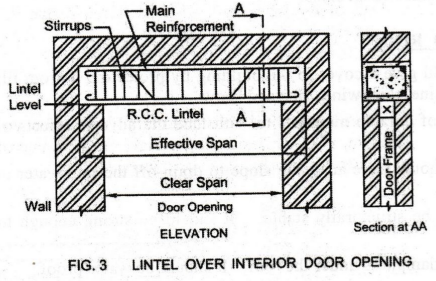
R.C.C.
Lintels may be Pre-cast or Cast-in-situ. Pre-cast R.C.C. Lintels are used for
small spans up to 2 m only. But, R.C.C. lintels are generally cast-in-situ. For
Cast-in-situ lintel, a centering is erected, reinforcement of rectangular or
square cross-section is placed and concreting 1:2 : 4 is done, compacted and
cured.
(ii)
R.C.C. Lintel over Exterior Window Opening
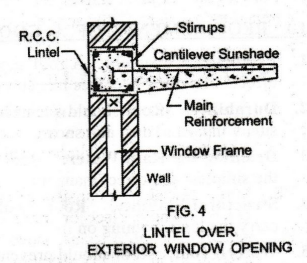
Fig.
4 shows a lintel provided over a window opening in an Exterior Wall. R.C.C.
lintels for outer doors and windows have overhanging projections. These
projections are called Sunshades. Sunshades protect the doors and windows from
sun and rain.
2. EFFECTIVE LOAD ON LINTEL
Fig.
5 shows Effective Load coming on a lintel.
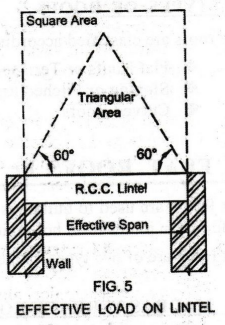
When
Lintel is placed in the Middle of Wall Assume that when a lintel is placed in
the middle of a wall, then the load on the lintel is distributed uniformly over
its effective span for a height equal to half the effective span.
The
lintel is designed to take the load of the wall in a triangular portion. The
base of the triangle is equal to the Effective Span of the lintel. The included
angle of the triangle is 60°.
When
Lintel is placed near the End of the Wall
When
the lintel is placed near the end of a wall, it is designed to support the load
of the wall in the square area as shown. In this, the side of the square is
equal to the effective span of the lintel.
Basic Civil & Mechanical Engineering: UNIT III: f. Beams, columns and lintels : Tag: : Functions, Classification, Effective Load - Lintels
Basic Civil & Mechanical Engineering: UNIT III: f. Beams, columns and lintels
Under Subject
Basic Civil and Mechanical Engineering
BE3255 2nd Semester 2021 Regulation | 2nd Semester EEE Dept 2021 Regulation
Introduction to Civil Engineering
CE25C01 1st Semester Civil, Agri Departments | 2025 Regulation | 1st Semester 2025 Regulation
Basic Civil and Mechanical Engineering
GE25C01 2nd Semester EEE Dept | 2025 Regulation | 2nd Semester 2025 Regulation
Related Subjects
Professional English II
HS3251 2nd Semester 2021 Regulation | 2nd Semester Common to all Dept 2021 Regulation
Statistics and Numerical Methods
MA3251 2nd Semester 2021 Regulation M2 Engineering Mathematics 2 | 2nd Semester Common to all Dept 2021 Regulation
Engineering Graphics
GE3251 eg 2nd semester | 2021 Regulation | 2nd Semester Common to all Dept 2021 Regulation

Physics for Electrical Engineering
PH3202 2nd Semester 2021 Regulation | 2nd Semester EEE Dept 2021 Regulation
Basic Civil and Mechanical Engineering
BE3255 2nd Semester 2021 Regulation | 2nd Semester EEE Dept 2021 Regulation
Electric Circuit Analysis
EE3251 2nd Semester 2021 Regulation | 2nd Semester EEE Dept 2021 Regulation

Physics for Electronics Engineering
PH3254 - Physics II - 2nd Semester - ECE Department - 2021 Regulation | 2nd Semester ECE Dept 2021 Regulation

Electrical and Instrumentation Engineering
BE3254 - 2nd Semester - ECE Dept - 2021 Regulation | 2nd Semester ECE Dept 2021 Regulation
Circuit Analysis
EC3251 - 2nd Semester - ECE Dept - 2021 Regulation | 2nd Semester ECE Dept 2021 Regulation

Materials Science
PH3251 2nd semester Mechanical Dept | 2021 Regulation | 2nd Semester Mechanical Dept 2021 Regulation

Basic Electrical and Electronics Engineering
BE3251 2nd semester Mechanical Dept | 2021 Regulation | 2nd Semester Mechanical Dept 2021 Regulation
Physics for Civil Engineering
PH3201 2021 Regulation | 2nd Semester Civil Dept 2021 Regulation

Basic Electrical, Electronics and Instrumentation Engineering
BE3252 2021 Regulation | 2nd Semester Civil Dept 2021 Regulation

Physics for Information Science
PH3256 2nd Semester CSE Dept | 2021 Regulation | 2nd Semester CSE Dept 2021 Regulation

Basic Electrical and Electronics Engineering
BE3251 2nd Semester CSE Dept 2021 | Regulation | 2nd Semester CSE Dept 2021 Regulation
Programming in C
CS3251 2nd Semester CSE Dept 2021 | Regulation | 2nd Semester CSE Dept 2021 Regulation