Professional English: Speaking: UNIT 4
Presenting an oral report
Speaking | Professional English
This article condenses an excellent list of rules for making a good oral presentation.
6. PRESENTING AN ORAL REPORT
Ten Simple Rules for Making Good Oral Presentations
This
article condenses an excellent list of rules for making a good oral
presentation.
1. Talk to the Audience
Know
your audience - Speak to the right audience. Know their backgrounds and
knowledge level of the material you are presenting and what they are hoping to
get out of the presentation. Deliver what the audience wants to hear. Deliver
relevant details. It should not be boring and the content should not be well-known.
Deliver something innovative. Deliver your content slowly, steadily and without
confusing others.
2. Be knowledgeable
Your
knowledge of the subject is best expressed through a clear and concise
presentation. There will be question and-answer session when the audience
becomes active participants. At that point, your knowledge of the material will
likely become clear. Hence be prepared.
3. Talk Only When You Have Something to Say
Remember
the audience's time is precious and should not be wasted by presentation of
uninteresting preliminary material.
4. Make the Take-Home Message Persistent
If
audience remembers three key points which you wanted the audience to remember
even after a week, then your oral presentation is right. If the audience remembers
other points but not the key points, then deliverance has gone wrong in some
way.
5. Be Logical
Think
of the presentation as a story. There is a logical flow-a clear beginning,
middle, and an end. You set the stage (beginning), you tell the story (middle),
and you have a big finish (the end) where the take-home message is clearly
understood.
6. Treat the Floor as a Stage
Presentations
should be entertaining, but do not overdo it and know your limits. If you are
humorous by nature, your presentation will be fun. If you are not humorous by
nature, do not try and be humorous. If you are good at telling anecdotes, try.
If you are not good at telling anecdotes, do not try and tell anecdotes, and so
on. A good entertainer will captivate the audience.
7. Practice and Time Your Presentation
The
more you practice, the better you perform. An important talk should not be
given for the first time to an audience of peers. You should have delivered it
to your research collaborators who will be kinder and gentler but still point
out obvious discrepancies. Even more important, when you give the presentation,
stick to what you practice.
8. Use Visuals Sparingly but Effectively
If
you have more than one visual for each minute you are talking, you have too
many and you will run over time. Obviously some visuals are quick, others take
time to get the message across. Avoid reading the visual unless you wish to
emphasize the point explicitly. Make the points few and clear.
9. Review Audio and/or Video of YourPresentations
There
is nothing more effective than listening to, or listening to and viewing, a
presentation you have made.
10. Provide Appropriate Acknowledgments
It
is often appropriate to acknowledge people at the beginning or at the point of
their contribution so that their contributions are very clear.
Example
Watch
the following you tube video on
Research
Paper Presentation, Sixth National IR Conference 2014
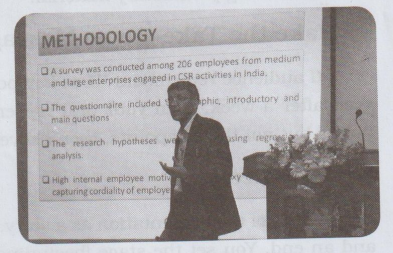
https://www.youtube.com/results?search
Exercise
Prepare
a report on the employability skills of the students and present.
Professional English: Speaking: UNIT 4 : Tag: : Speaking | Professional English - Presenting an oral report
Professional English: Speaking: UNIT 4
Under Subject
Professional English II
HS3251 2nd Semester 2021 Regulation | 2nd Semester Common to all Dept 2021 Regulation
Related Subjects
Professional English II
HS3251 2nd Semester 2021 Regulation | 2nd Semester Common to all Dept 2021 Regulation
Statistics and Numerical Methods
MA3251 2nd Semester 2021 Regulation M2 Engineering Mathematics 2 | 2nd Semester Common to all Dept 2021 Regulation
Engineering Graphics
GE3251 eg 2nd semester | 2021 Regulation | 2nd Semester Common to all Dept 2021 Regulation
Physics for Electrical Engineering
PH3202 2nd Semester 2021 Regulation | 2nd Semester EEE Dept 2021 Regulation
Basic Civil and Mechanical Engineering
BE3255 2nd Semester 2021 Regulation | 2nd Semester EEE Dept 2021 Regulation
Electric Circuit Analysis
EE3251 2nd Semester 2021 Regulation | 2nd Semester EEE Dept 2021 Regulation
Physics for Electronics Engineering
PH3254 - Physics II - 2nd Semester - ECE Department - 2021 Regulation | 2nd Semester ECE Dept 2021 Regulation
Electrical and Instrumentation Engineering
BE3254 - 2nd Semester - ECE Dept - 2021 Regulation | 2nd Semester ECE Dept 2021 Regulation
Circuit Analysis
EC3251 - 2nd Semester - ECE Dept - 2021 Regulation | 2nd Semester ECE Dept 2021 Regulation
Materials Science
PH3251 2nd semester Mechanical Dept | 2021 Regulation | 2nd Semester Mechanical Dept 2021 Regulation
Basic Electrical and Electronics Engineering
BE3251 2nd semester Mechanical Dept | 2021 Regulation | 2nd Semester Mechanical Dept 2021 Regulation
Physics for Civil Engineering
PH3201 2021 Regulation | 2nd Semester Civil Dept 2021 Regulation
Basic Electrical, Electronics and Instrumentation Engineering
BE3252 2021 Regulation | 2nd Semester Civil Dept 2021 Regulation
Physics for Information Science
PH3256 2nd Semester CSE Dept | 2021 Regulation | 2nd Semester CSE Dept 2021 Regulation
Basic Electrical and Electronics Engineering
BE3251 2nd Semester CSE Dept 2021 | Regulation | 2nd Semester CSE Dept 2021 Regulation
Programming in C
CS3251 2nd Semester CSE Dept 2021 | Regulation | 2nd Semester CSE Dept 2021 Regulation