Electrical Machines: Unit III: a. D.C. Motors
Principle of Operation of a D.C. Motor
In a practical d.c. motor, field winding produces a required magnetic field while armature conductors play a role of a current carrying conductors and hence armature conductors experience a force.
Principle
of Operation of a D.C. Motor
•
The principle of operation of a d.c. motor can be stated in a single statement
as 'when a current carrying conductor is placed in a magnetic field; it
experiences a mechanical force'. In a practical d.c. motor, field winding
produces a required magnetic field while armature conductors play a role of a
current carrying conductors and hence armature conductors experience a force.
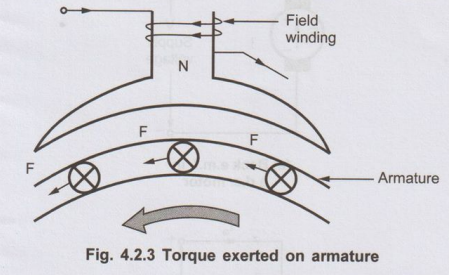
As conductors are placed in the slots which are on the periphery, the
individual force experienced by the conductors acts as a twisting or turning
force on the armature which is called a torque. The torque is the product of
force and the radius at which this force acts. So overall armature experiences
a torque and starts rotating. Let us study this motoring action in detail.
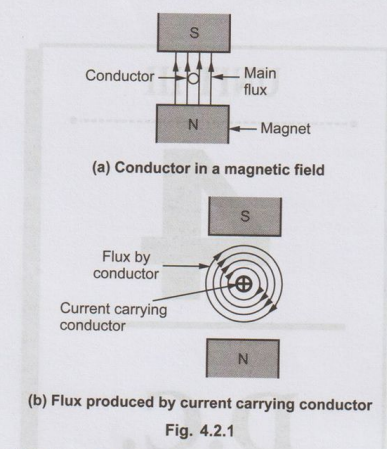
• Consider a single conductor placed in a
magnetic field as shown in the Fig. 4.2.1 (a). The magnetic field is produced
by a permanent magnet but in a practical d.c. motor it is produced by the field
winding when it carries a current.
•
Now this conductor is excited by a separate supply so that it carries a current
in a particular direction. Consider that it carries a current away from an
observer as shown in the Fig. 4.2.1 (b). Any current carrying conductor
produces its own magnetic field around it, hence this conductor also produces
its own flux, around. The direction of this flux can be determined by right
hand thumb rule. For direction of current considered, the direction of flux
around a conductor is clockwise. For simplicity of understanding, the main flux
produced by the permanent magnet is not shown in the Fig. 4.2.1 (b). Now there
are two fluxes present,
1.
The flux produced by the permanent magnet called main flux.
2.
The flux produced by the current carrying conductor.
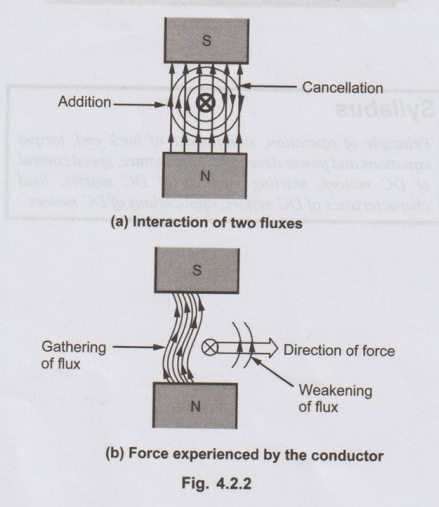
• These are shown in the Fig. 4.2.2 (a). From this, it is clear that on one side of the conductor, both the fluxes are in the same direction. In this case, on the left of the conductor there is gathering of the flux lines as two fluxes help each other. As against this, on the right of the conductor, the two fluxes are in opposite direction and hence try to cancel each other. Due to this, the density of the flux lines in this area gets weakened. So on the left, there exists high flux density area while on the right of the conductor there exists low flux density area as shown in the Fig. 4.2.2 (b).
•
This flux distribution around the conductor acts like a stretched rubber band
under tension. This exerts a mechanical force on the conductor which acts from
high flux density area towards low flux density area, i.e. from left to right
for the case considered as shown in the Fig. 4.2.2 (b).
Key Point :
In the practical d.c. motor, the permanent magnet is replaced by a field
winding which produces the required flux called main flux and all the armature
conductors, mounted on the periphery of the armature drum, get subjected to the
mechanical force. Due to this, overall armature experiences a twisting force
called torque and armature of the motor starts rotating.
Review Question
1. Explain the
working principle of a d.c. motor.
Electrical Machines: Unit III: a. D.C. Motors : Tag: : - Principle of Operation of a D.C. Motor
Electrical Machines: Unit III: a. D.C. Motors
Under Subject

Electrical Machines I
EE3303 EM 1 3rd Semester EEE Dept | 2021 Regulation | 3rd Semester EEE Dept 2021 Regulation
Related Subjects
Probability and complex function
MA3303 3rd Semester EEE Dept | 2021 Regulation | 3rd Semester EEE Dept 2021 Regulation

Electromagnetic Theory
EE3301 3rd Semester EEE Dept | 2021 Regulation | 3rd Semester EEE Dept 2021 Regulation
Digital Logic Circuits
EE3302 3rd Semester EEE Dept | 2021 Regulation | 3rd Semester EEE Dept 2021 Regulation
Electron Devices and Circuits
EC3301 3rd Semester EEE Dept | 2021 Regulation | 3rd Semester EEE Dept 2021 Regulation
Electrical Machines I
EE3303 EM 1 3rd Semester EEE Dept | 2021 Regulation | 3rd Semester EEE Dept 2021 Regulation
C Programming and Data Structures
CS3353 3rd Semester EEE, ECE Dept | 2021 Regulation | 3rd Semester EEE Dept 2021 Regulation