Physics for Electrical Engineering: Unit II: a. Electrical Properties of Materials
Quantum free electron (QFE) theory
Statement, Postulates, Merits, Example | Electrical Properties of Materials
The failures of classical free electron theory were rectified in quantum theory given by Sommerfeld in the year 1928.
QUANTUM
FREE ELECTRON (QFE) THEORY
The
failures of classical free electron theory were rectified in quantum theory
given by Sommerfeld in the year 1928.
This theory uses quantum concepts
and hence it is known as quantum free electron theory.
Sommerfeld
used Schrodinger's wave equation and de-Broglie's concept of matter waves to
obtain the expression for electron energies.
He
approached the problem quantum mechanically using Fermi Dirac statistics
instead of classical Maxwell - Boltzmann statistics.
Postulates of Quantum Free Electron
Theory
•
The potential energy of an electron is uniform or constant within the metal.
•
The electrons have wave nature.
•
The allowed energy levels of an electron are quantized.
•
The electrons move freely within the metal and they are not allowed to leave
the metal due to existance of potential barrier at its surfaces.
•
The free electrons obey Fermi - Dirac statistics.
Merits of Quantum Free Electron
Theory
•
This theory treats the electron quantum mechanically rather than classically.
•
It explains the electrical conductivity, therman conductivity, specific heat
capacity of metals, photoelectric effect and Compton effect, etc.
Demerits of Quantum Free Electron
Theory
•
Even though it explains most of the physical properties of the metals, it fails
to state the difference between conductor, semiconductor and insulator.
•
It also fails to explain the positive value of Hall coefficient and some of the
transport properties of the metals.
Electrons in Metals - Particle in a
three dimensional box
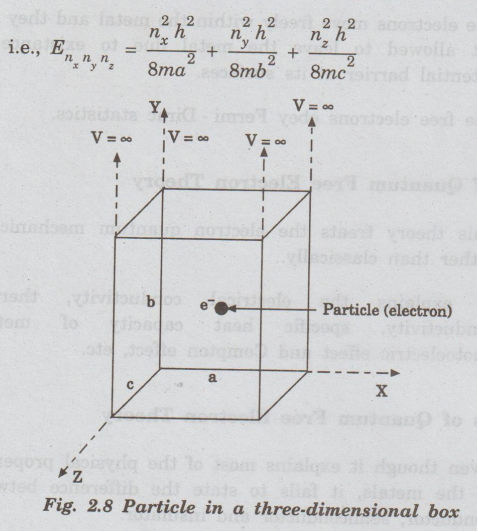
The
solution of one-dimensional potential well is extended for a three-dimensional
potential box.
In
a three-dimensional potential box, the particle (electron) can move in any
direction in space. Therefore, instead of one quantum number n, we have to use.
three quantum numbers, nx,ny and nz,
corresponding to the three coordinate axes namely x, y and z respectively.
If a, b, c are the lengths of the box as shown
in figure 2.8 along x, y and z axes, then
Energy
of the particle = Ex + Ey + Ez
If
a = b = c as for a cubical box, then
The
corresponding normalised wave function of an electron in a cubical box may be
written as
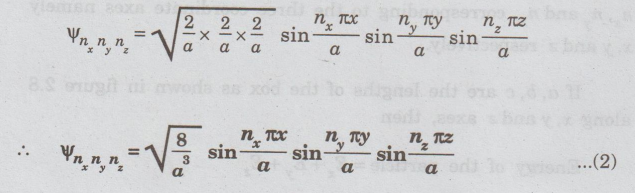
From
the equations (1) and (2), we understand that several combinations of the three
quantum numbers (nx, ny and nz) lead to
different energy eigen values and eigen functions.
Example
Suppose
a state has quantum numbers, then
nx
= 1, ny = 1, nz = 2
Then,
nx2 + ny2 + nz2
= 6
Similarly,
for a combination nx = 1, ny =2, nz = 1 and
for acombination nx = 2, ny = 1, nz = 1
we
have, nx2 + ny2 + nz2
= 6
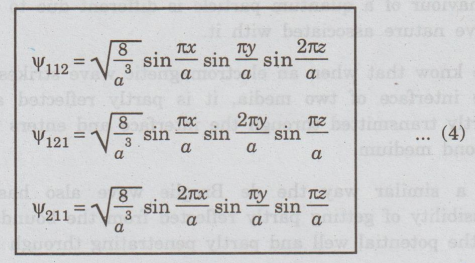
E112 = E121 =
E211= 6h2 / 8ma2 ....(3)
The
corresponding wave functions are written as
Physics for Electrical Engineering: Unit II: a. Electrical Properties of Materials : Tag: : Statement, Postulates, Merits, Example | Electrical Properties of Materials - Quantum free electron (QFE) theory
Physics for Electrical Engineering: Unit II: a. Electrical Properties of Materials
Under Subject

Physics for Electrical Engineering
PH3202 2nd Semester 2021 Regulation | 2nd Semester EEE Dept 2021 Regulation
Related Subjects

Professional English II
HS3251 2nd Semester 2021 Regulation | 2nd Semester Common to all Dept 2021 Regulation
Statistics and Numerical Methods
MA3251 2nd Semester 2021 Regulation M2 Engineering Mathematics 2 | 2nd Semester Common to all Dept 2021 Regulation
Engineering Graphics
GE3251 eg 2nd semester | 2021 Regulation | 2nd Semester Common to all Dept 2021 Regulation
Physics for Electrical Engineering
PH3202 2nd Semester 2021 Regulation | 2nd Semester EEE Dept 2021 Regulation

Basic Civil and Mechanical Engineering
BE3255 2nd Semester 2021 Regulation | 2nd Semester EEE Dept 2021 Regulation
Electric Circuit Analysis
EE3251 2nd Semester 2021 Regulation | 2nd Semester EEE Dept 2021 Regulation
Physics for Electronics Engineering
PH3254 - Physics II - 2nd Semester - ECE Department - 2021 Regulation | 2nd Semester ECE Dept 2021 Regulation

Electrical and Instrumentation Engineering
BE3254 - 2nd Semester - ECE Dept - 2021 Regulation | 2nd Semester ECE Dept 2021 Regulation
Circuit Analysis
EC3251 - 2nd Semester - ECE Dept - 2021 Regulation | 2nd Semester ECE Dept 2021 Regulation
Materials Science
PH3251 2nd semester Mechanical Dept | 2021 Regulation | 2nd Semester Mechanical Dept 2021 Regulation

Basic Electrical and Electronics Engineering
BE3251 2nd semester Mechanical Dept | 2021 Regulation | 2nd Semester Mechanical Dept 2021 Regulation

Physics for Civil Engineering
PH3201 2021 Regulation | 2nd Semester Civil Dept 2021 Regulation

Basic Electrical, Electronics and Instrumentation Engineering
BE3252 2021 Regulation | 2nd Semester Civil Dept 2021 Regulation
Physics for Information Science
PH3256 2nd Semester CSE Dept | 2021 Regulation | 2nd Semester CSE Dept 2021 Regulation

Basic Electrical and Electronics Engineering
BE3251 2nd Semester CSE Dept 2021 | Regulation | 2nd Semester CSE Dept 2021 Regulation
Programming in C
CS3251 2nd Semester CSE Dept 2021 | Regulation | 2nd Semester CSE Dept 2021 Regulation