Physics for Electrical Engineering: Unit II: b. Magnetic Properties of Materials
Quantum interference devices
Description, Working Principle, Definition, Application
SQUID stands for Superconducting QUantum Interference Device. It is an ultra-sensitive instrument used to measure very weak magnetic field of the order of 10-14 tesla.
QUANTUM
INTERFERENCE DEVICES
SQUID
SQUID
stands for Superconducting QUantum Interference Device. It is an
ultra-sensitive instrument used to measure very weak magnetic field of the
order of 10-14 tesla.
Principle
We
know that a small change in magnetic field produces variation in the quantum
flux.
Description and Working
A
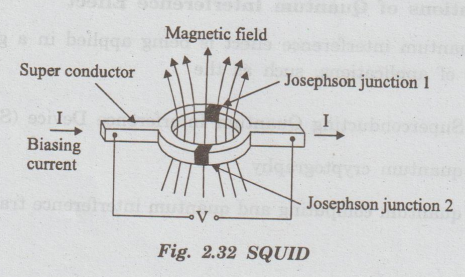
SQUID consists of a superconducting ring which can have magnetic fields of
quantum values (1, 2, 3...) of flux placed inbetween two Josephson junctions as
shown in fig. 2.32.
When
the magnetic field is applied perpendicular to the plane of the ring, the
current is induced at the two Josephson junctions. The induced current produces
the interference pattern and it flows around the ring so that the magnetic flux
in the ring can have the quantum value of magnetic field applied.
Application
(i)
SQUID can be used to detect the variation of very minute magnetic signals in
terms of quantum flux.
(ii)
It can also be used as storage device for magnetic flux.
(iii
)SQUID is useful in the study of earthquakes, removing paramagnetic impurities,
detection of magnetic signals from the brain, heart etc.
Quantum Interference Transistor (QUIT):
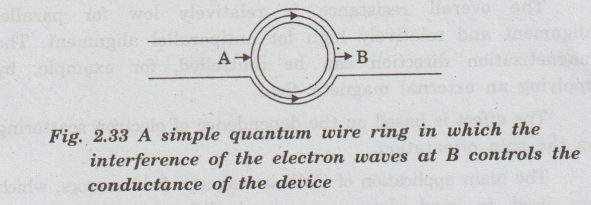
Electrons
are made to propagate through two arms of the quantum wire ring as shown in the
fig. 2.33.
Suppose
an electron wave enters the ring from left to right. The wave entering through
"A" gets split up into two partial waves. A constructive interference
can be expected to occur at "B" similar to the optical anlogue as
they travel through the same distance.
The
constructive interference at the output of the device reduces the resistance of
the ring. Various methods of introducing a phase difference of л between the
two waves have been suggested. This leads to destructive interference which in
turn will increase the resistance by reducing the current.
An
external voltage can control the nature of interference and the current. This
device is expected to act as a high-speed transistor.
Magneto resistance
Some metallic materials show a
large change in resistance on the application of a magnetic field. This effect
is called magneto resistance (MR).
Giant Magneto Resistance (GMR)
It is a quantum mechanical
magnetoresistance effect observed multilayers composed of ferromagnetic and
non-magnetic conductive layers.
Definition
The effect is observed as a
significant change in the electrical resistance depending whether on the magnetization
of adjacent ferromagnetic layers are in a parallel or an antiparallel
alignment.
The
overall resistance is relatively low for parallel alignment and relatively high
for antiparallel alignment. The magnetization direction can be controlled, for
example, by applying an external magnetic field.
The
effect is based on the dependence of electron scattering on the spin
orientation.
The
main application of GMR is magnetic field sensors, which are used to read data
in a hard disk drives, biosensors, microelectromechanical systems (MEMS) and
other devices. GMR multilayer structure are also used in magnetoresistive
random-access memory (MRAM) as cells that store one bit of information.
Explanation
The
GMR is seen in structures which have normal metal and ferromagnetic layers
alternatively. The electrical conductivity depends on the relative orientation
of magnetization in the successive ferromagnetic layers in the stack.
When
the relative magnetizations of the layers are switched from parallel (to the
plane of the layers) to antiparallel states, high and low resistivities are
obtained in the structure. This corresponds to 0 and 1 states in data storage
format.
Two
geometries are commonly used in GMR studies and are as shown in fig. 2.34.
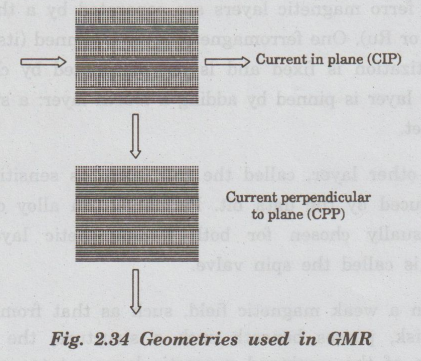
(a) Current in Plane (CIP) of
layers and
(b) Current Perpendicular to Plane
(CPP) of layers.
Since
the layers are only a few nanometers thick, the CIP mode offers high resistance
to the small cross sectional area encountered by the electrons.
To alter the resistivity by controlling the spin-dependent scattering, the lateral dimensions of the structure must be small when compared with the electron mean free path.
Physics for Electrical Engineering: Unit II: b. Magnetic Properties of Materials : Tag: : Description, Working Principle, Definition, Application - Quantum interference devices
Physics for Electrical Engineering: Unit II: b. Magnetic Properties of Materials
Under Subject

Physics for Electrical Engineering
PH3202 2nd Semester 2021 Regulation | 2nd Semester EEE Dept 2021 Regulation
Related Subjects

Professional English II
HS3251 2nd Semester 2021 Regulation | 2nd Semester Common to all Dept 2021 Regulation
Statistics and Numerical Methods
MA3251 2nd Semester 2021 Regulation M2 Engineering Mathematics 2 | 2nd Semester Common to all Dept 2021 Regulation
Engineering Graphics
GE3251 eg 2nd semester | 2021 Regulation | 2nd Semester Common to all Dept 2021 Regulation
Physics for Electrical Engineering
PH3202 2nd Semester 2021 Regulation | 2nd Semester EEE Dept 2021 Regulation

Basic Civil and Mechanical Engineering
BE3255 2nd Semester 2021 Regulation | 2nd Semester EEE Dept 2021 Regulation
Electric Circuit Analysis
EE3251 2nd Semester 2021 Regulation | 2nd Semester EEE Dept 2021 Regulation
Physics for Electronics Engineering
PH3254 - Physics II - 2nd Semester - ECE Department - 2021 Regulation | 2nd Semester ECE Dept 2021 Regulation

Electrical and Instrumentation Engineering
BE3254 - 2nd Semester - ECE Dept - 2021 Regulation | 2nd Semester ECE Dept 2021 Regulation
Circuit Analysis
EC3251 - 2nd Semester - ECE Dept - 2021 Regulation | 2nd Semester ECE Dept 2021 Regulation

Materials Science
PH3251 2nd semester Mechanical Dept | 2021 Regulation | 2nd Semester Mechanical Dept 2021 Regulation

Basic Electrical and Electronics Engineering
BE3251 2nd semester Mechanical Dept | 2021 Regulation | 2nd Semester Mechanical Dept 2021 Regulation

Physics for Civil Engineering
PH3201 2021 Regulation | 2nd Semester Civil Dept 2021 Regulation

Basic Electrical, Electronics and Instrumentation Engineering
BE3252 2021 Regulation | 2nd Semester Civil Dept 2021 Regulation

Physics for Information Science
PH3256 2nd Semester CSE Dept | 2021 Regulation | 2nd Semester CSE Dept 2021 Regulation

Basic Electrical and Electronics Engineering
BE3251 2nd Semester CSE Dept 2021 | Regulation | 2nd Semester CSE Dept 2021 Regulation
Programming in C
CS3251 2nd Semester CSE Dept 2021 | Regulation | 2nd Semester CSE Dept 2021 Regulation