Electromagnetic Theory: Unit IV: Time Varying Fields and Maxwells Equations
Retarded Potentials
Time Varying Fields and Maxwells Equations
• Let us now study the behaviour of these potentials when the fields are time varying.
Retarded Potentials
•
For static electric fields, the electric scalar potential is given by,

•
For static magnetic fields, the magnetic vector potential is given by,

•
Let us now study the behaviour of these potentials when the fields are time
varying.
•
For time varying fields,

•
As derived in earlier section, if we combine above relation with the expression
of Faraday's law, we can write,

•
It is clear from equations (9.7.3) and (9.7.4) that we can determine fields 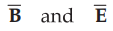 provided that potentials V and Ā are known. It is necessary to find expressions
for V and Ā, suitable for time varying fields.
provided that potentials V and Ā are known. It is necessary to find expressions
for V and Ā, suitable for time varying fields.
•
From the general field relations for time varying electric and magnetic fields,

•
By taking divergence of equation (9.7.4) and using above two relations which
are valid for time varying fields, we get

•
It is important that complicated equations (9.7.5) and (9.7.7) are not
sufficient enough to define Ā and V completely. These two equations demonstrate
necessary but not the sufficient conditions. In general any vector field can be
uniquely defined if its curl and divergence are known and the value of the
field is known at any one point.
•
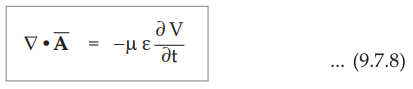
The curl of Ā is already specified in the equation (9.7.3). Now we may choose
the divergence of Ā from equation (9.7.7) as
•
Equation (9.7.8) gives relationship between Ā and V. It is called Lorentz
condition for potentials.
•
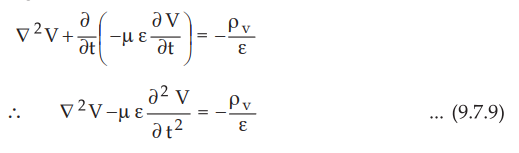
Using the Lorentz condition in equation (9.7.5), we get,
•
Similarly using Lorentz condition in equation (9.7.7), we get,

• Now equations (9.7.9) and (9.7.10) are very much symmetrical obtained from equations (9.7.5) and (9.7.7) by applying Lorentz condition for potentials. These are called wave equations.
•
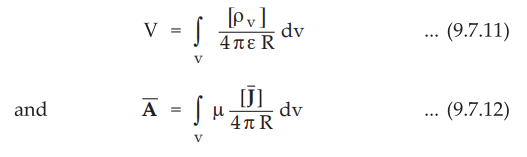
The solutions to the equation (9.7.9) and (9.7.10) are,
•
The terms [ρv ] and [ ] in the equations (9.7.11) and (9.7.12)
respectively, indicates that the time t in the expression ρ v (x, y, z, t) and (x, y, z, t) is replaced by the retarded time denoted by t'. The
retarded time is given by,
] in the equations (9.7.11) and (9.7.12)
respectively, indicates that the time t in the expression ρ v (x, y, z, t) and (x, y, z, t) is replaced by the retarded time denoted by t'. The
retarded time is given by,
t'
= t – R/v .... (9.7.13)
where
R = |  | i.e. Distance
between the differential element of charge being considered and the point at
which potential is to be measured.
| i.e. Distance
between the differential element of charge being considered and the point at
which potential is to be measured.
•
The velocity of wave propagation is denoted by v and it is defined as, ...
(9.7.14)
•
In free space, v = c ≅
3 × 10⁸ m/s, which is the speed of light in vacuum.
•
Thus the potentials V and Ā, represented by equations (9.7.11) and (9.7.12) are
called retarded electric scalar potential and retarded magnetic vector
potential respectively.
Review Question
1. Explain briefly about retarded, potential. What is the
significance of it ?
Electromagnetic Theory: Unit IV: Time Varying Fields and Maxwells Equations : Tag: : Time Varying Fields and Maxwells Equations - Retarded Potentials
Electromagnetic Theory: Unit IV: Time Varying Fields and Maxwells Equations
Under Subject

Electromagnetic Theory
EE3301 3rd Semester EEE Dept | 2021 Regulation | 3rd Semester EEE Dept 2021 Regulation
Electromagnetic Theory
EE25C10 3rd Semester EEE Dept | 2025 Regulation | 3rd Semester 2025 Regulation
Electro Magnetic Fields and Transmission Lines
EC25C06 3rd Semester ECE - Electronics and Communication Engineering Department | 2025 Regulation | 3rd Semester 2025 Regulation
Related Subjects
Probability and complex function
MA3303 3rd Semester EEE Dept | 2021 Regulation | 3rd Semester EEE Dept 2021 Regulation
Electromagnetic Theory
EE3301 3rd Semester EEE Dept | 2021 Regulation | 3rd Semester EEE Dept 2021 Regulation
Digital Logic Circuits
EE3302 3rd Semester EEE Dept | 2021 Regulation | 3rd Semester EEE Dept 2021 Regulation
Electron Devices and Circuits
EC3301 3rd Semester EEE Dept | 2021 Regulation | 3rd Semester EEE Dept 2021 Regulation

Electrical Machines I
EE3303 EM 1 3rd Semester EEE Dept | 2021 Regulation | 3rd Semester EEE Dept 2021 Regulation
C Programming and Data Structures
CS3353 3rd Semester EEE, ECE Dept | 2021 Regulation | 3rd Semester EEE Dept 2021 Regulation