Basic Civil & Mechanical Engineering: UNIT I: b. Structural engineering
Stress-strain diagram
Structural engineering
Ductile Materials: Materials like Mild Steel, Copper, etc., can be drawn into thin wires. These are therefore called as Ductile Materials.
STRESS-STRAIN DIAGRAM:
Ductile
Materials: Materials like Mild Steel, Copper,
etc., can be drawn into thin wires. These are therefore called as Ductile
Materials.
Brittle
Materials: Brittle Materials do not deform on
loading. They break suddenly at the time of failure. Examples: Cast Iron,
Glass, etc.
Elasticity:
When a body is subjected to a force or load, it undergoes deformation. On the
removal of load, if it regains its original shape and size (i.e., all the
deformation vanishes), then the body is said to behave in a perfectly elastic
manner.
Elasticity
is the property of a material to regain its original shape and size completely
on the removal of external load acting on it. Example: Mild Steel
Plasticity:
Plasticity is the property of a material which does not come back to its
original shape and size on the removal of external load acting on it. Example:
Lead.
1. TENSION TEST FOR MILD STEEL
See
Fig. 7. It shows the stress-strain relationship of the Tension Test conducted
on a specimen bar of uniform cross-section of ductile metal Mild Steel. The
various stages passed through by the specimen before it breaks are explained as
follows:
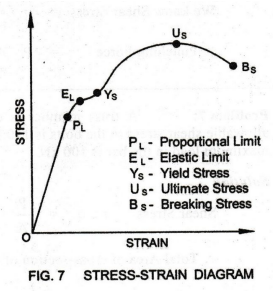
Proportional
Limit or Limit of Proportionality (PL): See Fig. 7.
From the origin O to a point PL, the stress-strain diagram is a straight line.
In the range O to PL, the stress is proportional to the strain.
Also,
the specimen will regain its original shape and size after unloading. The
stress corresponding to the load at PL is known as Proportional
Limit or Limit of Proportionality.
Elastic
Limit (EL): See Fig. 7. Beyond PL,
the stress is not proportional to the strain. It means that the proportionality
between stress and strain ends at the limit of proportionality. Thus, the
material ceases to obey Hooke's Law beyond the limit of proportionality.
Point
El represents the Elastic Limit. This is the limit up to which the strain
produced will disappear completely on the removal of load. The stress
corresponding to the load at Eų is known as Elastic Limit. Any loading beyond EL
will cause permanent deformation. It is called Permanent Set in the material.
Yield
Stress (Ys): See Fig. 7. Loading beyond El causes
elongation much larger than the elongations observed earlier. At the point Ys,
the material yields to a great extent. The stress corresponding to the load is
known as Yield Stress Ys.
Yield
Stress = Ys = Yield Load / Original Area of Cross-section (A)
Ultimate
Stress (Us): The maximum stress that a material can
withstand before its failure is known as Ultimate Stress Us.
Ultimate
Stress = Us = Maximum Load or Ultimater Load / Original Area of Cross-section
(A)
In
this stage, a part of the length reduces in its diameter. In that part, a neck
or waist is started forming. Now, the specimen goes rapidly to rupture. The
nominal stress at which the rupture occurs is called Rupture Strength.
Nominal
Stress at Rupture = Load at Rupture / Original Area of Cross-section (A)
Actual
Stress at Rupture = Load at Rupture / Neck Area of Cross-section
Breaking
Stress (Bs): The stress corresponding to the load at
which the material fails or breaks is known as Breaking Stress Bs.
The
nominal stress at breaking calculated based on the original area of cross
section of the specimen will be less than the nominal ultimate stress. However,
the actual stress at breaking calculated based on the actual (neck) cross
sectional area of the specimen at the time of breaking will be greater than the
ultimate stress.
Nominal
Stress at Breaking = Load at Breaking /
Original Area of Cross-section (A)
Actual
Stress at Breaking = Load at Breaking / Neck Area of Cross-section
Basic Civil & Mechanical Engineering: UNIT I: b. Structural engineering : Tag: : Structural engineering - Stress-strain diagram
Basic Civil & Mechanical Engineering: UNIT I: b. Structural engineering
Under Subject
Basic Civil and Mechanical Engineering
BE3255 2nd Semester 2021 Regulation | 2nd Semester EEE Dept 2021 Regulation
Introduction to Civil Engineering
CE25C01 1st Semester Civil, Agri Departments | 2025 Regulation | 1st Semester 2025 Regulation
Basic Civil and Mechanical Engineering
GE25C01 2nd Semester EEE Dept | 2025 Regulation | 2nd Semester 2025 Regulation
Related Subjects
Professional English II
HS3251 2nd Semester 2021 Regulation | 2nd Semester Common to all Dept 2021 Regulation
Statistics and Numerical Methods
MA3251 2nd Semester 2021 Regulation M2 Engineering Mathematics 2 | 2nd Semester Common to all Dept 2021 Regulation
Engineering Graphics
GE3251 eg 2nd semester | 2021 Regulation | 2nd Semester Common to all Dept 2021 Regulation
Physics for Electrical Engineering
PH3202 2nd Semester 2021 Regulation | 2nd Semester EEE Dept 2021 Regulation
Basic Civil and Mechanical Engineering
BE3255 2nd Semester 2021 Regulation | 2nd Semester EEE Dept 2021 Regulation
Electric Circuit Analysis
EE3251 2nd Semester 2021 Regulation | 2nd Semester EEE Dept 2021 Regulation
Physics for Electronics Engineering
PH3254 - Physics II - 2nd Semester - ECE Department - 2021 Regulation | 2nd Semester ECE Dept 2021 Regulation
Electrical and Instrumentation Engineering
BE3254 - 2nd Semester - ECE Dept - 2021 Regulation | 2nd Semester ECE Dept 2021 Regulation
Circuit Analysis
EC3251 - 2nd Semester - ECE Dept - 2021 Regulation | 2nd Semester ECE Dept 2021 Regulation
Materials Science
PH3251 2nd semester Mechanical Dept | 2021 Regulation | 2nd Semester Mechanical Dept 2021 Regulation
Basic Electrical and Electronics Engineering
BE3251 2nd semester Mechanical Dept | 2021 Regulation | 2nd Semester Mechanical Dept 2021 Regulation
Physics for Civil Engineering
PH3201 2021 Regulation | 2nd Semester Civil Dept 2021 Regulation
Basic Electrical, Electronics and Instrumentation Engineering
BE3252 2021 Regulation | 2nd Semester Civil Dept 2021 Regulation
Physics for Information Science
PH3256 2nd Semester CSE Dept | 2021 Regulation | 2nd Semester CSE Dept 2021 Regulation
Basic Electrical and Electronics Engineering
BE3251 2nd Semester CSE Dept 2021 | Regulation | 2nd Semester CSE Dept 2021 Regulation
Programming in C
CS3251 2nd Semester CSE Dept 2021 | Regulation | 2nd Semester CSE Dept 2021 Regulation