Statistics and Numerical Methods: Unit I: Testing of Hypothesis
Test Based on x2- Distribution
Solved Example Problems | Testing of Hypothesis | Statistics
By comparing the calculated value of x2 with the table value of x2 for n-1 degrees of freedom at any required level of significance we may accept or reject the null hypothesis.
TEST BASED ON x2-DISTRIBUTION
a. x2-test for single
variance
Let
x1, x1,...,x1 be a random sample from a normal
population with variance σ2. Set the null hypothesis' H0 :
σ2 = σ20 Then the test statistic is

where
s2 is the variance of the sample.
Then  defined above follows a x2-distribution
with n - 1 degrees
defined above follows a x2-distribution
with n - 1 degrees
By
comparing the calculated value of x2 with the table value of x2
for n-1 degrees of freedom at any required level of significance we may accept
or reject the null hypothesis.
Note
: If
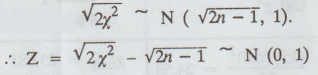
the sample size n is large (n > 30) then we can apply Fisher's approximation
and
we can apply normal test.
Example
1.4.a(1)
A
random sample of size 25 from a population gives the sample standard deviation
8.5. Test the hypothesis that the population s.d is 10.
Solution
:

Example
1.4.a.(2)
The
s.d of the distribution of times taken by 15 workers for performing a job is
6.4 sec. Can it be taken as a sample from a population whose s.d is 5 sec ?
Solution
:

Example
1.4.a(3)
It
is believed that the precision (as measured by the variance) of an instrument
is no more than 0.16. Write down the null and alternative hypothesis for testing
this belief. Carry out the test at 1% level given 11 measurements of be in the
same subject on the instrument. [A.U A/M 2017 R-13]
2.5,
2.3, 2.4, 2.3, 2.5, 2.7, 2.5, 2.6, 2.6, 2.7, 2.5
Solution
:
Given:
n = 11, σ2 = 0.16

4.
Conclusion :
Here
Cal x2 < table x2
i.e.,
1.182 < 23.209
So,
we accept H0: σ2 = 0.16
We
conclude that the data are consistent with the hypothesis that the precision of
the instrument is 0.16.
Example
1.4.a.(4)
Test
the hypothesis that σ = 10, given that s = 15 for a random sample of size 50
from a normal population.
Solution:
Given: σ = 10, s = 15, n = 50

6.
Conclusion :
Since,
|z| > 3, so we reject H0, it is significant at all levels of
significance. We conclude that σ ≠ 10
Example
1.4.a(5)
In
the past the standard deviation of weights of certain 1135 gm packages filled
by a machine was 7.1 gms. A random sample of 20 packages showed a standard
deviation of 9.1 gms. Is the apparent increase in variability significant at
0.05 level of significance?
Solution:
Given: n = 20, s = 9.1, σ = 7.1 ⇒
σ2 = 50.41
1.
H0 σ2 = 50.41
2.
H1 σ2 ≠ 50.41
3.

4.
Conclusion
Here,
Cal x2 > table x2
i.e.,
32.855 > 30.144
So,
we reject H0 : σ2 = 50.41
EXERCISES 1.4(a)______
1.
A sample of 20 observations gave a standard deviation 3.72. Is this compatible
with the hypothesis that the sample is from a normal population with variance
4.35.
2.
A random sample of size 20 from a population gives the sample standard
deviation of 6. Test the hypothesis that the population standard deviation is
9.
3.
Given 11 measurements of an instrument as 2.5, 2.3, 2.4, 2.3, 2.5, 2.7, 2.6,
2.6, 2.7, 2.5. It is believed that the precision of that instrument as measured
by the variance is 0.16. Test whether the data are consistent with the
hypothesis (at 1% level of significance).
4.
A sample of 12 values shows the s.d. to be 11. Does this agree with the
hypothesis that the population s.d is 10, the population being normal ?
5.
Weights in kgs of 10 students are given as 28, 40, 45, 53, 47, 43, 55, 48, 45,
49. Can we say that variance of the distribution of weights of all students
from which the above sample of 10 students was drawn is equal to 20 kgs.
Statistics and Numerical Methods: Unit I: Testing of Hypothesis : Tag: : Solved Example Problems | Testing of Hypothesis | Statistics - Test Based on x2- Distribution
Statistics and Numerical Methods: Unit I: Testing of Hypothesis
Under Subject
Statistics and Numerical Methods
MA3251 2nd Semester 2021 Regulation M2 Engineering Mathematics 2 | 2nd Semester Common to all Dept 2021 Regulation
Related Subjects
Professional English II
HS3251 2nd Semester 2021 Regulation | 2nd Semester Common to all Dept 2021 Regulation
Statistics and Numerical Methods
MA3251 2nd Semester 2021 Regulation M2 Engineering Mathematics 2 | 2nd Semester Common to all Dept 2021 Regulation
Engineering Graphics
GE3251 eg 2nd semester | 2021 Regulation | 2nd Semester Common to all Dept 2021 Regulation

Physics for Electrical Engineering
PH3202 2nd Semester 2021 Regulation | 2nd Semester EEE Dept 2021 Regulation

Basic Civil and Mechanical Engineering
BE3255 2nd Semester 2021 Regulation | 2nd Semester EEE Dept 2021 Regulation
Electric Circuit Analysis
EE3251 2nd Semester 2021 Regulation | 2nd Semester EEE Dept 2021 Regulation

Physics for Electronics Engineering
PH3254 - Physics II - 2nd Semester - ECE Department - 2021 Regulation | 2nd Semester ECE Dept 2021 Regulation

Electrical and Instrumentation Engineering
BE3254 - 2nd Semester - ECE Dept - 2021 Regulation | 2nd Semester ECE Dept 2021 Regulation
Circuit Analysis
EC3251 - 2nd Semester - ECE Dept - 2021 Regulation | 2nd Semester ECE Dept 2021 Regulation

Materials Science
PH3251 2nd semester Mechanical Dept | 2021 Regulation | 2nd Semester Mechanical Dept 2021 Regulation

Basic Electrical and Electronics Engineering
BE3251 2nd semester Mechanical Dept | 2021 Regulation | 2nd Semester Mechanical Dept 2021 Regulation
Physics for Civil Engineering
PH3201 2021 Regulation | 2nd Semester Civil Dept 2021 Regulation

Basic Electrical, Electronics and Instrumentation Engineering
BE3252 2021 Regulation | 2nd Semester Civil Dept 2021 Regulation

Physics for Information Science
PH3256 2nd Semester CSE Dept | 2021 Regulation | 2nd Semester CSE Dept 2021 Regulation

Basic Electrical and Electronics Engineering
BE3251 2nd Semester CSE Dept 2021 | Regulation | 2nd Semester CSE Dept 2021 Regulation
Programming in C
CS3251 2nd Semester CSE Dept 2021 | Regulation | 2nd Semester CSE Dept 2021 Regulation