Basic Civil & Mechanical Engineering: UNIT II: i. Stones
Types of building stones and their uses
Granite : It is obtained from igneous rocks. It is hard, durable and available in different colours. It is highly resistant to weathering and has good crushing strength. It can take mirror-like polish.
TYPES OF BUILDING STONES AND THEIR USES
1.
Granite
It
is obtained from igneous rocks. It is hard, durable and available in different
colours. It is highly resistant to weathering and has good crushing strength.
It can take mirror-like polish.
Uses
-
Granite is used for the construction of walls, columns and bridge piers.
-
It is used for steps, sills and facing works.
-
Also, it is used as ballast for road metal, rail track and coarse aggregate for
concrete.
-
It is unsuitable for carving.
2.
Basalt and Trap
Basalt
and Trap are also quarried from igneous rocks. These are hard, tough and
durable and available in different colours.
Uses:
Basalt and Trap are used for constructing masonry floors, ornamental or
decorative works and as road metal.
3.
Chalk
Chalk
belongs to sedimentary variety. It is pure white stone, soft and easy to form
powder.
Uses:
Chalk is used in preparing glazer's putty and also as colouring material in the
manufacture of Portland cement.
4.
Limestone
It
is derived from sedimentary rocks. It is easy to work. It consists of a high
percentage of Calcium Carbonate.
Uses:
Limestone is used for the manufacture of cement. It is also used for floors,
steps, walls and as road metal.
5.
Sandstone
It
belongs to sedimentary variety. Its structure shows sandy grains. It is easy to
work and dress. It is available in different colours. Its strength is low.
Uses:
It is used for different building works like facing works, carving, steps,
walls, columns and as road metal.
6.
Laterite
It
is derived from metamorphic rocks. It is sandy clay stone. It is porous and
soft. It can easily be quarried in blocks. It contains high percentage of iron
oxide.
Uses:
It is used for wall construction, rough stone masonry work and as road metal.
7.
Gneiss
Gneiss
is metamorphic in nature. It is easy to work and splits into thin slabs.
Uses:
It is used as thin slabs for flooring, street paving, rough stone masonry work,
etc.
8.
Marble
Marble
is metamorphic. It can take good polish. It can be easily cut with saw and
carved. It is available in different colours.
Uses
-
Marble is used for flooring in the form of slabs, wall lining, facing work,
steps, columns, etc.
-
It is also used for interior decoration and such ornamental works. Taj Mahal is
built fully of white marbles.
9.
Gravel
It
is available in river beds in the form of pebbles of any kind of stone.
Uses:
It
is used for surfacing road. It is also used in concrete.
10.
Slate
Slate
is metamorphic. It is black in colour and can be split easily.
Uses:
It is used as roofing tiles, paving works and as damp-proof course in
buildings.
11.
Quartzite
It
is metamorphic. It is hard, durable, brittle and crystalline. It is difficult
to work.
Uses:
It is used in rubble masonry, concrete aggregate, retaining walls and as road
metal.
1. COMPARISON OF BRICKS AND BUILDING STONES
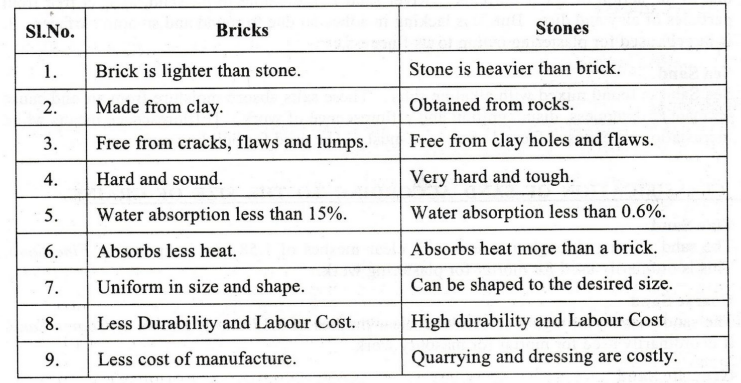
Bricks
1.
Brick is lighter than stone.
2.
Made from clay.
3.
Free from cracks, flaws and lumps.
4.
Hard and sound.
5.
Water absorption less than 15%.
6.
Absorbs less heat.
7.
Uniform in size and shape.
8.
Less Durability and Labour Cost.
9.
Less cost of manufacture.
Stones
1.
Stone is heavier than brick.
2.
Obtained from rocks.
3.
Free from clay holes and flaws.
4.
Very hard and tough.
5.
Water absorption less than 0.6%.
6.
Absorbs heat more than a brick.
7.
Can be shaped to the desired size.
8.
High durability and Labour Cost
9.
Quarrying and dressing are costly.
Basic Civil & Mechanical Engineering: UNIT II: i. Stones : Tag: : - Types of building stones and their uses
Basic Civil & Mechanical Engineering: UNIT II: i. Stones
Under Subject
Basic Civil and Mechanical Engineering
BE3255 2nd Semester 2021 Regulation | 2nd Semester EEE Dept 2021 Regulation
Related Subjects
Professional English II
HS3251 2nd Semester 2021 Regulation | 2nd Semester Common to all Dept 2021 Regulation
Statistics and Numerical Methods
MA3251 2nd Semester 2021 Regulation M2 Engineering Mathematics 2 | 2nd Semester Common to all Dept 2021 Regulation
Engineering Graphics
GE3251 eg 2nd semester | 2021 Regulation | 2nd Semester Common to all Dept 2021 Regulation

Physics for Electrical Engineering
PH3202 2nd Semester 2021 Regulation | 2nd Semester EEE Dept 2021 Regulation
Basic Civil and Mechanical Engineering
BE3255 2nd Semester 2021 Regulation | 2nd Semester EEE Dept 2021 Regulation
Electric Circuit Analysis
EE3251 2nd Semester 2021 Regulation | 2nd Semester EEE Dept 2021 Regulation

Physics for Electronics Engineering
PH3254 - Physics II - 2nd Semester - ECE Department - 2021 Regulation | 2nd Semester ECE Dept 2021 Regulation

Electrical and Instrumentation Engineering
BE3254 - 2nd Semester - ECE Dept - 2021 Regulation | 2nd Semester ECE Dept 2021 Regulation
Circuit Analysis
EC3251 - 2nd Semester - ECE Dept - 2021 Regulation | 2nd Semester ECE Dept 2021 Regulation
Materials Science
PH3251 2nd semester Mechanical Dept | 2021 Regulation | 2nd Semester Mechanical Dept 2021 Regulation

Basic Electrical and Electronics Engineering
BE3251 2nd semester Mechanical Dept | 2021 Regulation | 2nd Semester Mechanical Dept 2021 Regulation
Physics for Civil Engineering
PH3201 2021 Regulation | 2nd Semester Civil Dept 2021 Regulation

Basic Electrical, Electronics and Instrumentation Engineering
BE3252 2021 Regulation | 2nd Semester Civil Dept 2021 Regulation
Physics for Information Science
PH3256 2nd Semester CSE Dept | 2021 Regulation | 2nd Semester CSE Dept 2021 Regulation

Basic Electrical and Electronics Engineering
BE3251 2nd Semester CSE Dept 2021 | Regulation | 2nd Semester CSE Dept 2021 Regulation

Programming in C
CS3251 2nd Semester CSE Dept 2021 | Regulation | 2nd Semester CSE Dept 2021 Regulation