Basic Civil & Mechanical Engineering: UNIT III: a. Foundations for machines
Types of machine foundations
Machine foundations are broadly classified into three types, namely, 1. Concrete Block Foundation, 2. Block and Trough foundation and 3. Framed Foundation.
TYPES OF MACHINE FOUNDATIONS
Machine
foundations are broadly classified into three types, namely, 1. Concrete Block Foundation,
2. Block and Trough foundation and 3. Framed Foundation.
1. CONCRETE BLOCK FOUNDATION FOR RECIPROCATING MACHINES
Concrete
Block Foundation or simply Block Foundation is suitable for Reciprocating
Machines and Compressors which produce periodic unbalanced forces and moments.
See
Fig. 20. Concrete block foundation is used when the sub-soil has good bearing
capacity.
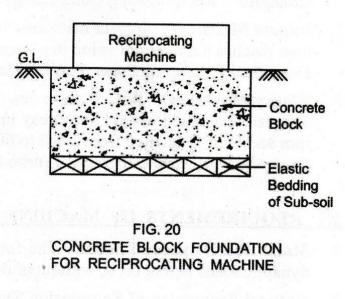
Block
Foundation consists of a Block of Concrete. The Reciprocating Machine is
mounted on the concrete block as shown. Both the reciprocating machine and the
block foundation are considered as a single body.
This
single body is resting on the Elastic Bedding of sub-soil or any resilient
(flexible) mounting. The resilient materials may be cork layer, timber
sleepers, springs, etc.
Design
Criteria of Foundations for Reciprocating Machines (IS : 2974 Part I - 1964)
1.
Size of the foundation block should be larger than the base of the
reciprocating machine.
2.
Foundation width should be equal to the distance of the C.G. of the crank shaft
to the base of the foundation.
3.
Depth of foundation should be such that stability against rotation in vertical
plane is ensured.
4.
The combined C.G. of the machine and the foundation block should be below the
top of the foundation.
5. The safe amplitude of vibrations should not exceed the limiting value for the machine prescribed by the Manufacturer.
2. BLOCK AND TROUGH FOUNDATION FOR IMPACT MACHINES
This
is used for machines producing impact loads such as Forge hammers and Punch
presses.
1.
Block and Trough Foundation with ELASTIC BEDDING for FORGE HAMMER
See
Fig. 21. Anvil of the forge hammer is a solid base block. Material to be forged
is placed on the anvil and forged into shape by striking it repeatedly with the
Tup of the forge hammer. Tup is a weighted block striking the material to be
forged or pressed.
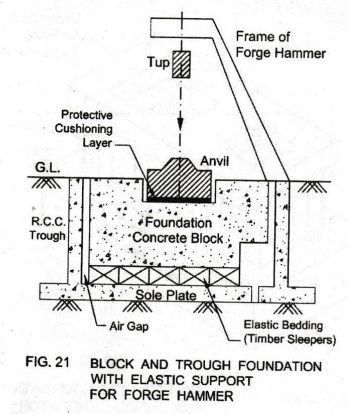 Anvil
rests on the Protective Cushioning Layer fixed on the Concrete Block.
Cushioning Layer is provided to prevent both the bouncing of the anvil and the
creation of heavy impact stresses. Otherwise, the top surface of the concrete
will be damaged.
Anvil
rests on the Protective Cushioning Layer fixed on the Concrete Block.
Cushioning Layer is provided to prevent both the bouncing of the anvil and the
creation of heavy impact stresses. Otherwise, the top surface of the concrete
will be damaged.
The
Concrete Block is resting on Elastic Bedding (Timber Sleepers). Elastic Bedding
is provided to reduce the amplitude of vibration. It is resting on Sole Plate.
The R.C.C. Trough also rests on the Sole Plate as shown.
2.
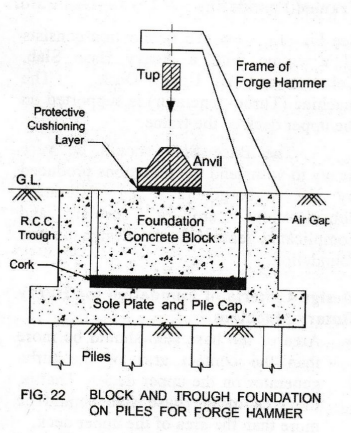
Block and Trough Foundation on PILES for FORGE HAMMER
Fig.
22 shows the foundation system resting on Piles. When the sub-soil has less
bearing capacity, piles are used. The concrete block is resting on the
resilient material known as Cork.
Design
Criteria of Foundations for IMPACT MACHINES (IS : 2974 Part II - 1964)
•
Center of gravity of the foundation block and anvil and also the resultant of
all the forces in the elastic bedding and the foundation support should all lie
in the line of fall of the Tup of the Hammer.
•
The stresses produced at the time of impact in the foundation base (i.e., soil,
cork or piles) should be within 80% of the allowable static stresses.
•
Maximum amplitude of vibration of foundation block should not be more than 1.2
mm.
•
Foundation should be isolated from neighbouring structure by an Air Gap.
•
If the soil has good bearing capacity, the foundation block is made to rest on
the soil directly. Also, it may rest on an Elastic Bedding (Resilient Mounting)
such as Timber Sleepers, Cork Layer, Springs, etc., or may be supported by
bearing or Friction Piles.
•
Area of foundation block should be such that the safe loading intensity of the
soil never exceeds during the impact operation of the hammer.
3. FRAMED FOUNDATION FOR HEAVY ROTARY TYPE MACHINES
This
type of foundation is used for Turbo-generators and High-speed rotary
compressors.
Framed
Foundation for Turbo-Generator
See
Fig. 23. Framed Foundation consists of a Frame with a Heavy Base Slab, Columns
and an Upper Deck. The machine (Turbo-generator) is supported on the upper deck
of the frame.
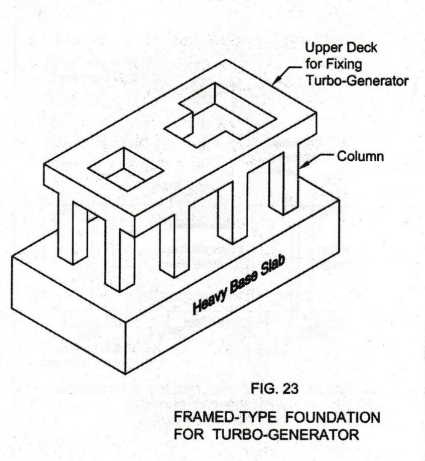
The
Base Slab should be very heavy to withstand the vibrations produced by the
turbo-generator. Vibration considerations are a special and complicated feature
in the design of this foundation.
Design
Criteria of foundation for Heavy Rotary Machines
•
Area of the base slab should be more than the contact area of the turbo generator
on the upper deck. That is, the area of the base slab should be more than the
area of the upper deck.
•
The weight of the base slab should be more than the weight of the
turbogenerator plus the weight of the foundation columns without the base slab.
•
Heavy base slab should be made in one operation without a construction joint.
Basic Civil & Mechanical Engineering: UNIT III: a. Foundations for machines : Tag: : - Types of machine foundations
Basic Civil & Mechanical Engineering: UNIT III: a. Foundations for machines
Under Subject
Basic Civil and Mechanical Engineering
BE3255 2nd Semester 2021 Regulation | 2nd Semester EEE Dept 2021 Regulation
Introduction to Civil Engineering
CE25C01 1st Semester Civil, Agri Departments | 2025 Regulation | 1st Semester 2025 Regulation
Basic Civil and Mechanical Engineering
GE25C01 2nd Semester EEE Dept | 2025 Regulation | 2nd Semester 2025 Regulation
Related Subjects

Professional English II
HS3251 2nd Semester 2021 Regulation | 2nd Semester Common to all Dept 2021 Regulation
Statistics and Numerical Methods
MA3251 2nd Semester 2021 Regulation M2 Engineering Mathematics 2 | 2nd Semester Common to all Dept 2021 Regulation
Engineering Graphics
GE3251 eg 2nd semester | 2021 Regulation | 2nd Semester Common to all Dept 2021 Regulation

Physics for Electrical Engineering
PH3202 2nd Semester 2021 Regulation | 2nd Semester EEE Dept 2021 Regulation
Basic Civil and Mechanical Engineering
BE3255 2nd Semester 2021 Regulation | 2nd Semester EEE Dept 2021 Regulation
Electric Circuit Analysis
EE3251 2nd Semester 2021 Regulation | 2nd Semester EEE Dept 2021 Regulation

Physics for Electronics Engineering
PH3254 - Physics II - 2nd Semester - ECE Department - 2021 Regulation | 2nd Semester ECE Dept 2021 Regulation

Electrical and Instrumentation Engineering
BE3254 - 2nd Semester - ECE Dept - 2021 Regulation | 2nd Semester ECE Dept 2021 Regulation
Circuit Analysis
EC3251 - 2nd Semester - ECE Dept - 2021 Regulation | 2nd Semester ECE Dept 2021 Regulation

Materials Science
PH3251 2nd semester Mechanical Dept | 2021 Regulation | 2nd Semester Mechanical Dept 2021 Regulation

Basic Electrical and Electronics Engineering
BE3251 2nd semester Mechanical Dept | 2021 Regulation | 2nd Semester Mechanical Dept 2021 Regulation
Physics for Civil Engineering
PH3201 2021 Regulation | 2nd Semester Civil Dept 2021 Regulation

Basic Electrical, Electronics and Instrumentation Engineering
BE3252 2021 Regulation | 2nd Semester Civil Dept 2021 Regulation

Physics for Information Science
PH3256 2nd Semester CSE Dept | 2021 Regulation | 2nd Semester CSE Dept 2021 Regulation

Basic Electrical and Electronics Engineering
BE3251 2nd Semester CSE Dept 2021 | Regulation | 2nd Semester CSE Dept 2021 Regulation
Programming in C
CS3251 2nd Semester CSE Dept 2021 | Regulation | 2nd Semester CSE Dept 2021 Regulation