Digital Logic Circuits: Unit IV: (a) Asynchronous Sequential Circuits
University Questions with Answers (Long Answered Questions)
Asynchronous Sequential Circuits | Digital Logic Circuits
Digital Logic Circuits: Unit IV: (a) Asynchronous Sequential Circuits : University Questions with Answers (Long Answered Questions)
University Questions with Answers
(Long Answered Questions)
(Regulation
2008)
Dec.-10
Q.1
List and explain the steps used for analyzing an asynchronous sequential
circuit. [Section 7.5] [8]
Q.2
When do you get the critical and non-critical races ? How will you obtain race
free conditions ? [Section 7.6] [10]
May-11
Q.3
Describe the steps involved in design of asynchronous sequential circuit in
detail with an example. [Section 7.6] [16]
Dec.-
11
Q.4
State the condition of stability in asynchronous sequential logic. [Section
7.5] [4]
Q.5
When does oscillation occur in an asynchronous sequential logic circuit ?
[Section 7.5] [4]
May-12
Q.6
List and explain the steps used for analyzing an asynchronous sequential
circuit. [Section 7.5] [8]
Dec.-12
Q.7
Describe the steps involved in design of asynchronous sequential circuit in
detail with an example. [Section 7.6] [16]
May-13
Q.8
List and explain the steps used for analyzing an asynchronous sequential
circuit. [Section 7.5] [8]
(Regulation
2013)
Dec.-14
Q.9
Describe with reasons, the effect of races in asynchronous sequential circuit design.
Explain its types with illustrations. Show the method of race-free state
assignments with examples. [Section 7.6] [16]
May-16
Q.10
Explain cycles and races in asynchronous sequential circuits. [Section 7.6.2] [8]
Q.11
What are transition table and flow table ? Give suitable examples. [Section
7.6] [8]
May-17
Q.12
A control mechanism for a vending machine accepts nickels and dimes. It
despense merchandise when 20 cents is deposited; it does not give change if 25
cents is deposited. Design the FSM that implements the required control, using
as few states as possible. Find a suitable assignment and derive next - state
and output expressions. [13]
Q.13
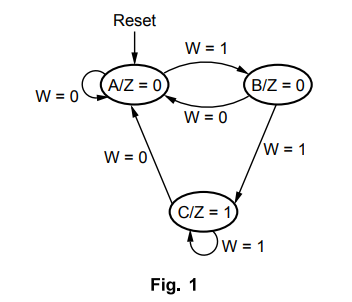
Write the VHDL code for the given state diagram, using behavioral modeling.
Design it using one - hot state assignment and implement it using Programmable
Array Logic (PAL). [15]
Dec.-17
Q.14
Design an asynchronous sequential circuit with two inputs x1 and x2 and one
output Z. Initially, both inputs are equal to zero. When x^ or x2 becomes 1,
the output Z becomes 1. When the second input also becomes 1, the output
changes to 0. The output stays at 0 until the circuit goes back to the initial
state. [15]
Q.15
Discuss about the hazards in asynchronous sequential circuit and the ways to
eliminate them. [Section 7.6.3] [13]
Digital Logic Circuits: Unit IV: (a) Asynchronous Sequential Circuits : Tag: : Asynchronous Sequential Circuits | Digital Logic Circuits - University Questions with Answers (Long Answered Questions)
Related Topics
Related Subjects
Digital Logic Circuits
EE3302 3rd Semester EEE Dept | 2021 Regulation | 3rd Semester EEE Dept 2021 Regulation