Basic Civil & Mechanical Engineering: UNIT V: b. Internal combustion engines
Vapour absorption refrigeration
Working Principal, Description, Layout Diagram, Uses
The difference between the Vapour Absorption System and Vapour Compression System is in the manner in which external heat is added to the vapourized refrigerant to increase its temperature above atmosphere.
VAPOUR ABSORPTION
REFRIGERATION
Principle
The difference between the Vapour Absorption
System and Vapour Compression System is in the manner in which external heat is
added to the vapourized refrigerant to increase its temperature above
atmosphere.
In
the Vapour Compression System, the motor-operated Compressor adds heat to the
refrigerant by compressing it to high pressure and high temperature.
But,
in the Vapour Absorption System, there is no compressor. The compressor is
replaced by the combined effects provided by an Absorber, Pump and Generator.
The compressor work is replaced by the heat supplied in the generator and pump
work. The pump consumes comparatively lesser amount of electric power. The
generator is operated by heat energy obtained by burning low cost fuel or any
other heat source such as solar energy.
Absorbent: Absorbent
absorbs refrigerant vapour and converts it into liquid. When heated
subsequently, it produces vapour. Water has this property and is used as the
absorbent.
Refrigerant:
Ammonia (NH3) is used as the refrigerant, as it easily dissolves in water and
vapourizes when heated subsequently.
Aqua-Ammonia System:
The homogenous mixture of Ammonia and Water is called AquaAmmonia. So, the
vapour absorption system is also called Aqua-Ammonia Refrigeration System.
Description
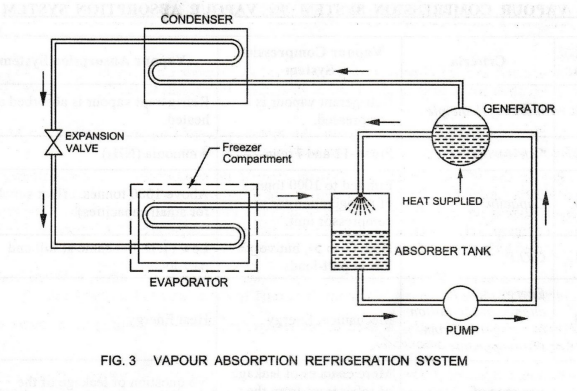
See Fig. 3. The Vapour Absorption
Refrigeration System consists of the following parts:
1.
Evaporator
2.
Absorber
3.
Circulation Pump
4.
Generator
5.
Condenser
6.
Expansion Valve
1. Evaporator:
It is placed in the Refrigerated Space. An Evaporator consists of coiled tubes.
The substance to be cooled is placed in the evaporator. It is the coldest
region or space in the refrigerator and serves as the Refrigerated Space or
Freezer Compartment.
2. Absorber Tank:
Absorber Tank contains absorbent (water). The absorbent should have high affinity
for the refrigerant, remain in the liquid phase under operating conditions. It
should have a high boiling point and low specific heat. It attracts the
refrigerant vapour from the evaporator.
3. Circulation Pump:
The Pump circulates the refrigerant to flow into the Generator.
4. Generator:
Heat is added to the Generator from an
external source. It may be a gas burner, or solar heater.
5. Condenser:
Air or water is used as the cooling medium in the condenser. Air is used for refrigerators
and window air conditioners. Water is used for large centralized air
conditioning systems.
6. Expansion Valve:
The condenser is connected to an Expansion Valve. The pressure of the liquid
passing through the expansion valve drops for reuse in the Evaporator.
Working
The dry LP ammonia vapour from the Evaporator
enters the Absorber. The Absorber contains cold water. Dry ammonia vapour is
absorbed (dissolved) in the cold water, producing a LP strong (concentrated)
ammonia solution. A Circulation Pump pumps the strong ammonia solution from the
Absorber to the Generator. Thus, the pressure of the solution is increased.
The
high pressure solution from the Pump enters the Generator. In the Generator,
the solution is heated by any heat source including solar. Hence, high pressure
Ammonia vapour is generated, which enters the Condenser.
Also,
the weak ammonia solution available in the Generator contains more amount of
water. It goes back to the Absorber and is sprayed at the top of the Absorber.
In the Absorber, water absorbs the incoming ammonia vapour and becomes once
again a strong solution.
In
the Condenser, cold water is circulated around the condenser tubes. Therefore,
the Ammonia vapour is condensed to liquid Ammonia. The HP ammonia liquid is then
expanded to LPLT in the Expansion Valve. The LPLT Ammonia liquid is passed to
the evaporator in the Freezer Compartment.
In
the Evaporator, the LPLT liquid absorbs the heat from the evaporator and
evaporates. The LP Ammonia vapour from the Evaporator flows again to the
Absorber. The cycle is repeated.
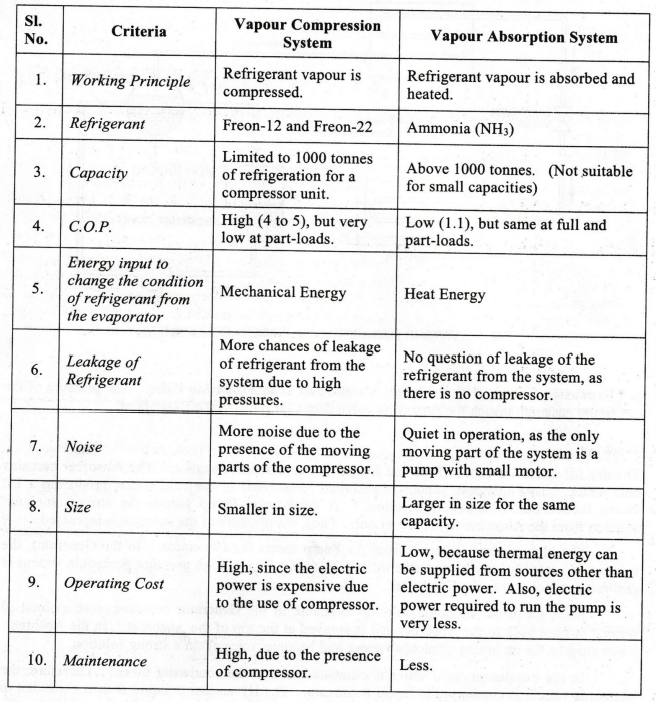
1. VAPOUR COMPRESSION SYSTEM Vs VAPOUR ABSORPTION SYSTEM
Basic Civil & Mechanical Engineering: UNIT V: b. Internal combustion engines : Tag: : Working Principal, Description, Layout Diagram, Uses - Vapour absorption refrigeration
Basic Civil & Mechanical Engineering: UNIT V: b. Internal combustion engines
Under Subject
Basic Civil and Mechanical Engineering
BE3255 2nd Semester 2021 Regulation | 2nd Semester EEE Dept 2021 Regulation
Related Subjects
Professional English II
HS3251 2nd Semester 2021 Regulation | 2nd Semester Common to all Dept 2021 Regulation
Statistics and Numerical Methods
MA3251 2nd Semester 2021 Regulation M2 Engineering Mathematics 2 | 2nd Semester Common to all Dept 2021 Regulation
Engineering Graphics
GE3251 eg 2nd semester | 2021 Regulation | 2nd Semester Common to all Dept 2021 Regulation
Physics for Electrical Engineering
PH3202 2nd Semester 2021 Regulation | 2nd Semester EEE Dept 2021 Regulation
Basic Civil and Mechanical Engineering
BE3255 2nd Semester 2021 Regulation | 2nd Semester EEE Dept 2021 Regulation
Electric Circuit Analysis
EE3251 2nd Semester 2021 Regulation | 2nd Semester EEE Dept 2021 Regulation
Physics for Electronics Engineering
PH3254 - Physics II - 2nd Semester - ECE Department - 2021 Regulation | 2nd Semester ECE Dept 2021 Regulation
Electrical and Instrumentation Engineering
BE3254 - 2nd Semester - ECE Dept - 2021 Regulation | 2nd Semester ECE Dept 2021 Regulation
Circuit Analysis
EC3251 - 2nd Semester - ECE Dept - 2021 Regulation | 2nd Semester ECE Dept 2021 Regulation
Materials Science
PH3251 2nd semester Mechanical Dept | 2021 Regulation | 2nd Semester Mechanical Dept 2021 Regulation
Basic Electrical and Electronics Engineering
BE3251 2nd semester Mechanical Dept | 2021 Regulation | 2nd Semester Mechanical Dept 2021 Regulation
Physics for Civil Engineering
PH3201 2021 Regulation | 2nd Semester Civil Dept 2021 Regulation
Basic Electrical, Electronics and Instrumentation Engineering
BE3252 2021 Regulation | 2nd Semester Civil Dept 2021 Regulation
Physics for Information Science
PH3256 2nd Semester CSE Dept | 2021 Regulation | 2nd Semester CSE Dept 2021 Regulation
Basic Electrical and Electronics Engineering
BE3251 2nd Semester CSE Dept 2021 | Regulation | 2nd Semester CSE Dept 2021 Regulation
Programming in C
CS3251 2nd Semester CSE Dept 2021 | Regulation | 2nd Semester CSE Dept 2021 Regulation