Physics for Electrical Engineering: Unit V: Nano Devices
Carbon nanotubes (CNT)
Definition, Structures, Types, Classification | Nano Devices
A group of nanostructures with large potential applications carbon nanotubes. The hexagonal lattice of carbon is simply graphite. A single layer of graphite is called graphene.
CARBON NANOTUBES (CNT)
A
group of nanostructures with large potential applications carbon nanotubes.
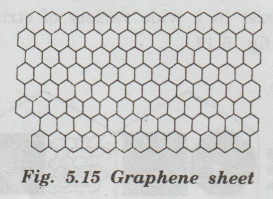
The hexagonal lattice of carbon is simply graphite. A single layer of graphite
is called graphene. (fig. 5.15) Sidetiva
The
carbon nanotube (CNT) consists of a graphene layer which is rolled up into a
cylindrical shape as shown in fig.5.15.
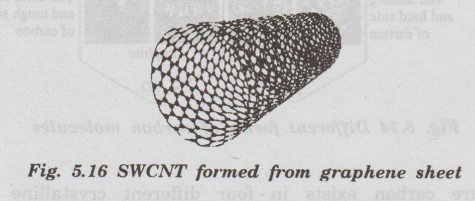
When
the graphene layer is rolled, the structure is tube like and it is a single
molecule. Each single molecule nanotube is made up of a hexagonal network of
covalently bonded carbon atoms.
In
some cases, the hexagons are arranged in a spiral form. The layer appears like
a rolled-up chicken wire (net having a large hexagonal mesh) with carbon atoms
at the apexes of the hexagon as shown in fig.5.16.
The
carbon nanotubes are hollow cylinders of extremely thin diameter, 10,000 times
smaller than a human hair.
Structures of CNT
The
CNTs have many structures on the basis of their length, type of spiral and
number of layers. Their electrical properties depend on their structure and
they act as both a metal or a semiconductor.
Types of CNT structures
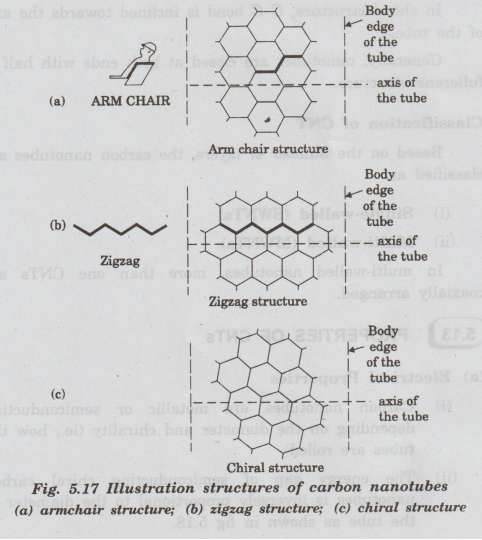
Three
types of nanotube structures are considered by rolling a graphite sheet with
different orientations about the axis.(Fig. 5.17)
They
are
(i)
Armchair structure dejan
(ii)
Zig-zag structure
(iii)
Chiral structure
Armchair
structure
When
the axis of the tube parallel to C-C bonds of the carbon hexagons, the
structure shown in fig. 5.18(a) is obtained. It is referred as "armchair"
structure. no
Zig-zag
and Chiral structure
The
tubes sketched in figs. 5.18(b) and 5.18(c), referred as zig-zag and chiral
structure. They are formed by rolling graphene sheet such that the axis of
the tube is not parallel to C-C bonds.
Zig-zag
structure consists of tube axis perpendicular to C-C bonds.
In
chiral structure, C-C bond is inclined towards the axis of the tube.
Generally,
nanotubes are closed at both ends with half of fullerene structure.
Classification of CNT
Based
on the number of layers, the carbon nanotubes are classified as
(i)
Single-walled (SWNTs)
(ii)
Multi-walled (MWNTs).
In
multi-walled nanotubes, more than one CNTs are coaxially arranged.
Physics for Electrical Engineering: Unit V: Nano Devices : Tag: : Definition, Structures, Types, Classification | Nano Devices - Carbon nanotubes (CNT)
Related Topics
Related Subjects

Physics for Electrical Engineering
PH3202 2nd Semester 2021 Regulation | 2nd Semester EEE Dept 2021 Regulation