Physics for Electrical Engineering: Unit V: Nano Devices
Quantum resistance and conductance
Nano Devices
If the wire is short enough, ie., shorter than the electron mean free path in the material, there will be no scattering and the transport is ballistic.
QUANTUM RESISTANCE AND CONDUCTANCE
For
an elementary description of quantum conductance effects, it is more
appropriate to deal with 1D mesoscopic semiconductor structures like quantum
wires.
If
the wire is short enough, ie., shorter than the electron mean free path in the
material, there will be no scattering and the transport is ballistic..
As
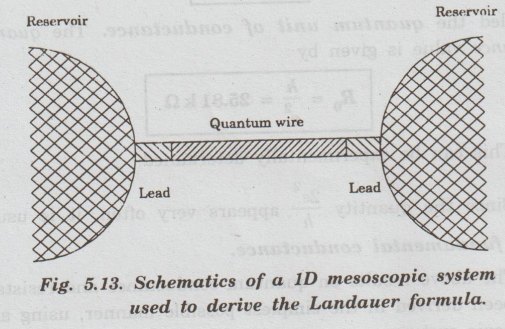
in fig. 5.13, the 1D quantum wire is connected through ideal leads. They do not
produce scattering events to reservoirs characterized by Fermi levels EF1
and EF2
In
order to flow of the current through the quantum wire, a small voltage V is
applied between the reservoirs.
As
a consequence, there is a potential energy eV between the two reservoirs equal
to EF1 - EF2. The current across the wire should be given
by the product of the concentration of (E), electrons (obtained from the
density of states function n1D in the energy interval (eV), the
electron velocity v (E), and the unit electronic charge:
I
= en1D (E) v (E) eV … (1)
Substituting
for n1D (E) by its expression, we obtain the following value of the
current:
I
= 2e2 / h V … (2)
It
is independent of the carrier velocity.
The
value of the conductance G = (I/V) is therefore:
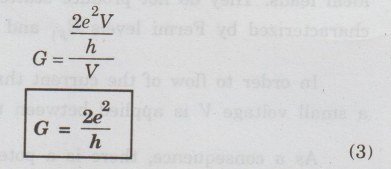
It
is interesting to observe that the conductance of the quantum wire is length
independent, in contrast to the classical case where it varies inversely to the
length.
The
quotient
G0
= e2 / h … (4)
is
called the quantum unit of conductance. The quantum resistance
value is given by
R0
= h/e2 = 25.81 k Ω … (5)
This
can be experimentally determined.
Since
the quantity 2e2/h appears very often, it is usually called fundamental
conductance.
The
above results on quantum conductance and resistance have been derived in the
simplest possible manner, using a 1D mesoscopic system.
This
quantification of macroscopic classical concepts, like conductance and
resistance, is of fundamental importance in mesoscopic physics.
Carbon
In
nanotechnology, researchers are looking out for certain materials with desired
properties through which the nanoscale components and structures can be
obtained.
Carbon
is found to be one such material suitable for nano- technology based components
due to its inherent desirable properties.
Carbon
is a unique atom among other elements because of its ability to exist in a wide
variety of structures and forms as shown in the fig. 5.14.
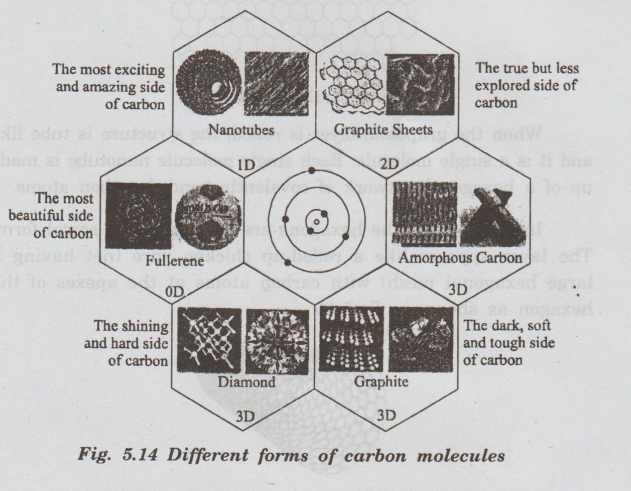
Pure
carbon exists in four different crystalline forms namely Diamond, Graphite,
Fullerenes and Nanotubes.
Carbon
atom is the basic building block of these crystalline structure. Among these, Fullerenes
and Nanotubes are found to be useful in nanotechnology for various
fabrication of nanostructures.
Physics for Electrical Engineering: Unit V: Nano Devices : Tag: : Nano Devices - Quantum resistance and conductance
Physics for Electrical Engineering: Unit V: Nano Devices
Under Subject
Physics for Electrical Engineering
PH3202 2nd Semester 2021 Regulation | 2nd Semester EEE Dept 2021 Regulation
Related Subjects
Professional English II
HS3251 2nd Semester 2021 Regulation | 2nd Semester Common to all Dept 2021 Regulation
Statistics and Numerical Methods
MA3251 2nd Semester 2021 Regulation M2 Engineering Mathematics 2 | 2nd Semester Common to all Dept 2021 Regulation
Engineering Graphics
GE3251 eg 2nd semester | 2021 Regulation | 2nd Semester Common to all Dept 2021 Regulation
Physics for Electrical Engineering
PH3202 2nd Semester 2021 Regulation | 2nd Semester EEE Dept 2021 Regulation
Basic Civil and Mechanical Engineering
BE3255 2nd Semester 2021 Regulation | 2nd Semester EEE Dept 2021 Regulation
Electric Circuit Analysis
EE3251 2nd Semester 2021 Regulation | 2nd Semester EEE Dept 2021 Regulation
Physics for Electronics Engineering
PH3254 - Physics II - 2nd Semester - ECE Department - 2021 Regulation | 2nd Semester ECE Dept 2021 Regulation
Electrical and Instrumentation Engineering
BE3254 - 2nd Semester - ECE Dept - 2021 Regulation | 2nd Semester ECE Dept 2021 Regulation
Circuit Analysis
EC3251 - 2nd Semester - ECE Dept - 2021 Regulation | 2nd Semester ECE Dept 2021 Regulation
Materials Science
PH3251 2nd semester Mechanical Dept | 2021 Regulation | 2nd Semester Mechanical Dept 2021 Regulation
Basic Electrical and Electronics Engineering
BE3251 2nd semester Mechanical Dept | 2021 Regulation | 2nd Semester Mechanical Dept 2021 Regulation
Physics for Civil Engineering
PH3201 2021 Regulation | 2nd Semester Civil Dept 2021 Regulation
Basic Electrical, Electronics and Instrumentation Engineering
BE3252 2021 Regulation | 2nd Semester Civil Dept 2021 Regulation
Physics for Information Science
PH3256 2nd Semester CSE Dept | 2021 Regulation | 2nd Semester CSE Dept 2021 Regulation
Basic Electrical and Electronics Engineering
BE3251 2nd Semester CSE Dept 2021 | Regulation | 2nd Semester CSE Dept 2021 Regulation
Programming in C
CS3251 2nd Semester CSE Dept 2021 | Regulation | 2nd Semester CSE Dept 2021 Regulation