Physics for Electrical Engineering: Unit V: Nano Devices
Properties of CNTs
Carbon nanotubes | Nano Devices
Carbon nanotubes are metallic or semiconducting depending on the diameter and chirality (ie., how the tubes are rolled).
PROPERTIES OF CNTs
(a) Electrical Properties
(i)
Carbon nanotubes are metallic or semiconducting depending on the diameter and
chirality (ie., how the tubes are rolled).
(ii)
The energy gap of semiconducting chiral carbon nanotubes is inversely
proportional to the diameter of the tube as shown in fig 5.18.
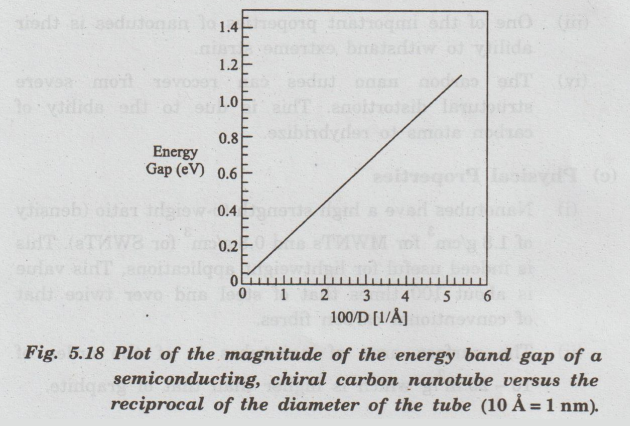
The
energy bandgap decreases with increase of diameter of the CNTs.
(iii)
The energy gap also varies along the tube axis and reaches a minimum value at
the tube ends. This is due to the presence of localized defects at the ends due
to the extra energy states.
(iv)
In SWNTs, conduction Occurs through discrete electronic states that are
coherent between the electrical contacts (hundreds of nanometers).
This
means that nanotubes can be treated as quantum wires atleast at very low
temperatures.
(b) Mechanical Properties
(i) The strength of the carbon-carbon bond is
very high bas as therefore any structure based on aligned carbon-carbon bonds
will ultimately have high strength.
(ii)
Young's modulus of CNT is about 1.8 TPa (1012 Pa about 10 times
larger than that of steel).
Nanotubes
have therefore high ultimate tensile-strength
(iii)
One of the important properties of nanotubes is their ability to withstand
extreme strain.
(iv)
The carbon nano tubes can recover from severe structural distortions. This is
due to the ability of carbon atoms to rehybridize. 8.0
(c) Physical Properties
(i)
Nanotubes have a high strength-to-weight ratio (density of 1.8 g/cm for MWNTs
and 0.8 g/cm3 for SWNTs). This is indeed useful for lightweight
applications. This value is about 100 times that of steel and over twice that
of conventional carbon fibres.
(ii)
The surface area of nanotubes is of the order of 10-20 mg which is higher than
that of graphite.
(d) Chemical properties
Nanotubes
are highly resistant to any chemical reaction. It is difficult to oxidize them
and the onset of oxidation in nanotubes is 100°C higher than that of carbon
fibres.
As
a result, temperature is not a limitation in practical application of
nanotubes.
(e) Thermal properties
Nanotubes
have a high thermal conductivity and the value increases with decrease in
diameter.
Physics for Electrical Engineering: Unit V: Nano Devices : Tag: : Carbon nanotubes | Nano Devices - Properties of CNTs
Physics for Electrical Engineering: Unit V: Nano Devices
Under Subject
Physics for Electrical Engineering
PH3202 2nd Semester 2021 Regulation | 2nd Semester EEE Dept 2021 Regulation
Related Subjects

Professional English II
HS3251 2nd Semester 2021 Regulation | 2nd Semester Common to all Dept 2021 Regulation
Statistics and Numerical Methods
MA3251 2nd Semester 2021 Regulation M2 Engineering Mathematics 2 | 2nd Semester Common to all Dept 2021 Regulation
Engineering Graphics
GE3251 eg 2nd semester | 2021 Regulation | 2nd Semester Common to all Dept 2021 Regulation
Physics for Electrical Engineering
PH3202 2nd Semester 2021 Regulation | 2nd Semester EEE Dept 2021 Regulation
Basic Civil and Mechanical Engineering
BE3255 2nd Semester 2021 Regulation | 2nd Semester EEE Dept 2021 Regulation
Electric Circuit Analysis
EE3251 2nd Semester 2021 Regulation | 2nd Semester EEE Dept 2021 Regulation
Physics for Electronics Engineering
PH3254 - Physics II - 2nd Semester - ECE Department - 2021 Regulation | 2nd Semester ECE Dept 2021 Regulation

Electrical and Instrumentation Engineering
BE3254 - 2nd Semester - ECE Dept - 2021 Regulation | 2nd Semester ECE Dept 2021 Regulation
Circuit Analysis
EC3251 - 2nd Semester - ECE Dept - 2021 Regulation | 2nd Semester ECE Dept 2021 Regulation
Materials Science
PH3251 2nd semester Mechanical Dept | 2021 Regulation | 2nd Semester Mechanical Dept 2021 Regulation
Basic Electrical and Electronics Engineering
BE3251 2nd semester Mechanical Dept | 2021 Regulation | 2nd Semester Mechanical Dept 2021 Regulation
Physics for Civil Engineering
PH3201 2021 Regulation | 2nd Semester Civil Dept 2021 Regulation

Basic Electrical, Electronics and Instrumentation Engineering
BE3252 2021 Regulation | 2nd Semester Civil Dept 2021 Regulation
Physics for Information Science
PH3256 2nd Semester CSE Dept | 2021 Regulation | 2nd Semester CSE Dept 2021 Regulation
Basic Electrical and Electronics Engineering
BE3251 2nd Semester CSE Dept 2021 | Regulation | 2nd Semester CSE Dept 2021 Regulation

Programming in C
CS3251 2nd Semester CSE Dept 2021 | Regulation | 2nd Semester CSE Dept 2021 Regulation