Basic Civil & Mechanical Engineering: UNIT II: d. Levelling
Classification of levelling
Surveying
In Simple Levelling, we find the difference of level between two stations which are not far away.
CLASSIFICATION OF LEVELLING
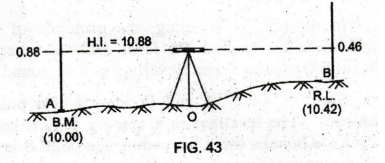
1. SIMPLE LEVELLING (Fig. 43)
In
Simple Levelling, we find the difference of level between two stations which
are not far away.
Fig.
43 shows a levelling instrument setup at station O, placed approximately midway
between the two stations A and B. Station O need not lie on the line joining A
and B.
To
determine the Elevation of Station B
Bench
Mark (B.M.) of staff A is 10 m, which is the known elevation of A. The reading
of the staff at A is first noted as 0.88 m. Then, reading of the staff at B is
noted as 0.46 m, after adjusting the bubble to be at the center and the
telescope becomes horizontal.
The
difference in elevation between A and B = 0:88 m - 0.46 m = 0.42. m. Further,
the station A on which a greater staff reading is obtained, is at a lower
level. That is, A is at a lower level than B by 0.42 m.
Note:
If
the Reduced Level (R.L.) of A is 10, then R.L. of B is found as follows:
Height
of the instrument at O H.I. = (10 + 0.88) m = 10.88 m
R.L.
of B (i.e., elevation of B) = [(10 + 0.88) -0.46] m
=
(10 + 0.42) m
=
10.42 m
PROBLEM
1:
The staff readings taken at stations A and B are 2.750 and 0.725 m
respectively. Find the R.L. of B if the R.L. of A is 50.000 and the difference
in level between A and B. (UD)
Solution:
Given:
R.L. of A = 50.000; B.S. = 2.750; F.S. = 0.725
Height
of Instrument (H.I.) = R.L. + B.S. =
50.000 + 2.750 = 52.750
R.L.
of B = H.I. - F.S.
=
52.750 – 0.725 = 52.025 m
Difference
in level between A & B = R.L. of B - R.L. of A = 52.025 – 50.000 = 2.025 m
Or
Difference in level between A & B = B.S. on A - F.S. on B = 2.750 - 0.725 =
2.025 m
2. DIFFERENTIAL LEVELLING or SERIES LEVELLING or COMPOUND LEVELLING
Differential
Levelling requires more than one setting of the levelling instrument to determine
the difference in level (elevation) between two points,
-
when they are too far apart, - when the difference in elevation between them is
too great, or
-
when they are intervened by obstacles and the levels could not be found from a
single setup of the instrument.
In
differential levelling, the principle of simple levelling is employed in
series, in successive stages, to find the level difference between the points
which are quite far apart. Hence, it is known as Series Levelling or Compound
Levelling.
See
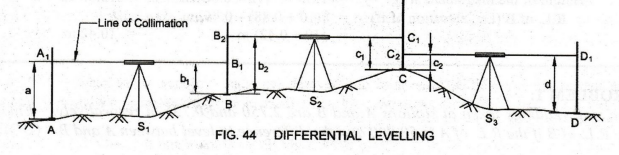
Fig. 44. A and D are the two points whose difference in elevation is to be
determined. The levelling staff reading at A is noted as a from the station
point Sı. After adjusting the bubble, the staff reading at a point B is noted
from Si as bı. B is selected such that AS, is approximately equal to S1B.
Note
that the staff reading a is the Back Sight (B.S.) and bi is the Fore Sight
(F.S.).
Then,
the levelling instrument is shifted to the station point S2. The staff reading
at B from S2 is noted as b2. Another point C is selected for the levelling
staff. The above procedure is repeated till the end point D is reached.
The
difference in level between the levelling staffs A and B is (a - bi).
Similarly, the difference in level between levelling staffs B and C is (b2 -
ci) and so on. Thus, the difference in level between the end points A and D
=
algebraic sum of the differences calculated above
=
(a - b1) + (b2 – C1) + (C2 – d)
Basic Civil & Mechanical Engineering: UNIT II: d. Levelling : Tag: : Surveying - Classification of levelling
Basic Civil & Mechanical Engineering: UNIT II: d. Levelling
Under Subject
Basic Civil and Mechanical Engineering
BE3255 2nd Semester 2021 Regulation | 2nd Semester EEE Dept 2021 Regulation
Related Subjects

Professional English II
HS3251 2nd Semester 2021 Regulation | 2nd Semester Common to all Dept 2021 Regulation
Statistics and Numerical Methods
MA3251 2nd Semester 2021 Regulation M2 Engineering Mathematics 2 | 2nd Semester Common to all Dept 2021 Regulation
Engineering Graphics
GE3251 eg 2nd semester | 2021 Regulation | 2nd Semester Common to all Dept 2021 Regulation

Physics for Electrical Engineering
PH3202 2nd Semester 2021 Regulation | 2nd Semester EEE Dept 2021 Regulation
Basic Civil and Mechanical Engineering
BE3255 2nd Semester 2021 Regulation | 2nd Semester EEE Dept 2021 Regulation
Electric Circuit Analysis
EE3251 2nd Semester 2021 Regulation | 2nd Semester EEE Dept 2021 Regulation

Physics for Electronics Engineering
PH3254 - Physics II - 2nd Semester - ECE Department - 2021 Regulation | 2nd Semester ECE Dept 2021 Regulation

Electrical and Instrumentation Engineering
BE3254 - 2nd Semester - ECE Dept - 2021 Regulation | 2nd Semester ECE Dept 2021 Regulation
Circuit Analysis
EC3251 - 2nd Semester - ECE Dept - 2021 Regulation | 2nd Semester ECE Dept 2021 Regulation

Materials Science
PH3251 2nd semester Mechanical Dept | 2021 Regulation | 2nd Semester Mechanical Dept 2021 Regulation

Basic Electrical and Electronics Engineering
BE3251 2nd semester Mechanical Dept | 2021 Regulation | 2nd Semester Mechanical Dept 2021 Regulation
Physics for Civil Engineering
PH3201 2021 Regulation | 2nd Semester Civil Dept 2021 Regulation

Basic Electrical, Electronics and Instrumentation Engineering
BE3252 2021 Regulation | 2nd Semester Civil Dept 2021 Regulation

Physics for Information Science
PH3256 2nd Semester CSE Dept | 2021 Regulation | 2nd Semester CSE Dept 2021 Regulation

Basic Electrical and Electronics Engineering
BE3251 2nd Semester CSE Dept 2021 | Regulation | 2nd Semester CSE Dept 2021 Regulation
Programming in C
CS3251 2nd Semester CSE Dept 2021 | Regulation | 2nd Semester CSE Dept 2021 Regulation