Basic Civil & Mechanical Engineering: UNIT II: d. Levelling
Principle of levelling
Surveying
The Principle of Levelling is that a Spirit Level (bubble tube) is to establish a line called the Line of Collimation or Line of Sight.
PRINCIPLE OF LEVELLING
The
Principle of Levelling is that a Spirit Level (bubble tube) is to establish a
line called the Line of Collimation or Line of Sight. The established line lies
in a horizontal plane. It is made to pass through the horizontal crosshair of
the instrument. When the levelling instrument is properly levelled,
(i)
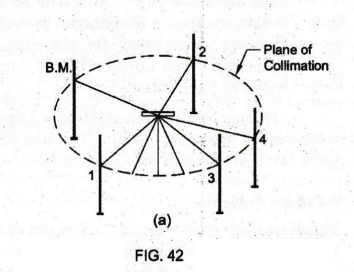
the telescope revolves in a horizontal plane known as Plane of Collimation,
when it is : rotated about the vertical axis;
(ii)
the readings taken on various staff stations are the vertical measurements
below or above the plane of collimation.
See
Fig. 42(a). All the points 1, 2, 3 and 4, where the line of sight strikes, are
in the same horizontal plane.
Further,
the horizontal distances in levelling between the instrument and staff stations
are negligible. Hence, all the points in the horizontal line are taken to lie
on the same level.
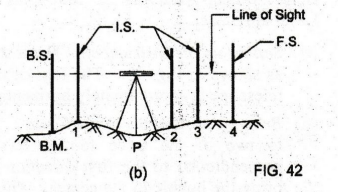
See
Fig. 42(b). In levelling practice, there are two important steps:
1.
The levelling instrument is setup at a convenient position. A levelling staff
is held at a point of known elevation (say, B.M. or C.P.). The B.S. is taken on
the staff and the reduced level of line of sight (Height of Instrument H.I.) is
determined.
2.
The staff is then held on points of unknown elevations and staff readings (F.S.
or I.S.) are taken.. The level (R.L.) of the points are computed from the R.L.
of the line of sight (H.I.) and the staff readings.
Height
of Instrument (H.I.) = R.L. of line of sight = R.L. of B.M. + B.S.
R.L.
of a point = H.I. - F.S. or H.I. - I.S.
Note:
1. After every B.S., there must be a F.S. But, there may be many Intermediate
Sights (I.S.).
2.
Levelling must always commence from a permanent B.M. and end on a permanent
B.M.
Basic Civil & Mechanical Engineering: UNIT II: d. Levelling : Tag: : Surveying - Principle of levelling
Basic Civil & Mechanical Engineering: UNIT II: d. Levelling
Under Subject
Basic Civil and Mechanical Engineering
BE3255 2nd Semester 2021 Regulation | 2nd Semester EEE Dept 2021 Regulation
Introduction to Civil Engineering
CE25C01 1st Semester Civil, Agri Departments | 2025 Regulation | 1st Semester 2025 Regulation
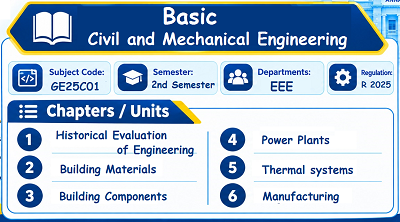
Basic Civil and Mechanical Engineering
GE25C01 2nd Semester EEE Dept | 2025 Regulation | 2nd Semester 2025 Regulation
Related Subjects
Professional English II
HS3251 2nd Semester 2021 Regulation | 2nd Semester Common to all Dept 2021 Regulation
Statistics and Numerical Methods
MA3251 2nd Semester 2021 Regulation M2 Engineering Mathematics 2 | 2nd Semester Common to all Dept 2021 Regulation
Engineering Graphics
GE3251 eg 2nd semester | 2021 Regulation | 2nd Semester Common to all Dept 2021 Regulation
Physics for Electrical Engineering
PH3202 2nd Semester 2021 Regulation | 2nd Semester EEE Dept 2021 Regulation
Basic Civil and Mechanical Engineering
BE3255 2nd Semester 2021 Regulation | 2nd Semester EEE Dept 2021 Regulation
Electric Circuit Analysis
EE3251 2nd Semester 2021 Regulation | 2nd Semester EEE Dept 2021 Regulation
Physics for Electronics Engineering
PH3254 - Physics II - 2nd Semester - ECE Department - 2021 Regulation | 2nd Semester ECE Dept 2021 Regulation
Electrical and Instrumentation Engineering
BE3254 - 2nd Semester - ECE Dept - 2021 Regulation | 2nd Semester ECE Dept 2021 Regulation
Circuit Analysis
EC3251 - 2nd Semester - ECE Dept - 2021 Regulation | 2nd Semester ECE Dept 2021 Regulation
Materials Science
PH3251 2nd semester Mechanical Dept | 2021 Regulation | 2nd Semester Mechanical Dept 2021 Regulation
Basic Electrical and Electronics Engineering
BE3251 2nd semester Mechanical Dept | 2021 Regulation | 2nd Semester Mechanical Dept 2021 Regulation
Physics for Civil Engineering
PH3201 2021 Regulation | 2nd Semester Civil Dept 2021 Regulation
Basic Electrical, Electronics and Instrumentation Engineering
BE3252 2021 Regulation | 2nd Semester Civil Dept 2021 Regulation
Physics for Information Science
PH3256 2nd Semester CSE Dept | 2021 Regulation | 2nd Semester CSE Dept 2021 Regulation
Basic Electrical and Electronics Engineering
BE3251 2nd Semester CSE Dept 2021 | Regulation | 2nd Semester CSE Dept 2021 Regulation
Programming in C
CS3251 2nd Semester CSE Dept 2021 | Regulation | 2nd Semester CSE Dept 2021 Regulation