Physics for Electrical Engineering: Unit I: Dielectric Materials and Insulation
Local field or Internal field
Lorentz field
When a dielectric material is placed in an externa electrical field, it produces an induced dipole moment.
LOCAL
FIELD OR INTERNAL FIELD
When
a dielectric material is placed in an externa electrical field, it produces an
induced dipole moment.
Now,
there are electrical fields acting at any point inside dielectrics.
(i) macroscopic electric field due
to external electrical field
(ii) electrical field due to
electric dipole moment
This long-range coulomb electrical
field produced due to dipoles is known as internal field or local field.
It is responsible for polarisation
of each atom or molecule in a solid.
Lorentz method to find internal
field (Derivation)
The
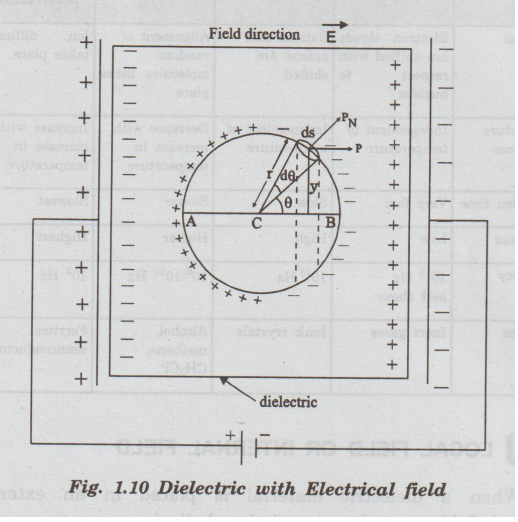
dielectric material is uniformly polarised by placing it in between two plates
of a parallel plate capacitor (uniform electrical field) as shown in fig. 1.10.
To
find internal field acting on an atom at C of dielectric, let us consider an
imaginary small spherical cavity around the atom.
The
internal field (Eint) at the atom site is considered to be resultant
of the following four components. E1, E2, E3
and E4
i.e.,
Eint = E1+E2+E3+E4...
(1)
where
E1
→ Electrical field due to charges on the plates of the capacitor (without
dielectric)
E2
→ Electrical field due to polarised charges (induced charges) on the plane
surface of the dielectric
E3
→ Electrical field due to polarised charges induced on the surface of the imaginary
spherical cavity (to be calculated)
E4
→ Electrical field due to permanent dipoles of atoms inside the spherical
cavity considered
Macroscopically,
we can take E = E1 +E2 i.e., the electrical field
externally applied (E1) and the electrical field induced on the
plane surface of the dielectric (E2) is considered as a single
electrical field (E).
If
we consider a dielectric that is highly symmetric, the electrical field due to
dipoles present inside the imaginary cavity will cancel out each other. Therefore,
the electrical field due to permanent dipoles present inside the cavity E4
= 0.
Now,
the equation (1) reduces to
Eint
= E+E3 .....(2)
Calculation of E3
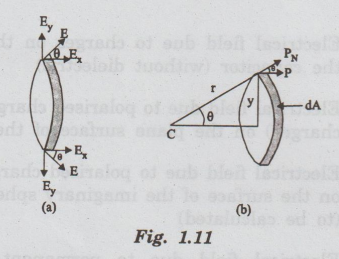
Let
us consider a small area ds on the surface of spherical cavity. It is confined
within an angle dθ at an angle θ in the direction of electrical
field E.
Polarisation
(P) is parallel to E. PN is the component of polarisation
perpendicular to the area ds as shown in fig. 1.11.
PN
= P cos θ
q' is the charge on the area ds.
Polarisation
is also defined as the surface charges per unit area
PN
= q'/ ds
PN
= P cos θ = q' / ds
Charge
on ds, q'= P cos θ ds.............(3)
Electrical
field intensity at C due to charge q' (Coulomb's law) is given by
E
= q' / 4 πεor2
Substituting
for q' from the eqn (3), we have
E
= P cos θ ds / 4πεor2......(4)
This
electrical field intensity is along the radius r and it is resolved into two
components (Ex and Ey) as shown in fig. 1.11(a).
The
component of intensity parallel to the electrical field direction
Ex
= E cos θ ....(5)
Substituting
E from eqn (4) in eqn (5), we have
Ex
= P cos θ ds cos θ / 4 πεor2
Ex=
P cos2 θ ds/4 πεor2.....(6)
The
component of intensity perpendicular to the field direction,
Ey
= E sin θ
Since
the perpendicular components are in opposite directions [fig. 1.11 (a)], they
cancel out each other. Hence, the parallel components alone are taken into
consideration.
Now,
consider a ring of area dA which is obtained by revolving ds about AB [fig.
1.11 (b)].
Electrical
field intensity due to charges present in the whole sphere is obtained by
integrating equation (9) within the limits 0 to л. This electric field is taken
as E3.
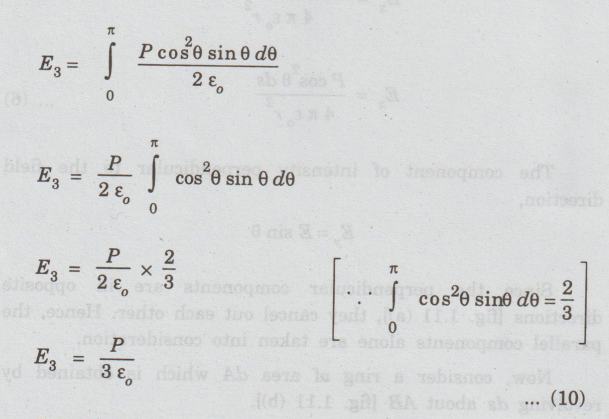
Substituting
eqn (10) in eqn (2), we get
Eint
= E+ P / 3ε0 ......(11)
Eint
is the internal field or Lorentz field.
The
equation (11) shows that Eint is larger than the macroscopic field
intensity E. Hence, the molecules are more effectively polarised.
Physics for Electrical Engineering: Unit I: Dielectric Materials and Insulation : Tag: : Lorentz field - Local field or Internal field
Physics for Electrical Engineering: Unit I: Dielectric Materials and Insulation
Under Subject

Physics for Electrical Engineering
PH3202 2nd Semester 2021 Regulation | 2nd Semester EEE Dept 2021 Regulation
Related Subjects

Professional English II
HS3251 2nd Semester 2021 Regulation | 2nd Semester Common to all Dept 2021 Regulation
Statistics and Numerical Methods
MA3251 2nd Semester 2021 Regulation M2 Engineering Mathematics 2 | 2nd Semester Common to all Dept 2021 Regulation
Engineering Graphics
GE3251 eg 2nd semester | 2021 Regulation | 2nd Semester Common to all Dept 2021 Regulation
Physics for Electrical Engineering
PH3202 2nd Semester 2021 Regulation | 2nd Semester EEE Dept 2021 Regulation

Basic Civil and Mechanical Engineering
BE3255 2nd Semester 2021 Regulation | 2nd Semester EEE Dept 2021 Regulation
Electric Circuit Analysis
EE3251 2nd Semester 2021 Regulation | 2nd Semester EEE Dept 2021 Regulation
Physics for Electronics Engineering
PH3254 - Physics II - 2nd Semester - ECE Department - 2021 Regulation | 2nd Semester ECE Dept 2021 Regulation

Electrical and Instrumentation Engineering
BE3254 - 2nd Semester - ECE Dept - 2021 Regulation | 2nd Semester ECE Dept 2021 Regulation
Circuit Analysis
EC3251 - 2nd Semester - ECE Dept - 2021 Regulation | 2nd Semester ECE Dept 2021 Regulation

Materials Science
PH3251 2nd semester Mechanical Dept | 2021 Regulation | 2nd Semester Mechanical Dept 2021 Regulation

Basic Electrical and Electronics Engineering
BE3251 2nd semester Mechanical Dept | 2021 Regulation | 2nd Semester Mechanical Dept 2021 Regulation
Physics for Civil Engineering
PH3201 2021 Regulation | 2nd Semester Civil Dept 2021 Regulation

Basic Electrical, Electronics and Instrumentation Engineering
BE3252 2021 Regulation | 2nd Semester Civil Dept 2021 Regulation

Physics for Information Science
PH3256 2nd Semester CSE Dept | 2021 Regulation | 2nd Semester CSE Dept 2021 Regulation

Basic Electrical and Electronics Engineering
BE3251 2nd Semester CSE Dept 2021 | Regulation | 2nd Semester CSE Dept 2021 Regulation
Programming in C
CS3251 2nd Semester CSE Dept 2021 | Regulation | 2nd Semester CSE Dept 2021 Regulation