Physics for Electrical Engineering: Unit I: Dielectric Materials and Insulation
Matter Polarisation - Electronics Polarisation
Definition, Formula
The electrical behaviour of a dielectric material can be changed by the application of an external electrical field.
MATTER POLARISATION - Electronics Polarisation
The electrical behaviour of a dielectric material can be changed by the application of an external electrical field.
When an external electrical field is applied to a dielectric, it exerts a force on both positive and negative-charged particles of each atom present in the dielectric material.
The positive charges are pushed in the same direction as that of the electrical field while negative charges are pushed in the opposite direction. (fig. 1.3)
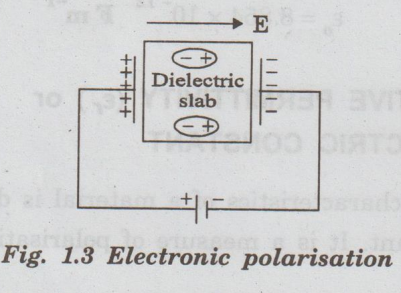
Consequently, the centres of positive and negative charges of each atom are displaced from their equilibrium positions in opposite directions.
This displacement of electrical charges produces local dipoles or electrical doublet throughout the dielectric. Now, the dielectric is said to be polarised.
Definition
The process of producing electrical dipoles inside the dielectric by the application of an external electrical field is called polarisation in dielectrics.
Polarisability (α)
It is found that the average dipole moment ( ) of a system is proportional to the applied electric field (E).
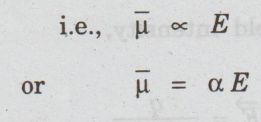
where α is proportionality constant and it is known as the polarisability.
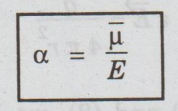
Polarisability is defined as the ratio of average dipole moment to the electric field applied. Its unit is farad m2 or Fm2.
Physics for Electrical Engineering: Unit I: Dielectric Materials and Insulation : Tag: : Definition, Formula - Matter Polarisation - Electronics Polarisation
Physics for Electrical Engineering: Unit I: Dielectric Materials and Insulation
Under Subject
Physics for Electrical Engineering
PH3202 2nd Semester 2021 Regulation | 2nd Semester EEE Dept 2021 Regulation
Related Subjects

Professional English II
HS3251 2nd Semester 2021 Regulation | 2nd Semester Common to all Dept 2021 Regulation
Statistics and Numerical Methods
MA3251 2nd Semester 2021 Regulation M2 Engineering Mathematics 2 | 2nd Semester Common to all Dept 2021 Regulation
Engineering Graphics
GE3251 eg 2nd semester | 2021 Regulation | 2nd Semester Common to all Dept 2021 Regulation
Physics for Electrical Engineering
PH3202 2nd Semester 2021 Regulation | 2nd Semester EEE Dept 2021 Regulation
Basic Civil and Mechanical Engineering
BE3255 2nd Semester 2021 Regulation | 2nd Semester EEE Dept 2021 Regulation
Electric Circuit Analysis
EE3251 2nd Semester 2021 Regulation | 2nd Semester EEE Dept 2021 Regulation
Physics for Electronics Engineering
PH3254 - Physics II - 2nd Semester - ECE Department - 2021 Regulation | 2nd Semester ECE Dept 2021 Regulation

Electrical and Instrumentation Engineering
BE3254 - 2nd Semester - ECE Dept - 2021 Regulation | 2nd Semester ECE Dept 2021 Regulation
Circuit Analysis
EC3251 - 2nd Semester - ECE Dept - 2021 Regulation | 2nd Semester ECE Dept 2021 Regulation
Materials Science
PH3251 2nd semester Mechanical Dept | 2021 Regulation | 2nd Semester Mechanical Dept 2021 Regulation

Basic Electrical and Electronics Engineering
BE3251 2nd semester Mechanical Dept | 2021 Regulation | 2nd Semester Mechanical Dept 2021 Regulation

Physics for Civil Engineering
PH3201 2021 Regulation | 2nd Semester Civil Dept 2021 Regulation

Basic Electrical, Electronics and Instrumentation Engineering
BE3252 2021 Regulation | 2nd Semester Civil Dept 2021 Regulation
Physics for Information Science
PH3256 2nd Semester CSE Dept | 2021 Regulation | 2nd Semester CSE Dept 2021 Regulation

Basic Electrical and Electronics Engineering
BE3251 2nd Semester CSE Dept 2021 | Regulation | 2nd Semester CSE Dept 2021 Regulation
Programming in C
CS3251 2nd Semester CSE Dept 2021 | Regulation | 2nd Semester CSE Dept 2021 Regulation