Electric Circuit Analysis: Model Question and Answer
Model Question and Answer - 1 PART A
Electric Circuit Analysis
Electric Circuit Analysis: Model Question and Answer
MODEL QUESTION AND
ANSWER
MODEL QUESTION PAPER - I
1. State Kirchhoffs law
KCL:
The algebraic sum of currents meeting at
a junction (node) is equal to zero.
KVL:
The algebraic sum of EMF plus the algebraic sum of voltage across the impedance
in any closed electrical circuit is equal to zero.
2. Write the mesh equations for the
circuit shown in Figure.
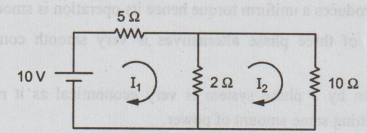
Ans
:
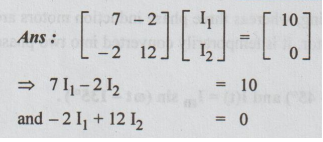
⇒ 7I1 – 2I2
= 10
and
- 2 I1 + I 2I2= 0
3. State superposition theorem.
"In
a linear circuit containing more than one source, the current that flows at any
point or the voltage that exists between any two points is the algebraic sum of
the currents or the voltages that would have been produced by each source taken
separately with all other sources removed."
4. State Reciprocity theorem.
Statement:
In a linear, bilateral network a voltage source V volts in a branch gives rise
to a current I, in another branch. If V is applied in the second branch, the
current in the first branch will V be I. This V/I is called transfer impedance
or resistance.
5. Define transient time.
The
time required for the network to change from one steady state to another steady
state is called transient time or period.
6. A resistance of 5Ω and an
inductance of 0.03 H are connected in series with a voltage source of 10 V
(dc). Find the time constant of the circuit.
Ans:
Time constant T = L / R
=
0.03 / 5 sec
=
6 × 10⁻³ sec
=
6 ms
7. What are the advantages of
3-phase system over 1-phase system? phase system over 1-phase system?
Advantages
of 3ϕ systems:
1.
For the same size a 3 phase machine delivers more power than single phase
machine. A three phase induction motor delivers 1.5 times the power as single
phase motor of same size. Thus 3 phase machines are economical and occupy less
space as compared to equivalent single ys niphase machines.
2. Single phase machine's performance is not
satisfactory, for example a single phase induction motor produces pulsating
torque and hence is not desirable compared to this a three phase induction
motor produces a uniform torque hence its operation is smooth and steady.
3.
Parallel operation of three phase alternatives is very smooth compared to single
phase alternators.
4.
Power transmission by 3 phase system is very economical as it requires less
amount of copper for transmitting same amount of power.
5.
Single phase induction motors are not self starting, whereas three phase
induction motors are self starting. To start single phase induction motor, it
is temporarily converted into two phase induction motor.
8. Calculate the power factor if
V(t) = Vm sin (ωt - 45°) and I(t) = Im sin (ωt-135°).
Power
factor = cos ϕ
=
cos ϕ ( Voltage angle - Current angle)
=cos
(-45+135)
=
cos 90°
=
0
9. Define Bandwidth.
The
bandwidth of a resonant circuit is defined as the difference of the upper half
power frequencies and lower half power frequencies.
Bandwidth
= f2 - f1
f1
= Lower half power frequency
f2
= Upper half power frequency
10. Define quality factor of a
coil.
The
quality factor of a coil is determined by the maximum amount of energy that can
be stored in the circuit compared with the energy that is lost during one
complete period of the response.
Q
= Quality factor
=
2 π Maximum energy stored / Total energy
lost in one period
Electric Circuit Analysis: Model Question and Answer : Tag: : Electric Circuit Analysis - Model Question and Answer - 1 PART A
Electric Circuit Analysis: Model Question and Answer
Under Subject
Electric Circuit Analysis
EE3251 2nd Semester 2021 Regulation | 2nd Semester EEE Dept 2021 Regulation
Circuits and Network Analysis
EC25C02 2nd Semester ECE Dept | 2025 Regulation | 2nd Semester 2025 Regulation
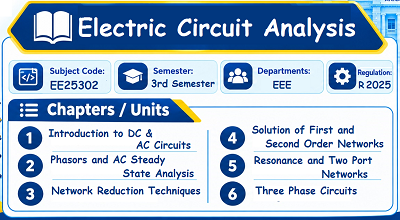
Electric Circuit Analysis
EE25302 3rd Semester EEE Dept | 2025 Regulation | 3rd Semester 2025 Regulation
Related Subjects

Professional English II
HS3251 2nd Semester 2021 Regulation | 2nd Semester Common to all Dept 2021 Regulation
Statistics and Numerical Methods
MA3251 2nd Semester 2021 Regulation M2 Engineering Mathematics 2 | 2nd Semester Common to all Dept 2021 Regulation

Engineering Graphics
GE3251 eg 2nd semester | 2021 Regulation | 2nd Semester Common to all Dept 2021 Regulation
Physics for Electrical Engineering
PH3202 2nd Semester 2021 Regulation | 2nd Semester EEE Dept 2021 Regulation
Basic Civil and Mechanical Engineering
BE3255 2nd Semester 2021 Regulation | 2nd Semester EEE Dept 2021 Regulation
Electric Circuit Analysis
EE3251 2nd Semester 2021 Regulation | 2nd Semester EEE Dept 2021 Regulation
Physics for Electronics Engineering
PH3254 - Physics II - 2nd Semester - ECE Department - 2021 Regulation | 2nd Semester ECE Dept 2021 Regulation
Electrical and Instrumentation Engineering
BE3254 - 2nd Semester - ECE Dept - 2021 Regulation | 2nd Semester ECE Dept 2021 Regulation
Circuit Analysis
EC3251 - 2nd Semester - ECE Dept - 2021 Regulation | 2nd Semester ECE Dept 2021 Regulation
Materials Science
PH3251 2nd semester Mechanical Dept | 2021 Regulation | 2nd Semester Mechanical Dept 2021 Regulation
Basic Electrical and Electronics Engineering
BE3251 2nd semester Mechanical Dept | 2021 Regulation | 2nd Semester Mechanical Dept 2021 Regulation
Physics for Civil Engineering
PH3201 2021 Regulation | 2nd Semester Civil Dept 2021 Regulation
Basic Electrical, Electronics and Instrumentation Engineering
BE3252 2021 Regulation | 2nd Semester Civil Dept 2021 Regulation

Physics for Information Science
PH3256 2nd Semester CSE Dept | 2021 Regulation | 2nd Semester CSE Dept 2021 Regulation
Basic Electrical and Electronics Engineering
BE3251 2nd Semester CSE Dept 2021 | Regulation | 2nd Semester CSE Dept 2021 Regulation
Programming in C
CS3251 2nd Semester CSE Dept 2021 | Regulation | 2nd Semester CSE Dept 2021 Regulation