Electric Circuit Analysis: Two Mark Question and Answers
Two Mark Question and Answers set - 6
Electric Circuit Analysis
Electric Circuit Analysis: Two Mark Question and Answers
126. State maximum power transfer
theorem.
Ans:
The theorem is defined as below for a D.C. circuit. "Maximum power will be
delivered from a voltage source to a load, when the load resistance is equal to
the internal resistance of the source."
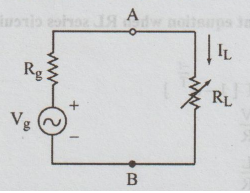
Refer
the figure given. When power delivered to RL is maximum,
RL
= Rg
127. Write some applications of
maximum power transfer theorem.
Ans:
1. In communication circuits.
2.
In power networks.
128. The power delivered is maximum
if the load impedance is equal to the supply circuit impedance - True or False.
Ans:
True.
129. The transients are due to the
presence of energy storing elements in the circuit - True or False.
Ans:
True.
130. What is a step function?
Ans:
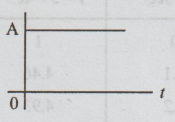
A step function is defined mathematically as f (t) = A u(t),
where
u (t) = 1 for t > 0
=
0 for t < 0
Graphically
it is shown as below.
131. What is an initial condition?
Ans:
Initial
conditions of a network are the values of currents and voltage just before
switching. The instant just before switching is denoted by t = 0-. The instant
exactly at switching is denoted by t = 0 and the instant just after switching
is denoted by t = 0+.
132. What is a transient ?
Ans:
If a circuit containing one or more energy-storage elements (such as L and C)
is excited by a source which abruptly changes its value, the energy state of
the circuit is disturbed. This disturbance may also be due to variation of the
storage elements and also due to switching conditions.
After
certain time, the circuit settles down to a new steady state operation. The
time required for the circuit to change from one steady state to another steady
state is known as transient period. The values of voltage and current within
this period are known as transient response or simply transients.
133. What is the steady state value
?
Ans:
A circuit consisting of constant sources is said to be in steady state if the
voltages and currents do not change with time.
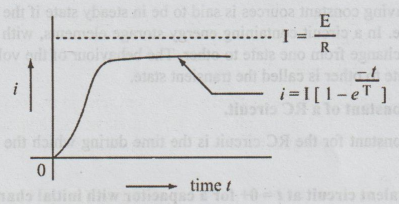
134. Write the transient current
equation when RL series circuit is connected to a step voltage of V volts.
Ans:
I
= I [ 1 – e-1/T]
where
I = V / R
T
= Time constant = L / R
135. A D.C. voltage of 100 volts is
applied to a series RL circuit with R = 25Ω.What will be the current in the
circuit at twice the time constant ?
Ans:As
the voltage source exists, there is rise of current in the circuit,
i
= I [1-e-t/T ]
Here
I = V/R = 100/25 = 4A
Given
that t = 2T
i
= 4 [1-e-2T/T ]
=
4 [1-e-2] = 3.46 A
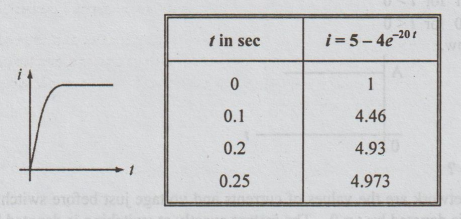
136. Sketch the current given by i
(t)=5 - 4e-20t.
137. Distinguish between free and
forced response.
Ans:
When a circuit contains storage elements which are independent of the sources,
the response depends upon the nature of circuit. This response is called
natural or free response.
The
storage elements deliver the energy to the resistances. So, the response
changes with time, gets saturated after some time. It is referred to as the
transient response. When we consider sources acting on a circuit, the response
depends on the nature of such sources. This response is called forced response.
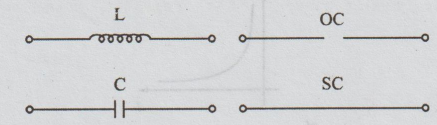
138. Draw the equivalent circuit
for inductor and capacitor at t = 0+ when there is no initial energy.
Ans:
139. Define a time constant of a RL
circuit.
Ans:
The time constant of RL series circuit is defined as the period during which
the current rises to 63.22% of its final value.
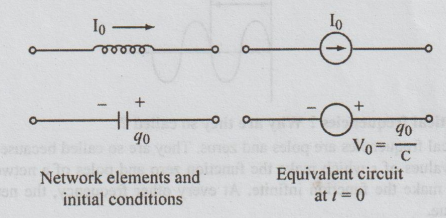
140. Draw the equivalent circuit
for the inductor and capacitor at t = 0+ with presence of initial energy.
Ans
:
141. Distinguish between the steady
state and the transient response of an electrical circuit.
Ans:
A circuit having constant sources is said to be in steady state if the currents
and the voltages do not vary with time. In a circuit containing energy storage
elements, with change in excitation, the voltage and currents change from one
state to other. The behaviour of the voltage or current when it is changed from
one state to other is called the transient state.
142. Define a time constant of a RC
circuit.
Ans:
The time constant for the RC circuit is the time during which the current falls
to 36.8% of initial current.
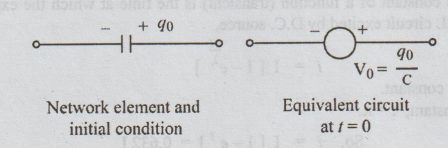
143.
Draw the equivalent circuit at t=0+ for a capacitor with initial charge of q0.
Ans:
144. Sketch the response of RC
network for a unit step input.
Ans
:
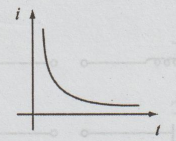
i
= 1 e-1/λ
λ
= CR called time constant.
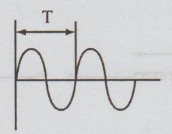
145. What are periodic inputs ?
Ans:
Periodic functions are those for which f (t) = f(t + nπ), where n is an integer
and T is the period. As example, sine wave form
146. What are critical frequencies?
Why are they so called?
Ans:
The
critical frequencies are poles and zeros. They are so called because zeros of
the network function give the values of s which make the function zero and
poles of a network function give the values of s which make the function
infinite. At every other frequency, the network function has a finite non-zero
value.
147. Draw the transient response of
R-L circuit for step input.
Ans
:
148. Define the time constant of a transient response.
Ans:
The
time constant of a function (transient) is the time at which the exponent of e
is unity. For example, for RL circuit excited by D.C. source,
i
= I [1-e-1/λ ]
λ
is called time constant.
At
one time constant, t = λ.
So,
i = I [1- e-1] = 0.632 I
149. Find the time constant of RL
circuit having R = 10Ω and L = 0.1 mH.
Ans
:
R
= 10 Ω and L = 0.1 mH
T
= L / R = 0.1 × 10⁻³ / 10
=
10-5 sec = 10 μ sec
150. What is meant by critical
damping?
Ans:
For RLC series circuit excited by a D.C. source, if (R/2L)2 = 1/LC,
the current is said to be critically
damped.
151. Define logarithmic decrement.
Ans:
For RLC series circuit, excited by a D.C. source,if
(R/2L)2
< 1/LC, the current i is said to be oscillatory.
It
is called under-damping one. We can write that,
loge
v = 2πα / β
v
= e 2πα / β
loge
v = ∆
∆
is called logarithmic decrement.
152. Define damping ratio.
Ans:
Consider a RLC circuit. The ratio of value of resistance in a circuit to the
resistance for critical damping is called damping ratio and is denoted by σ.
153. What is meant by free
response?
Ans:
Free response is also known as natural response or transient response. It is
due to the internal energy stored in the network. It depends upon the type of
elements, their size, etc. This response is independent of the source. The
natural response dies gradually. i.e., It approaches zero as time becomes
infinity.
154. What is meant by a natural
frequency and a damped frequency?
Ans:
The natural frequency of oscillation is given by
ωn
= 1/ √LC
Damped
frequency
=
β = ωn √1-
σ2
155. Write the expression for the
natural frequency for a RLC series circuit.
Ans:
Natural frequency ωn = 1 /
√LC
Rad/sec.
Electric Circuit Analysis: Two Mark Question and Answers : Tag: : Electric Circuit Analysis - Two Mark Question and Answers set - 6
Electric Circuit Analysis: Two Mark Question and Answers
Under Subject
Electric Circuit Analysis
EE3251 2nd Semester 2021 Regulation | 2nd Semester EEE Dept 2021 Regulation
Related Subjects
Professional English II
HS3251 2nd Semester 2021 Regulation | 2nd Semester Common to all Dept 2021 Regulation
Statistics and Numerical Methods
MA3251 2nd Semester 2021 Regulation M2 Engineering Mathematics 2 | 2nd Semester Common to all Dept 2021 Regulation
Engineering Graphics
GE3251 eg 2nd semester | 2021 Regulation | 2nd Semester Common to all Dept 2021 Regulation
Physics for Electrical Engineering
PH3202 2nd Semester 2021 Regulation | 2nd Semester EEE Dept 2021 Regulation
Basic Civil and Mechanical Engineering
BE3255 2nd Semester 2021 Regulation | 2nd Semester EEE Dept 2021 Regulation
Electric Circuit Analysis
EE3251 2nd Semester 2021 Regulation | 2nd Semester EEE Dept 2021 Regulation
Physics for Electronics Engineering
PH3254 - Physics II - 2nd Semester - ECE Department - 2021 Regulation | 2nd Semester ECE Dept 2021 Regulation
Electrical and Instrumentation Engineering
BE3254 - 2nd Semester - ECE Dept - 2021 Regulation | 2nd Semester ECE Dept 2021 Regulation
Circuit Analysis
EC3251 - 2nd Semester - ECE Dept - 2021 Regulation | 2nd Semester ECE Dept 2021 Regulation

Materials Science
PH3251 2nd semester Mechanical Dept | 2021 Regulation | 2nd Semester Mechanical Dept 2021 Regulation
Basic Electrical and Electronics Engineering
BE3251 2nd semester Mechanical Dept | 2021 Regulation | 2nd Semester Mechanical Dept 2021 Regulation
Physics for Civil Engineering
PH3201 2021 Regulation | 2nd Semester Civil Dept 2021 Regulation
Basic Electrical, Electronics and Instrumentation Engineering
BE3252 2021 Regulation | 2nd Semester Civil Dept 2021 Regulation
Physics for Information Science
PH3256 2nd Semester CSE Dept | 2021 Regulation | 2nd Semester CSE Dept 2021 Regulation
Basic Electrical and Electronics Engineering
BE3251 2nd Semester CSE Dept 2021 | Regulation | 2nd Semester CSE Dept 2021 Regulation
Programming in C
CS3251 2nd Semester CSE Dept 2021 | Regulation | 2nd Semester CSE Dept 2021 Regulation