Basic Civil & Mechanical Engineering: UNIT II: b. Chain surveying
Principle of chain surveying
This primary investigation of the area is called Reconnaissance Survey.
PRINCIPLE OF CHAIN SURVEYING
Reconnaissance
Survey: Before commencing chain surveying, go round the
area. Identify important locations for stations and possible obstacles. This
primary investigation of the area is called Reconnaissance Survey. A sketch is
prepared showing important lines to be measured. These lines should be close to
the boundary. Then a Plan or Map is prepared.
1. PRINCIPLE OF CHAIN SURVEYING – Chain Triangulation
Chain
Surveying consists of measuring of lengths of straight lines using Chain or
Tape.
The
principle of chain surveying is to divide the area of the land into a network
of Triangles of suitable sides. The triangle is the simplest geometrical figure
that can be plotted with the lengths of its sides alone. Hence, chain surveying
is also termed as Chain Triangulation. The exact arrangement of triangles to be
formed depends upon the shape of the ground and obstacles met with.
Well-Proportioned
Triangles: The area to be surveyed is marked as a skeleton or
framework with a number of Well-Proportioned Triangles. A triangle is said to
be well-proportioned, if its angles are 30° to 120°. The error in plotting a
triangle will be minimum, if it is wellproportioned. All the sides of the
triangles are measured and cross-checked using Check Lines.
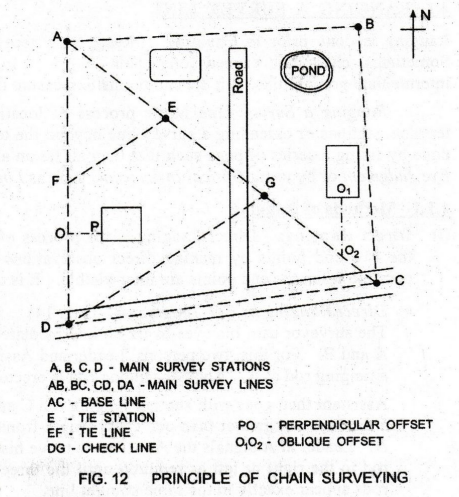
2. TERMINOLOGY (Fig. 12).
1.
Survey Station: It is defined as the beginning point or
end point of a chain line. Survey stations should be selected such that they
are inter-visible. These are of two types, Main Survey Station and Tie Station
or Subsidiary Station.
2.
Main Survey Station: It is at the ends of main survey lines.
It fixes the boundaries of the survey.
3.
Tie Station or Subsidiary Station: It is the station
selected on a main survey line for running auxiliary lines to locate the
interior details.
4.
Main Survey Lines: Lines joining the main survey stations
are Main Survey Lines. These lines should run as close as possible to the
boundaries to avoid long offsets.
5.
Base Line: Base Line is the longest of the main survey lines.
It divides the area into two halves. That is, the survey line passing
through the center of the area is known as Base Line.
6.
Check Line: It is the line joining any two points on
the two sides of a triangle or by joining the apex of a triangle to any
point on the opposite side. It is meant for checking the accuracy of the
measurements made in the field.
7.
Tie Line or Subsidiary Line: It is the chain line
joining the tie station on the main survey line. It is used (i) to
locate the interior details far away from main survey line and (ii) to check
the accuracy of the frame work.
8.
Offset: See Fig. 13. Lateral distance of buildings,
boundaries, etc., measured from a chain line or survey line AB is called
Offset.
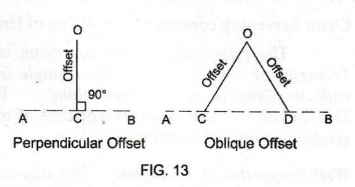
When
measurements are made perpendicular to the chain line, it is called a
Perpendicular Offset. If they are not perpendicular to the chain line,
then it is called an Oblique Offset.
Basic Civil & Mechanical Engineering: UNIT II: b. Chain surveying : Tag: : - Principle of chain surveying
Basic Civil & Mechanical Engineering: UNIT II: b. Chain surveying
Under Subject
Basic Civil and Mechanical Engineering
BE3255 2nd Semester 2021 Regulation | 2nd Semester EEE Dept 2021 Regulation
Related Subjects

Professional English II
HS3251 2nd Semester 2021 Regulation | 2nd Semester Common to all Dept 2021 Regulation
Statistics and Numerical Methods
MA3251 2nd Semester 2021 Regulation M2 Engineering Mathematics 2 | 2nd Semester Common to all Dept 2021 Regulation
Engineering Graphics
GE3251 eg 2nd semester | 2021 Regulation | 2nd Semester Common to all Dept 2021 Regulation

Physics for Electrical Engineering
PH3202 2nd Semester 2021 Regulation | 2nd Semester EEE Dept 2021 Regulation
Basic Civil and Mechanical Engineering
BE3255 2nd Semester 2021 Regulation | 2nd Semester EEE Dept 2021 Regulation
Electric Circuit Analysis
EE3251 2nd Semester 2021 Regulation | 2nd Semester EEE Dept 2021 Regulation

Physics for Electronics Engineering
PH3254 - Physics II - 2nd Semester - ECE Department - 2021 Regulation | 2nd Semester ECE Dept 2021 Regulation
Electrical and Instrumentation Engineering
BE3254 - 2nd Semester - ECE Dept - 2021 Regulation | 2nd Semester ECE Dept 2021 Regulation
Circuit Analysis
EC3251 - 2nd Semester - ECE Dept - 2021 Regulation | 2nd Semester ECE Dept 2021 Regulation

Materials Science
PH3251 2nd semester Mechanical Dept | 2021 Regulation | 2nd Semester Mechanical Dept 2021 Regulation

Basic Electrical and Electronics Engineering
BE3251 2nd semester Mechanical Dept | 2021 Regulation | 2nd Semester Mechanical Dept 2021 Regulation
Physics for Civil Engineering
PH3201 2021 Regulation | 2nd Semester Civil Dept 2021 Regulation
Basic Electrical, Electronics and Instrumentation Engineering
BE3252 2021 Regulation | 2nd Semester Civil Dept 2021 Regulation

Physics for Information Science
PH3256 2nd Semester CSE Dept | 2021 Regulation | 2nd Semester CSE Dept 2021 Regulation
Basic Electrical and Electronics Engineering
BE3251 2nd Semester CSE Dept 2021 | Regulation | 2nd Semester CSE Dept 2021 Regulation
Programming in C
CS3251 2nd Semester CSE Dept 2021 | Regulation | 2nd Semester CSE Dept 2021 Regulation