Electric Circuit Analysis: Unit I: b. Basic circuits analysis
R.M.S (root mean square) value or effective value
Basic circuits analysis
The steady current which when flowing through a given resistor for a given time produces the same amount of heat as produced by the alternating current when flowing through the same resistor for the same time is called R.M.S. or effective value of the alternating current.
R.M.S (ROOT MEAN SQUARE) VALUE OR EFFECTIVE VALUE
Definition
The
steady current which when flowing through a given resistor for a given time
produces the same amount of heat as produced by the alternating current when
flowing through the same resistor for the same time is called R.M.S. or
effective value of the alternating current.
Thus
for defining R.M.S value, the heating effects of A.C. and D.C. are compared.
1. To Find R.M.S Value
Method
1 [Mid-ordinate Method]
Let
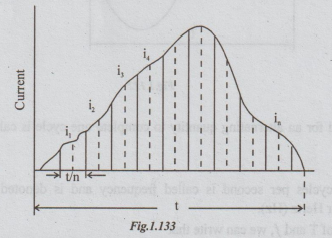
the wave form of the alternating current be as shown in the figure. Let the
current of this wave form flow through a resistor R ohms for time t seconds.
Divide
the time base t into n equal intervals of time, each of duration t/n seconds.
Let the average values of instantaneous currents during these intervals be i,
iz..., in as shown in the figure. They are also called mid-ordinates. As a
result of current flow, heat is produced.
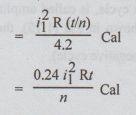
Heat
produced in first interval
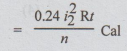
Heat
produced in second interval
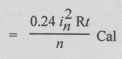
Heat
produced in nth interval
Hence,
total heat produced in t seconds
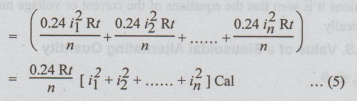
Suppose
that a direct current of I pass through the same resistor for the same time t.
The
heat produced by I = 0.2412Rt ... (6)
If
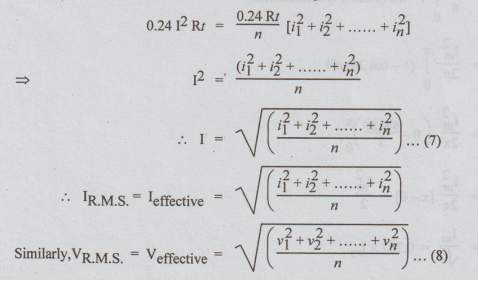
I be the effective value of the A.C. current then heat produced by I = total
heat produced by the alternating current. Equating equations (5) and (6), we
get,
Note:
1.
The name R.M.S. has come from the expression for R.M.S. value given by equation
(7).
2.
This method can be applied for both symmetrical and unsymmetrical wave forms.
It is mainly useful for the wave forms whose equations will be complicated.
3.
For irregular shape waveforms, the result will be more accurate if we take more
intervals.
Methods
2: (Analytical method)
For
unsymmetrical wave forms.
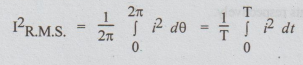
For
symmetrical wave forms.

From the above expressions it is seen that the equations of the current or voltage must be known to find the R.M.S value analytically.
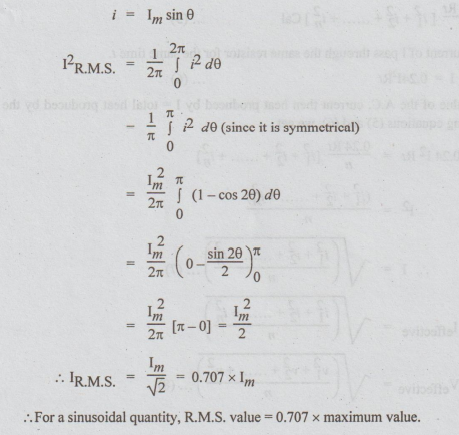
2. To find the R.M.S. Value of a Sinusoidal Alternating Quantity
Note:
1.
In electrical engineering unless otherwise stated the given a.c. voltage and
current must be treated as R.M.S. values.
Suppose
we say the supply voltage in house is 230 volts, it means that the R.M.S value
of the supply voltage is 230 volts.
2.
The suffix R.M.S. or effective is only optional. We can denote R.M.S value of
current as I instead of IR.M.S or leffective. Similarly, we can denote R.M.S.
value of voltage by V instead of VR.M.S or Veffective
3.
Sometimes we can denote R.M.S value of voltage by E. As a whole, we use V(or E)
and I for R.M.S. values of A.C. voltages and currents respectively.
3. To illustrate the Significance of R.M.S. Value of an Alternating Current
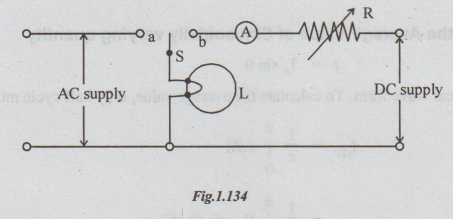
Refer
the figure below. L is the metal filament lamp connected to an A.C. supply by
closing the switch S onto the position a. The brightness of the filament is
noted. Now, the switch S is moved to position b and the resistance of the rheostat
R is adjusted to give the same brightness. The reading on the moving coil
ammeter A gives the value of direct current that produces the same heating
effect as that produced by the alternating current (i.e.,) the reading of the
ammeter gives the R.M.S. value of the A.C. current. For example, if ammeter
reading is 0.5A then we say that the R.M.S. value of the alternating current is
0.5A.
Note
The
R.M.S value of a given alternating quantity can also be found graphically by
the following formula:.
R.M.S.
value = √(Area of the squared wave / base)
Electric Circuit Analysis: Unit I: b. Basic circuits analysis : Tag: : Basic circuits analysis - R.M.S (root mean square) value or effective value
Electric Circuit Analysis: Unit I: b. Basic circuits analysis
Under Subject
Electric Circuit Analysis
EE3251 2nd Semester 2021 Regulation | 2nd Semester EEE Dept 2021 Regulation
Circuits and Network Analysis
EC25C02 2nd Semester ECE Dept | 2025 Regulation | 2nd Semester 2025 Regulation
Electric Circuit Analysis
EE25302 3rd Semester EEE Dept | 2025 Regulation | 3rd Semester 2025 Regulation
Related Subjects
Professional English II
HS3251 2nd Semester 2021 Regulation | 2nd Semester Common to all Dept 2021 Regulation
Statistics and Numerical Methods
MA3251 2nd Semester 2021 Regulation M2 Engineering Mathematics 2 | 2nd Semester Common to all Dept 2021 Regulation
Engineering Graphics
GE3251 eg 2nd semester | 2021 Regulation | 2nd Semester Common to all Dept 2021 Regulation
Physics for Electrical Engineering
PH3202 2nd Semester 2021 Regulation | 2nd Semester EEE Dept 2021 Regulation
Basic Civil and Mechanical Engineering
BE3255 2nd Semester 2021 Regulation | 2nd Semester EEE Dept 2021 Regulation
Electric Circuit Analysis
EE3251 2nd Semester 2021 Regulation | 2nd Semester EEE Dept 2021 Regulation
Physics for Electronics Engineering
PH3254 - Physics II - 2nd Semester - ECE Department - 2021 Regulation | 2nd Semester ECE Dept 2021 Regulation
Electrical and Instrumentation Engineering
BE3254 - 2nd Semester - ECE Dept - 2021 Regulation | 2nd Semester ECE Dept 2021 Regulation
Circuit Analysis
EC3251 - 2nd Semester - ECE Dept - 2021 Regulation | 2nd Semester ECE Dept 2021 Regulation
Materials Science
PH3251 2nd semester Mechanical Dept | 2021 Regulation | 2nd Semester Mechanical Dept 2021 Regulation
Basic Electrical and Electronics Engineering
BE3251 2nd semester Mechanical Dept | 2021 Regulation | 2nd Semester Mechanical Dept 2021 Regulation
Physics for Civil Engineering
PH3201 2021 Regulation | 2nd Semester Civil Dept 2021 Regulation
Basic Electrical, Electronics and Instrumentation Engineering
BE3252 2021 Regulation | 2nd Semester Civil Dept 2021 Regulation

Physics for Information Science
PH3256 2nd Semester CSE Dept | 2021 Regulation | 2nd Semester CSE Dept 2021 Regulation
Basic Electrical and Electronics Engineering
BE3251 2nd Semester CSE Dept 2021 | Regulation | 2nd Semester CSE Dept 2021 Regulation
Programming in C
CS3251 2nd Semester CSE Dept 2021 | Regulation | 2nd Semester CSE Dept 2021 Regulation