Electric Circuit Analysis: Unit II: Network Reduction and Theorems for dc and ac Circuits
Worked examples [Transformation or conversion of sources]
dc and ac Circuits
Electric Circuit Analysis: Unit II: Network Reduction and Theorems for dc and ac Circuits : Worked examples
WORKED EXAMPLES
TRANSFORMATION OR CONVERSION OF SOURCES
Example
1 Convert the following voltage source into current source.
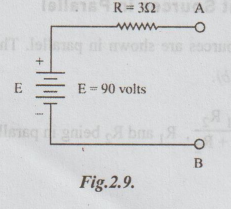
Solution:
Equivalent current source is as below:
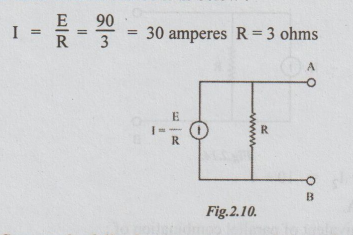
Example
2 Convert the following current source into equivalent voltage source.
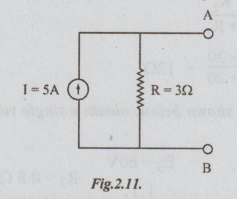
Solution:
The equivalent voltage source circuit is as shown in the figure.2.12.
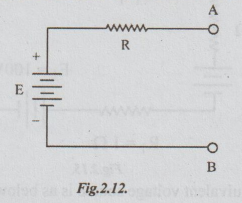
E
= IR = 5 × 3 = 15 volts, R = 3Ω
3.
For the circuit shown below obtain a single current source circuit, between the
terminals A and B.
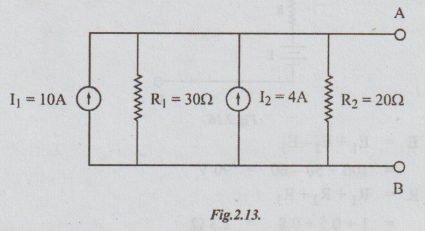
Solution:
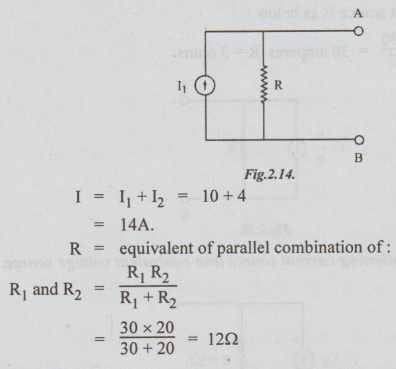
Equivalent current source circuit is as below:
Example
4 For the circuit shown below, obtain a single voltage source between the
terminals A and B.
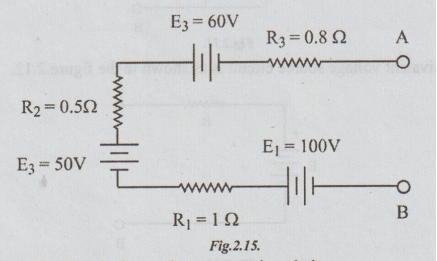
Solution:
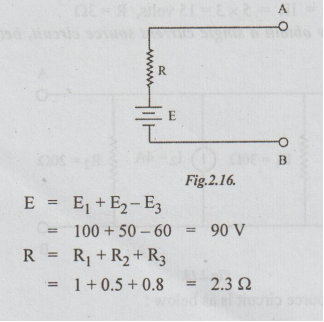
The circuit of equivalent voltage source is as below:
Example
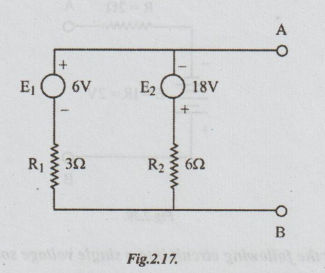
5 For the circuit shown below, obtain a single voltage source between the
terminals A and B.
Solution:
The above circuit is a parallel combination of voltage sources.
Step
1: Converting the voltage sources into current
sources, we get the following circuit. The direction of current sources should
be noted.

Step
2: The equivalent current source of the above
combination of current sources is :
I
= I1~ I2 = 2~3
=
1A
The
arrow is in the direction of that of I2.
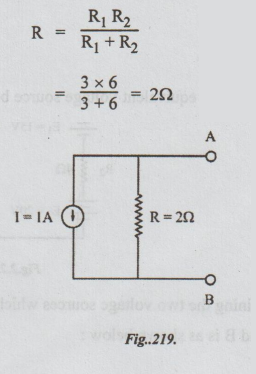
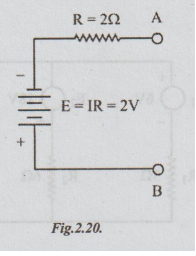
Step
3: The equivalent voltage source is as shown below:
Example
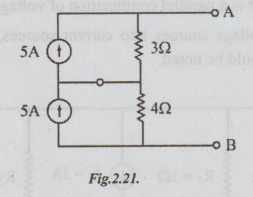
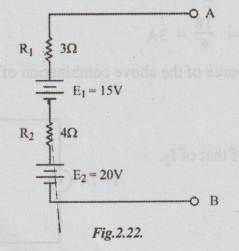
6 Convert the following circuit into a single voltage source.
Solution:
The original circuit consists of two current sources. Since one terminal is
common for both sources, they are in series.
Step
1: Converting the current sources into equivalent
voltage sources the following circuit is obtained.
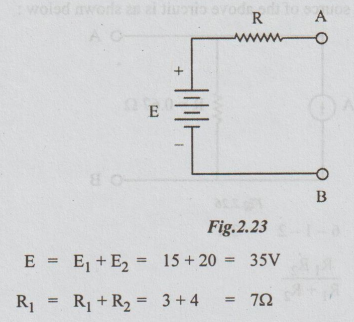
Step
2: Combining the two voltage sources which are in
series, equivalent voltage source between the terminals A and B is as shown
below:
Example
7 For the circuit shown below obtain the equivalent current source between the
terminals A and B.
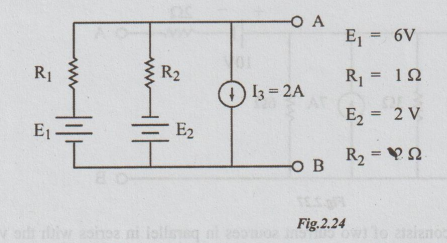
Solution:
This problem is a parallel combination of voltage and current sources.
Step
1: Converting the voltage sources into current sources
and re-drawing the circuit, the following figure is obtained.
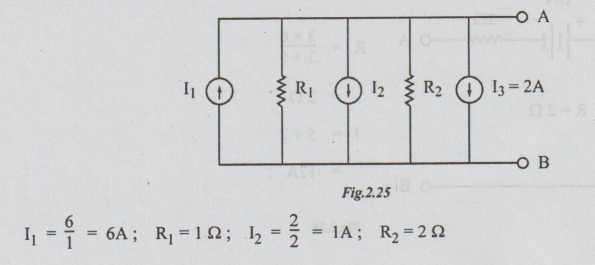
Step
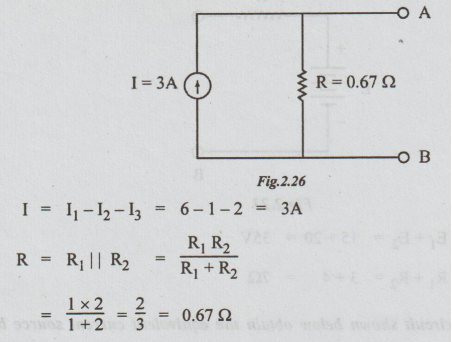
2: The equivalent current source of the above circuit
is as shown below:
Example
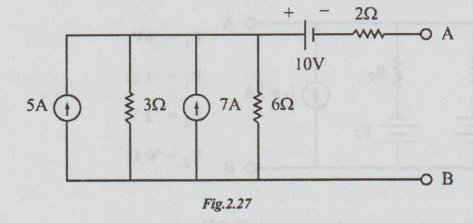
8 Reduce the following to a single source equivalent.
Solution:
The above circuit consists of two current sources in parallel in series with
the voltage source, between the terminals A and B. The simplification consists
of the following steps.
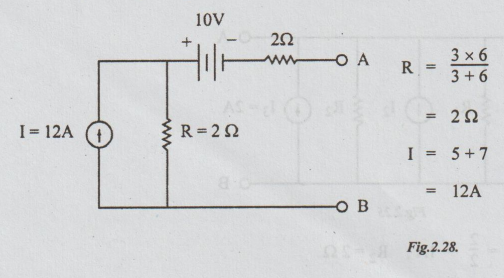
Step
1: Replacing the current sources by single current
source, the following circuit is obtained.
Step
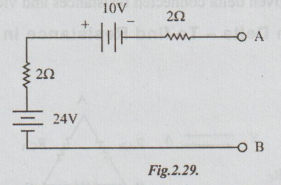
2: Converting the current source into voltage source
and redrawing the circuit, we get
Step
3: Combining the voltage sources in series, we get the
following equivalent voltage source.
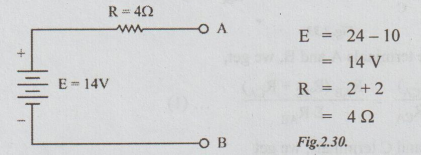
Note
3: If necessary we can convert the above voltage
source into its equivalent current source by using the conversion technique.
Electric Circuit Analysis: Unit II: Network Reduction and Theorems for dc and ac Circuits : Tag: : dc and ac Circuits - Worked examples [Transformation or conversion of sources]
Electric Circuit Analysis: Unit II: Network Reduction and Theorems for dc and ac Circuits
Under Subject
Electric Circuit Analysis
EE3251 2nd Semester 2021 Regulation | 2nd Semester EEE Dept 2021 Regulation
Related Subjects
Professional English II
HS3251 2nd Semester 2021 Regulation | 2nd Semester Common to all Dept 2021 Regulation
Statistics and Numerical Methods
MA3251 2nd Semester 2021 Regulation M2 Engineering Mathematics 2 | 2nd Semester Common to all Dept 2021 Regulation
Engineering Graphics
GE3251 eg 2nd semester | 2021 Regulation | 2nd Semester Common to all Dept 2021 Regulation
Physics for Electrical Engineering
PH3202 2nd Semester 2021 Regulation | 2nd Semester EEE Dept 2021 Regulation
Basic Civil and Mechanical Engineering
BE3255 2nd Semester 2021 Regulation | 2nd Semester EEE Dept 2021 Regulation
Electric Circuit Analysis
EE3251 2nd Semester 2021 Regulation | 2nd Semester EEE Dept 2021 Regulation
Physics for Electronics Engineering
PH3254 - Physics II - 2nd Semester - ECE Department - 2021 Regulation | 2nd Semester ECE Dept 2021 Regulation
Electrical and Instrumentation Engineering
BE3254 - 2nd Semester - ECE Dept - 2021 Regulation | 2nd Semester ECE Dept 2021 Regulation
Circuit Analysis
EC3251 - 2nd Semester - ECE Dept - 2021 Regulation | 2nd Semester ECE Dept 2021 Regulation
Materials Science
PH3251 2nd semester Mechanical Dept | 2021 Regulation | 2nd Semester Mechanical Dept 2021 Regulation
Basic Electrical and Electronics Engineering
BE3251 2nd semester Mechanical Dept | 2021 Regulation | 2nd Semester Mechanical Dept 2021 Regulation
Physics for Civil Engineering
PH3201 2021 Regulation | 2nd Semester Civil Dept 2021 Regulation
Basic Electrical, Electronics and Instrumentation Engineering
BE3252 2021 Regulation | 2nd Semester Civil Dept 2021 Regulation
Physics for Information Science
PH3256 2nd Semester CSE Dept | 2021 Regulation | 2nd Semester CSE Dept 2021 Regulation
Basic Electrical and Electronics Engineering
BE3251 2nd Semester CSE Dept 2021 | Regulation | 2nd Semester CSE Dept 2021 Regulation
Programming in C
CS3251 2nd Semester CSE Dept 2021 | Regulation | 2nd Semester CSE Dept 2021 Regulation