Statistics and Numerical Methods: Unit IV: Interpolation, numerical differentiation and numerical integration
(b) numerical double integrals by trapezoidal and simpson's 1/3rd Rules
Solved Example Problems
(a) Trapezoidal Rule for double integration, (b) Simpson's rule for double integration
(b) NUMERICAL DOUBLE INTEGRALS BY TRAPEZOIDAL AND SIMPSON'S 1/3rd
RULES
(a) Trapezoidal Rule for double integration
Consider
the double integral

where
xi + 1 = x; + h and yj + 1 = yi + k
Apply
trapezoidal rule repeatedly to get the value of I. As follows
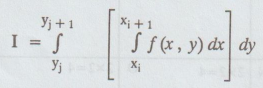
Apply
trapezoidal rule to the inner integral, when y is a constant and x varies.
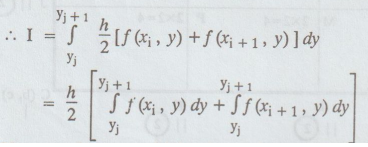
Now,
apply trapezoidal rule to the two integrals. Here y varies and x1, Xi + 1 are
constants.

Extension
to general form of Trapezoidal rule JADIREMUM [using 1 1 idea]
Suppose,
we want to evaluate 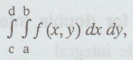 , where a, b, c, d are constants. The area of
integration is the rectangle in the xy plane as shown below.
, where a, b, c, d are constants. The area of
integration is the rectangle in the xy plane as shown below.
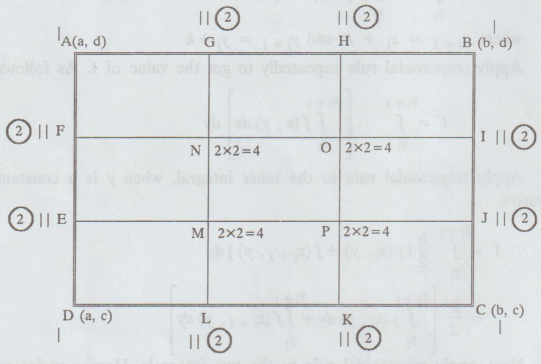
Divide
the area of integration (rectangle ABCD) into meshes by dividing AB into 3
equal parts (in general into m equal parts) each part length being h, and AD
into 3 equal parts, (in general n equal parts) each part length being k.
Now,
the integral over the whole rectangle is equal to sum of the integrals over
each mesh. So, extending the formula given by (3),
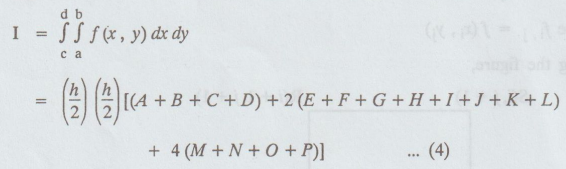
I
= hk / 4 [(Sum of values of ƒ at the four corners)
+
2 (Sum of the values of ƒ at the remaining nodes on the boundary) + 4 (Sum of
the values of the values of ƒ at the interior nodes)] ... (5)
(b) Simpson's rule for double integration
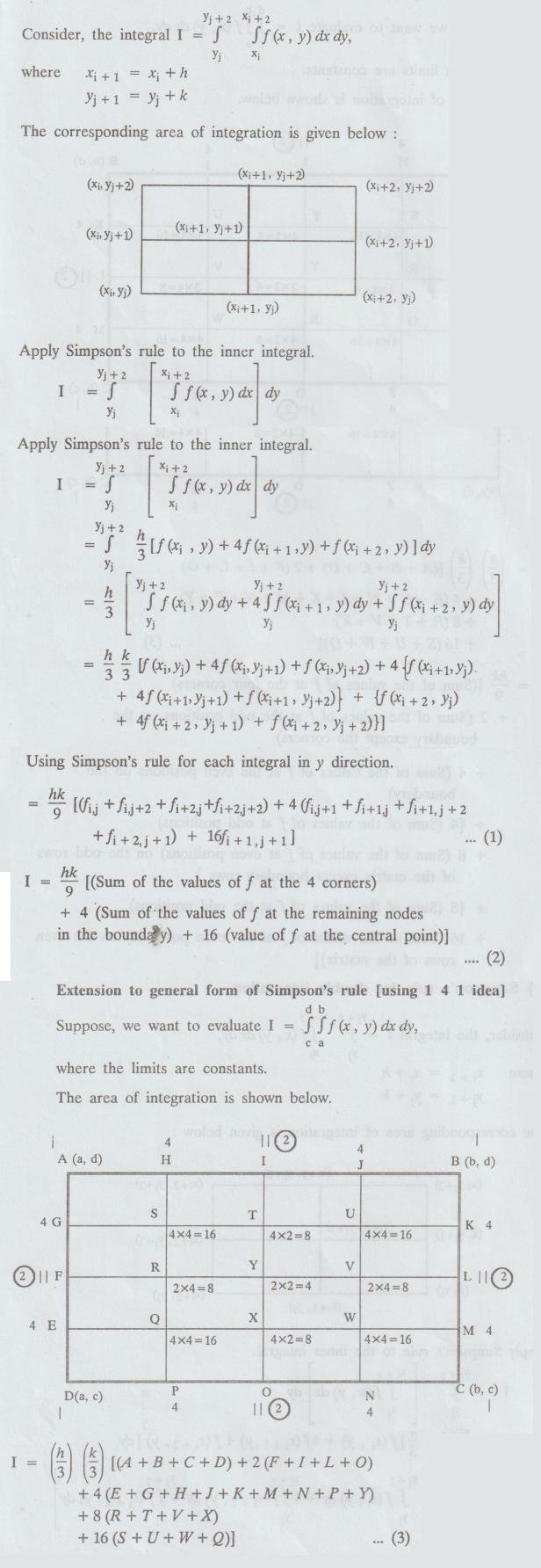
I
= hk / 9 [(Sum of the values of ƒ at the
four corners)
+
2 (Sum of the values of f at the odd positions on the boundary except the
corners)
+
4 (Sum of the values of ƒ at the even positions on the boundary)
+
{4 (Sum of the values of ƒ at odd positions)
+
8 (Sum of the values of f at even positions) on the odd rows
of
the matrix except boundary rows }
+
{8 (Sum of the values of f at the odd positions)
+
16 (Sum of the values of ƒ at the even positions) on the even rows of the
matrix}]
1.
Evaluate 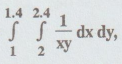 using Trapezoidal and Simpson's rule.Verify your
result by actual integration.
using Trapezoidal and Simpson's rule.Verify your
result by actual integration.
[A.U
CBT A/M 2011] [A.U CBT N/D 2011, N/D M/J 2013] [A.U N/D 2021 R-17]
Solution
:
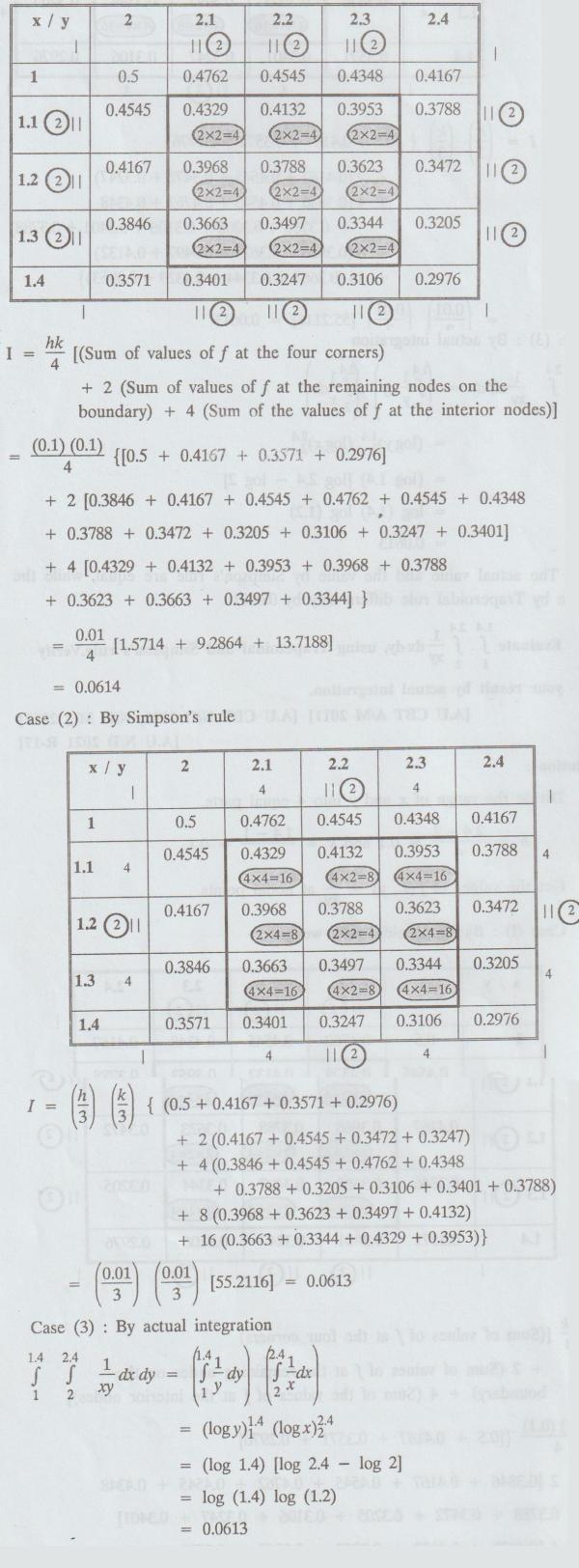
Divide
the range of x and y into 4 equal parts.
H
= 2.42 – 4 / 4 = 0.1 and k = 1.4 – 4 / 4 = 0.1
Get
the values of f (x, y) = 1/xy at nodal points.
Case
(1) By Trapezoidal rule, we get
The
actual value and the value by Simpson's rule are equal, while the value by
Trapezoidal rule differs only by 0.0001.
2.
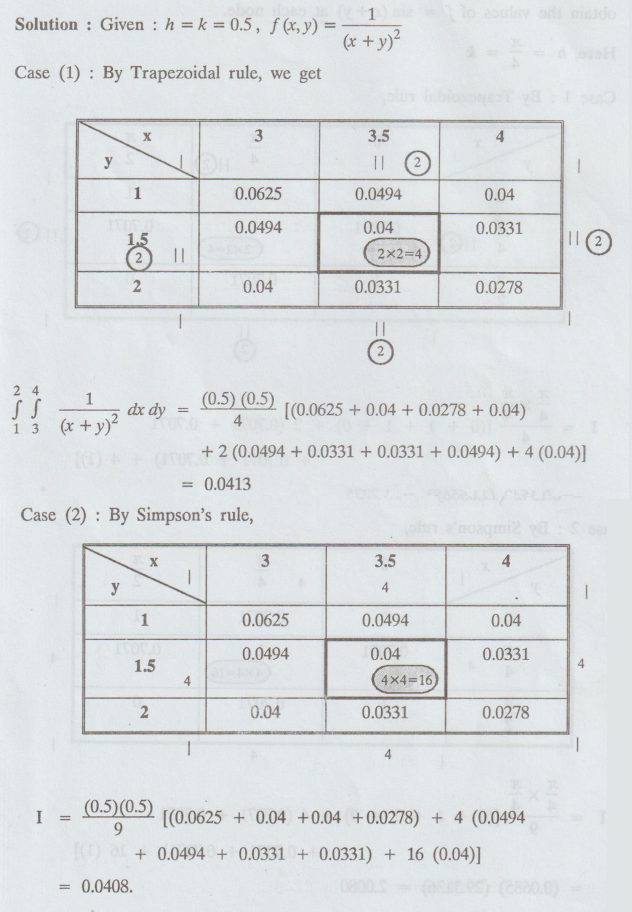
Evaluate 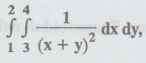 taking h= k = 0.5 by both Trapezoidal rule and
Simpson's rule.
taking h= k = 0.5 by both Trapezoidal rule and
Simpson's rule.
[A.U N/D 2020 R-17 NM] [A.U. A/M 2021 R-17 NM]
Solution:
3.
Evaluate, 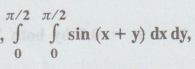 sin (x + y) dx dy, by using Trapezoidal rule.nava
Simpson's
rule and also by actual integration.'
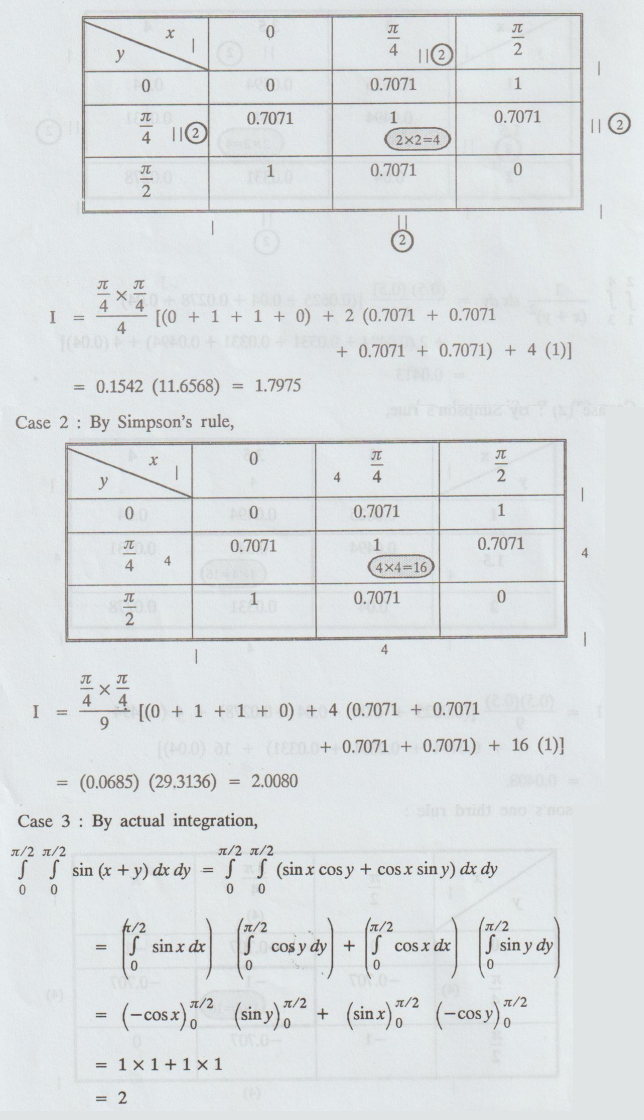
Solution:
Divide the range on x and y direction into equal parts and obtain the values of
f sin (x + y) at each node.
Here,
h = π / 4 = k
Case
1: By Trapezoidal rule,
The
value got by Simpson's rule differs from the exact value only by 0.008, while
the error in the Trapezoidal rule is 0.2125.
4.
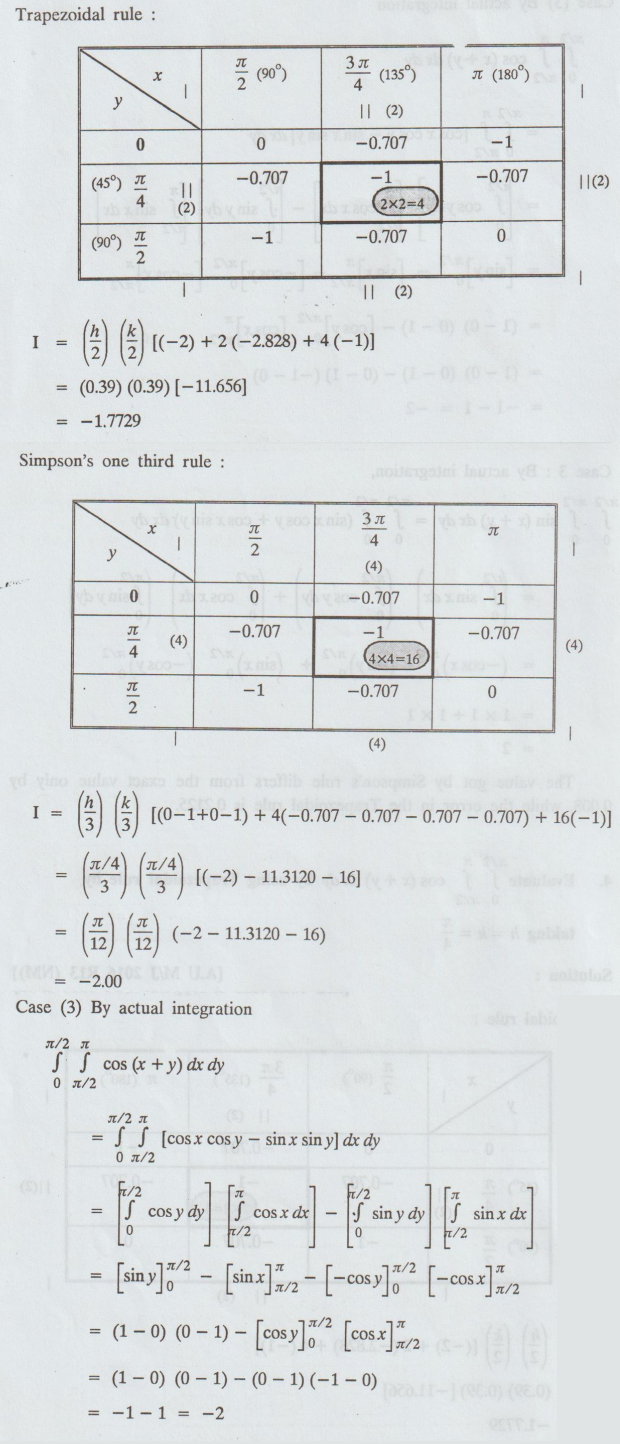
Evaluate 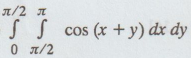 by using Trapezoidal rule by taking h
= k = π / 4 [A.U
M/J 2016 R13 (NM)] [A.U N/D 2020 R-17] [A.U A/M 2021 R-17]
by using Trapezoidal rule by taking h
= k = π / 4 [A.U
M/J 2016 R13 (NM)] [A.U N/D 2020 R-17] [A.U A/M 2021 R-17]
Solution:
5.
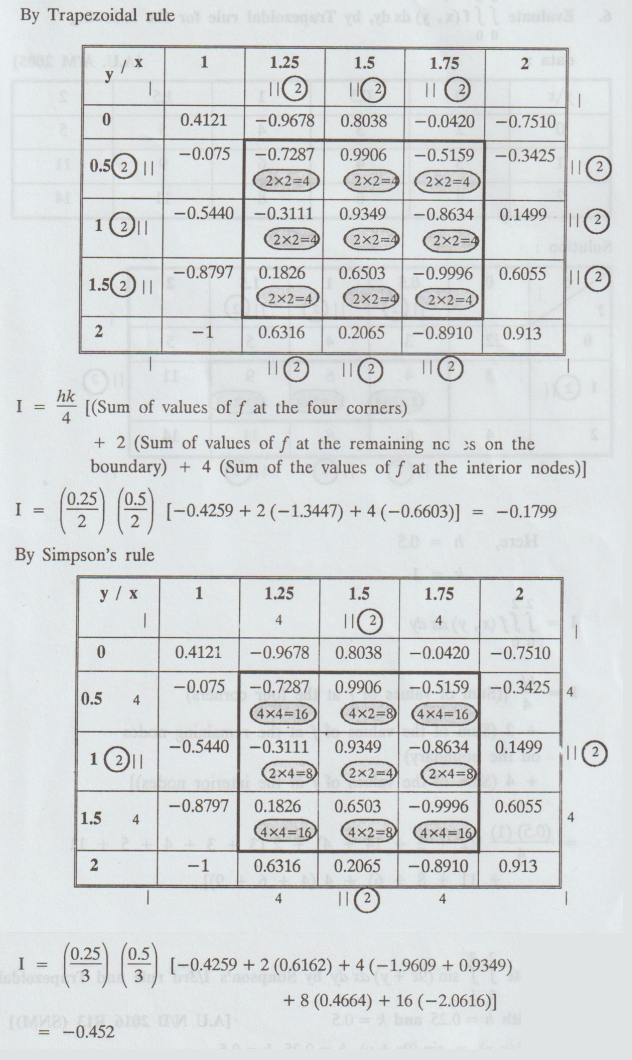
Evaluate  sin (9x + y) dx dy by Simpson's 1/3rd rule and
Trapezoidal rule with h = 0.25 and k = 0.5
sin (9x + y) dx dy by Simpson's 1/3rd rule and
Trapezoidal rule with h = 0.25 and k = 0.5
[A.U
N/D 2016 R13 (SNM)]
Solution
:
f(x, y) = sin (9x + y), h = 0.25, k = 0.5
By
Trapezoidal rule
6.
Evaluate 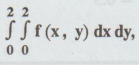 by Trapezoidal rule for the following data :
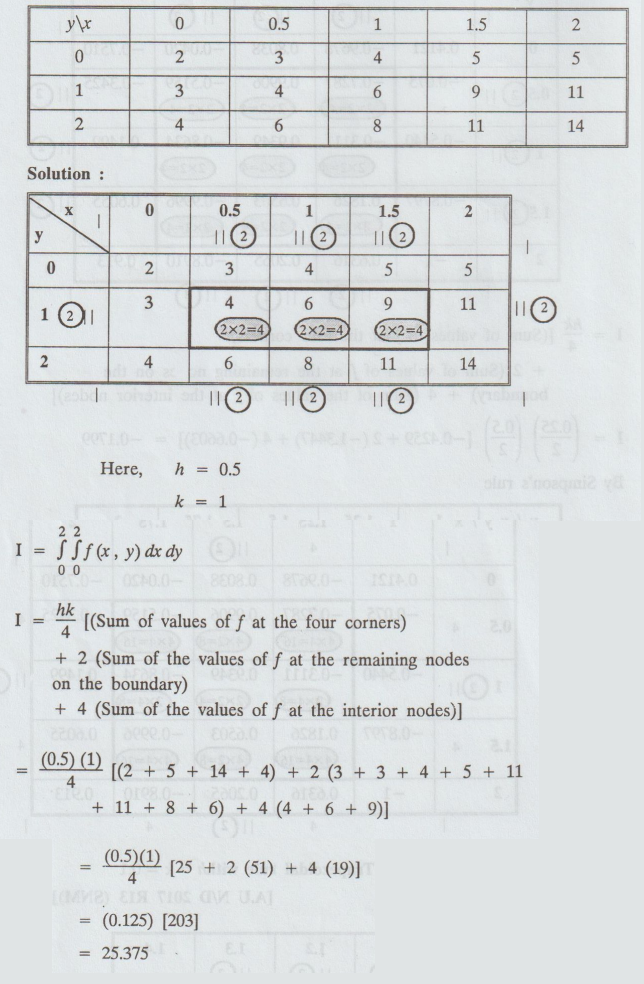
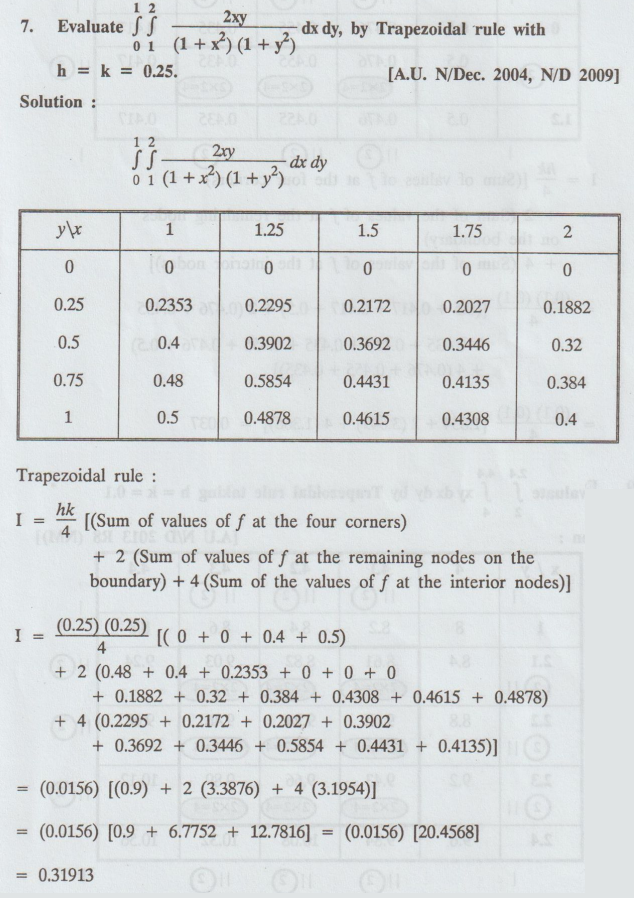
8.
Evaluate 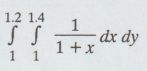 by Trapezoidal rule with h = k = 0.1
Solution
:
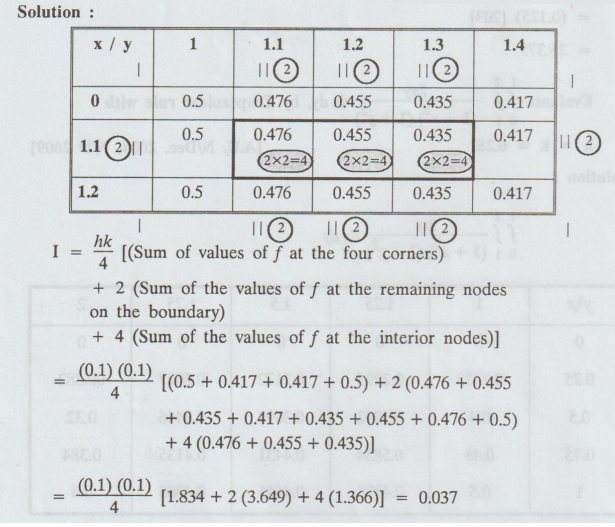
9.
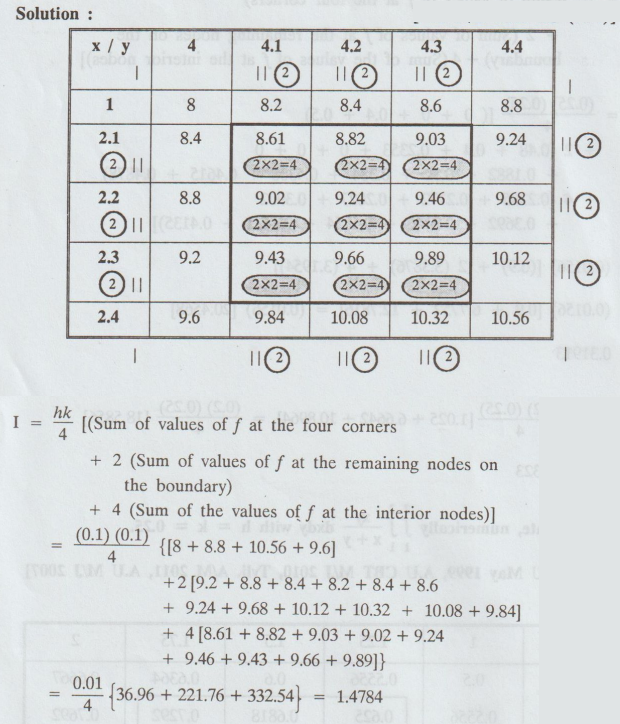
Evaluate 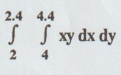 by Trapezoidal rule taking h = k = 0.1
Solution
:
10.
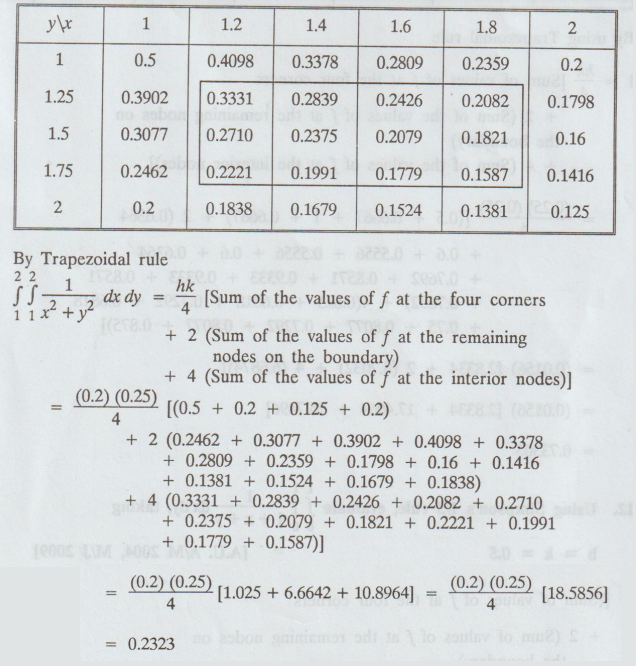
Evaluate 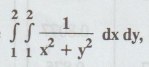 numerically with h = 0.2 along x-direction and k =
0.25 along y-direction.
numerically with h = 0.2 along x-direction and k =
0.25 along y-direction.
Solution
:
11.
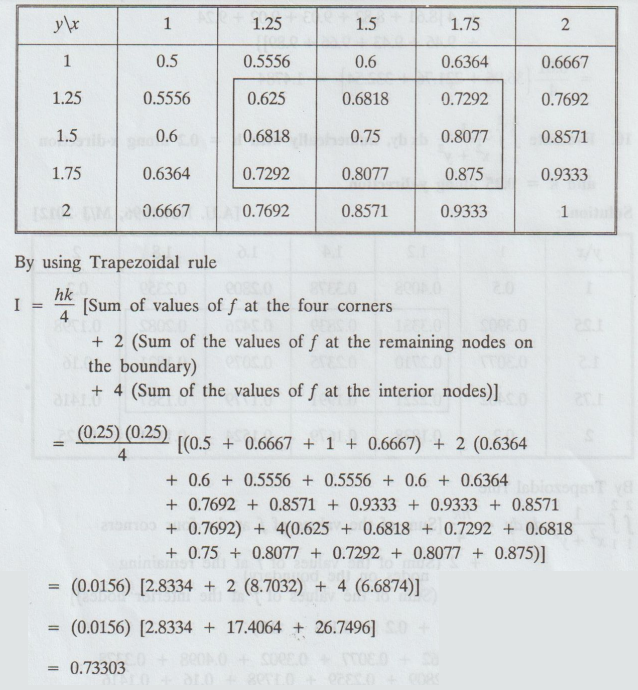
Evaluate numerically 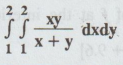 with h = k = 0.25
Solution
:
12.
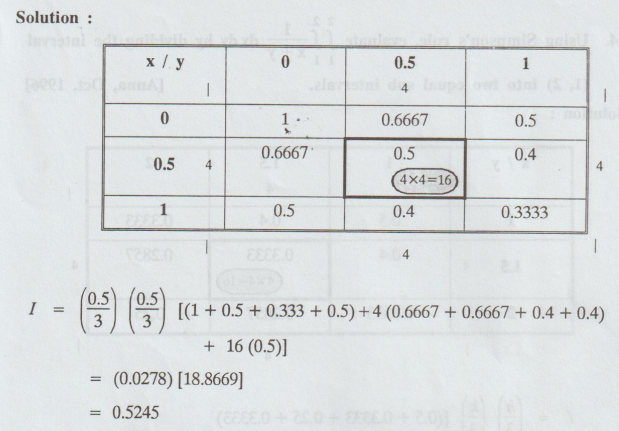
Using Simpson’s 1/3 rule, evaluate 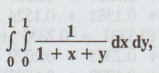 taking h = k = 0.5
Solution
:
13.
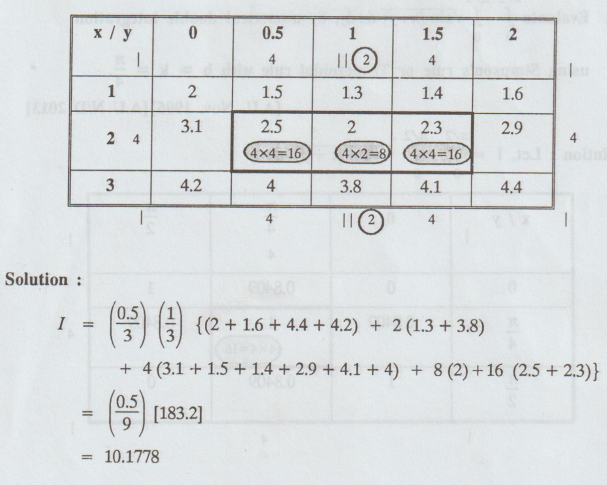
The function f(x,y) is defined by the following table. Compute 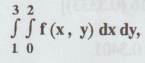 using Simpson’s rule in both direction.
Solution
:
14.
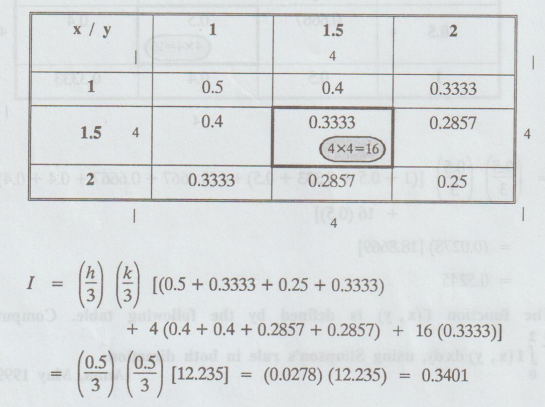
Using Simpson’s rule evaluate 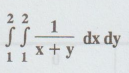 by dividing the interval (1,2)
into two equal sub intervals.
by dividing the interval (1,2)
into two equal sub intervals.
Solution
:
15.
Evaluate 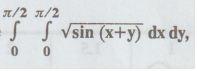 by numerical double intergration using Simpson’s
rule or Trapezoidal rule with h = k = π/4
by numerical double intergration using Simpson’s
rule or Trapezoidal rule with h = k = π/4
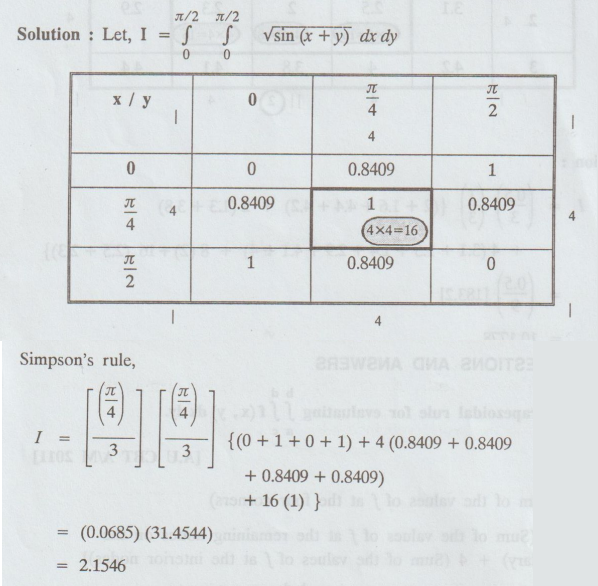
Solution
:
16.
Evaluate 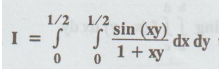 using Simpson’s rule with h = k = ¼.
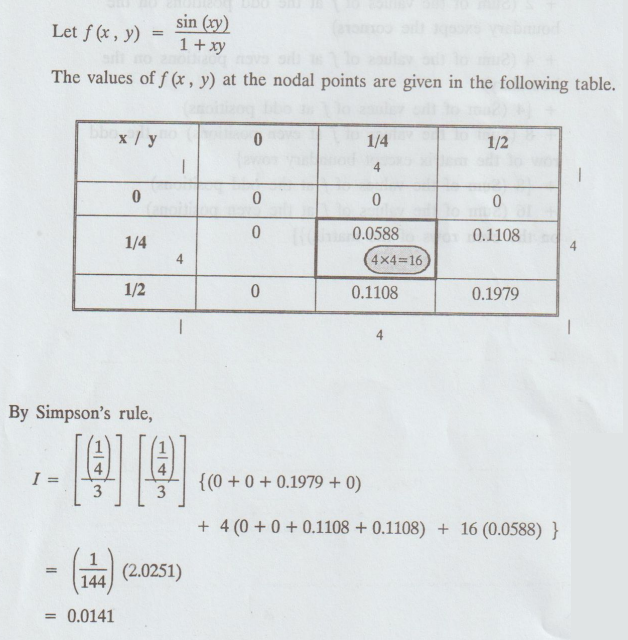
Solution
:
Statistics and Numerical Methods: Unit IV: Interpolation, numerical differentiation and numerical integration : Tag: : Solved Example Problems - (b) numerical double integrals by trapezoidal and simpson's 1/3rd Rules
Statistics and Numerical Methods: Unit IV: Interpolation, numerical differentiation and numerical integration
Under Subject
Statistics and Numerical Methods
MA3251 2nd Semester 2021 Regulation M2 Engineering Mathematics 2 | 2nd Semester Common to all Dept 2021 Regulation
Related Subjects

Professional English II
HS3251 2nd Semester 2021 Regulation | 2nd Semester Common to all Dept 2021 Regulation
Statistics and Numerical Methods
MA3251 2nd Semester 2021 Regulation M2 Engineering Mathematics 2 | 2nd Semester Common to all Dept 2021 Regulation

Engineering Graphics
GE3251 eg 2nd semester | 2021 Regulation | 2nd Semester Common to all Dept 2021 Regulation

Physics for Electrical Engineering
PH3202 2nd Semester 2021 Regulation | 2nd Semester EEE Dept 2021 Regulation

Basic Civil and Mechanical Engineering
BE3255 2nd Semester 2021 Regulation | 2nd Semester EEE Dept 2021 Regulation
Electric Circuit Analysis
EE3251 2nd Semester 2021 Regulation | 2nd Semester EEE Dept 2021 Regulation

Physics for Electronics Engineering
PH3254 - Physics II - 2nd Semester - ECE Department - 2021 Regulation | 2nd Semester ECE Dept 2021 Regulation

Electrical and Instrumentation Engineering
BE3254 - 2nd Semester - ECE Dept - 2021 Regulation | 2nd Semester ECE Dept 2021 Regulation
Circuit Analysis
EC3251 - 2nd Semester - ECE Dept - 2021 Regulation | 2nd Semester ECE Dept 2021 Regulation

Materials Science
PH3251 2nd semester Mechanical Dept | 2021 Regulation | 2nd Semester Mechanical Dept 2021 Regulation

Basic Electrical and Electronics Engineering
BE3251 2nd semester Mechanical Dept | 2021 Regulation | 2nd Semester Mechanical Dept 2021 Regulation

Physics for Civil Engineering
PH3201 2021 Regulation | 2nd Semester Civil Dept 2021 Regulation

Basic Electrical, Electronics and Instrumentation Engineering
BE3252 2021 Regulation | 2nd Semester Civil Dept 2021 Regulation

Physics for Information Science
PH3256 2nd Semester CSE Dept | 2021 Regulation | 2nd Semester CSE Dept 2021 Regulation

Basic Electrical and Electronics Engineering
BE3251 2nd Semester CSE Dept 2021 | Regulation | 2nd Semester CSE Dept 2021 Regulation

Programming in C
CS3251 2nd Semester CSE Dept 2021 | Regulation | 2nd Semester CSE Dept 2021 Regulation