Statistics and Numerical Methods: Unit IV: Interpolation, numerical differentiation and numerical integration
Approximation of derivatives using interpolation polynomials
Solved Example Problems
(a) Newton's forward difference formula, (b) Newton's backward difference formula, (c) Maxima and Minima of a tabulated function
APPROXIMATION OF DERIVATIVES USING INTERPOLATION POLYNOMIALS
(a) Newton's forward difference formula
Our
Aim is to find the derivative of y = f(x) passing through the (n + 1) points,
at a point nearer to the starting value x = xo.
Newton's
forward difference interpolation formula is

Equations
(5), (6) and (7) give the values of first second and third derivatives at the
starting value x = xo-mol
(b) Newton's backward difference formula
Newton's
backward difference formula is

Equations
(5), (6) and (7) give the values of first, second and third es of fir
derivatives at x = xn.
(c) Maxima and Minima of a tabulated function
Newton's
forward interpolation formula is

For
maxima or minima dy / du = 0. Hence equating the right hand side of (1) to zero
and retaining only upto third differences, we obtain

Substituting
the values of Ay0, A2 y0, A3y0
from the difference table, we solve this quadratic for u. Then the
corresponding values of x are given by x = x0+ uh at which y is maximum or
minimum.
Note:
If the interval of differencing is not constant (i.e., x's are not equally
spaced), we get Newton's divided difference formula (or) Lagrange's
interpolation formula for general x, and then differentiating it w.r.to x, we
can get the derivatives at any x in the range.
1.
Find f'(3) and f'' (3) for the following data: [A.U. April/May 2005]

Solution:
Since we require f' (3) and f'' (3) we use Newton's forward formula.

2.
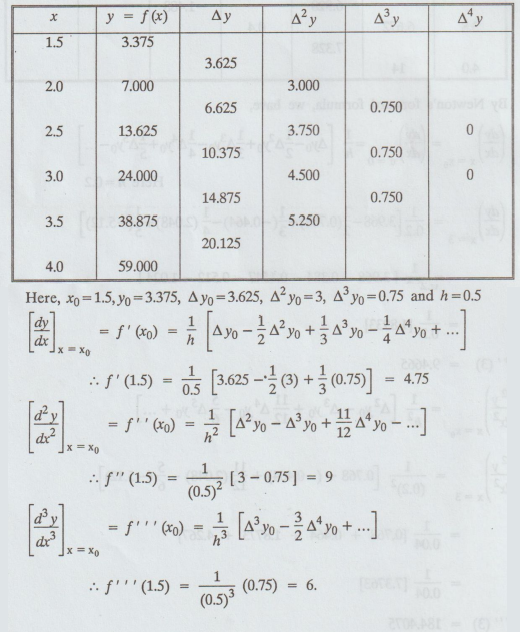
Find the first, second and third derivatives of f (x) at x = 1.5 if

[A.U N/D 2013, N/D 2014, M/J 2013, A.U.Trichy
A/M 2010] [A.U. Tvli N/D 2011] [A.U A/M 2017 R-13] [A.U
N/D 2021 R-17]
Solution:
We have to find the derivative at the point x = 1.5 which is the starting point
of the given data. Therefore, we use Newton's forward interpolation formula.
Forward
difference table
3.
Compute f' (0) and f'' (4) from the data.

Solution:
Since,
we require f' (0.5) and f'' (3.5), we use Newton's forward formula and Newton's
backward formula.

4.
Find dy/dx and d2y / dx2 at x = 51, from the following
data [A.U CBT N/D 2010, A.U M/J 2012]

Solution:
Here
h = 10. To find the derivatives of y at x Newton's forward difference formula
taking the origin at a = 50.

5.
The following data gives the velocity of a particle for 20 seconds at an
interval of 5 seconds. Find the initial acceleration using the entire data.
[A.U. A/M 2004, CBT M/J 2010]

Solution:
v is dependent on time t
(i.e.,) v = v(t). We require acceleration dv /
dt at 0.

6.
Find the maximum and minimum value of y tabulated below.

Solution:
Netwon's forward difference formula is

7.
Find the maximum and minimum value of y from the following table.

Solution:
Here, h = 1
Newton's
forward difference formula is

8.
Find y' (x) given [A.U Tvli A/M 2011]

Hence,
find y' (x) at x = 0.5
Solution:
Here, h = 1. We apply Newton's forward interpolation formula for derivative

9.
Consider the following table of data:

Find
f'(0.25) using Newton's forward difference approximation, and f'(0.95) using
Newton's backward difference approximation.
Solution
:
Here, h = 0.2
Newton's
forward interpolation formula for derivative

10.
The population of a certain town is given below. Find the rate of growth of the
population in 1931, 1941, 1961 and 1971.

11.
Find the first and second derivatives at x = 1.6 for the function represented
by the following tabular data:

Solution:
Since
the arguments are not equally spaced, we will use Newton's divided difference
formula.
Divided
difference table

12.
Given the following data, find y' (6) & y' (5) and the maximum value of y.

[A.U M/J 2006, N/D 2006, M/J 2007, N/D 2007,
Tvli M/J 2009] [A.U N/D 2011, N/D 2012] [A.U N/D 2020 R-17 NM] [A/M 2021 R-17
NM]
Solution:
Since
the arguments are not equally spaced, we will use Newton's divided difference
formula
Divided
Difference Table

y
(x) is maximum if y' (x) = 0. 3x2 + 4x + 3 = 0. But the roots are imaginary.
Therefore, there is no extremum value in the range. In fact, it is an
increasing curve.
13.
From the following table of values of x and y, obtain
y'
(x) and y (x) for x = 16
[A.U
N/D 2010]

Solution
:
Since
we require f' (16) and f" (16), we use Newton's forward formula h = 2

14.
From the following table find the rate of change of pressure with respect to
volume when v = 2.

Solution
:

dp
/ dt at v = 2 is required.
We
use forward formula of Newton.
15.
The following table gives the velocity v of a particle at time t. Find its
acceleration at t = 2.

Solution
:
v
is dependent on time t
v
= v(t), we require acceleration = dv/dt
Therefore,
we have to find v' (2).

16.
Find the first two derivatives of (x)3 at x = 50 and x = 56, for the given
table : [A.U N/D 2011]

Solution:
We
use Newton's backward formula

Statistics and Numerical Methods: Unit IV: Interpolation, numerical differentiation and numerical integration : Tag: : Solved Example Problems - Approximation of derivatives using interpolation polynomials
Statistics and Numerical Methods: Unit IV: Interpolation, numerical differentiation and numerical integration
Under Subject
Statistics and Numerical Methods
MA3251 2nd Semester 2021 Regulation M2 Engineering Mathematics 2 | 2nd Semester Common to all Dept 2021 Regulation
Related Subjects

Professional English II
HS3251 2nd Semester 2021 Regulation | 2nd Semester Common to all Dept 2021 Regulation
Statistics and Numerical Methods
MA3251 2nd Semester 2021 Regulation M2 Engineering Mathematics 2 | 2nd Semester Common to all Dept 2021 Regulation

Engineering Graphics
GE3251 eg 2nd semester | 2021 Regulation | 2nd Semester Common to all Dept 2021 Regulation

Physics for Electrical Engineering
PH3202 2nd Semester 2021 Regulation | 2nd Semester EEE Dept 2021 Regulation

Basic Civil and Mechanical Engineering
BE3255 2nd Semester 2021 Regulation | 2nd Semester EEE Dept 2021 Regulation
Electric Circuit Analysis
EE3251 2nd Semester 2021 Regulation | 2nd Semester EEE Dept 2021 Regulation

Physics for Electronics Engineering
PH3254 - Physics II - 2nd Semester - ECE Department - 2021 Regulation | 2nd Semester ECE Dept 2021 Regulation

Electrical and Instrumentation Engineering
BE3254 - 2nd Semester - ECE Dept - 2021 Regulation | 2nd Semester ECE Dept 2021 Regulation
Circuit Analysis
EC3251 - 2nd Semester - ECE Dept - 2021 Regulation | 2nd Semester ECE Dept 2021 Regulation

Materials Science
PH3251 2nd semester Mechanical Dept | 2021 Regulation | 2nd Semester Mechanical Dept 2021 Regulation

Basic Electrical and Electronics Engineering
BE3251 2nd semester Mechanical Dept | 2021 Regulation | 2nd Semester Mechanical Dept 2021 Regulation

Physics for Civil Engineering
PH3201 2021 Regulation | 2nd Semester Civil Dept 2021 Regulation

Basic Electrical, Electronics and Instrumentation Engineering
BE3252 2021 Regulation | 2nd Semester Civil Dept 2021 Regulation

Physics for Information Science
PH3256 2nd Semester CSE Dept | 2021 Regulation | 2nd Semester CSE Dept 2021 Regulation

Basic Electrical and Electronics Engineering
BE3251 2nd Semester CSE Dept 2021 | Regulation | 2nd Semester CSE Dept 2021 Regulation

Programming in C
CS3251 2nd Semester CSE Dept 2021 | Regulation | 2nd Semester CSE Dept 2021 Regulation