Physics for Electrical Engineering: Unit III: Semiconductors and Transport Physics
Additional Q and A
Semiconductors and Transport Physics | Physics for Electrical Engineering
Physics for Electrical Engineering: Unit III: Semiconductors and Transport Physics : Additional Q and A
ADDITIONAL Q&A
1.
What is a semiconductor?
Semiconductor
is a special class of material which behaves like an insulator at 0 K and acts
as conductor at temperature other than 0 K. Its resistivity lies in between a
conductor and an insulator.
2.
Draw the energy level diagram of a semiconductor.
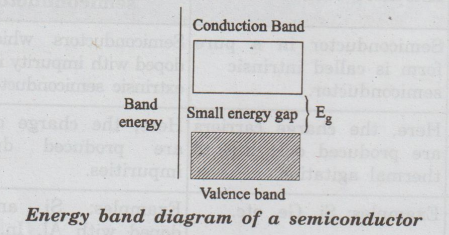
Conduction
Band
3.
What is an intrinsic semiconductor?
Semiconductor
in an extremely pure pure form (without impurities) is known as intrinsic
semiconductor.
4.
What is an extrinsic semiconductor?
A
semiconducting material in which impurity atoms added (doped) to the material
to modify its conductivity is known as extrinsic semiconductor or impurity
semiconductor.
5.
What is an n-type semiconductor?
When
a small amount of pentavalent impurity is added to a pure semiconductor, it
becomes extrinsic or impure semiconductor and it is known as n-type
semiconductor.
6.
What is a p-type semiconductor?
When
a small amount of trivalent impurity is added to a pure semiconductor, it
becomes extrinsic semiconductor or impure semiconductor and it is called p-type
semiconductor.
7.
What is meant by doping and doping agent?
The
technique of adding impurities to a pure semiconductor is known as doping and
the added impurity is called doping agent.
8.
Explain the concept of hole in semiconductor.
In
intrinsic semiconductor, charge carriers are created due to breaking of
covalent bonds. When a covalent bond is broken, an electron escapes to the
conduction band leaving behind an empty space in the valence band. This missing
electron is called a hole.
9.
What is meant by donor energy level?
A
pentavalent impurity when doped with an intrinsic semiconductor donates one
electron which produces an energy level called donor energy level.
10.
What is meant by acceptor energy level?
A
trivalent impurity when doped with an semiconductor accepts one electron which
produces an energy level called acceptor energy level.
11.
Mention the uses of compound semiconductor.
They
are used as photovoltaic materials, photoconductive cell, laser materials and
for making LED (Light Emitting Diode].
12.
Define drift velocity.
When
an electrical field is applied in a semiconducting material, the free charge
carriers such as free electrons and holes attain drift velocity vd
The
drift velocity attained by the carriers is proportional to the electrical field
strength E.
i.e.,
vd ∞ E
vd
= μE ...(1)
where
μ is a proportionality constant and it is known as the mobility of the charge
carrier.
13.
Define drift current.
The
electric current produced due to the motion of charge carriers under the
influence of an external electric field is known as drift current.
14.
Define diffusion current.
The
non-uniform distribution of charge carriers creates the regions of uneven
concentrations in the semiconductor.
The
charge carriers move from the regions of higher concentration to the regions of
lower concentration. This process is known as diffusion. The current is known
as diffusion current.
15.
What is a Hall device?
The
device which uses the hall effect for its application is known as Hall device.
16.
What are different types of Hall devices?
There
are three types of Hall devices.
They
are
(a)
Gauss Meter
(b)
Electronic Multiplier
(c)
Electronic Wattmeter
17.
What is a schottky diode?
It
is a junction formed between a metal and n-type semiconductor.
When
the metal has a higher work function than that of n-type semiconductor then the
junction formed is called schottky diode.
18.
What are advantages of schottky diodes?
•
In schottky diode, stored charges or depletion region is negligible. So, a
schottky diode has a very low capacitance.
•
In schottky diode, the depleting region is negligible. So (Pogan the schottky
diode will immediately switch from ON to OFF state (fast recovery time).
•
The depletion region is negligible in schottky diode. So bas 19 applying a
small voltage is enough to produce large current.
•
It has high efficiency.
•
It operates at high frequencies.
•
It produces less noise.
19.
What are the application of scholtky diode?
•
Schottky diode can be used for rectification of signals of frequencies even
exceeding 300 MHz.
•
It is commonly used in switching device at frequencies of 20 GHz.
•
It is used in radio frequency (RF) applications.
•
It is widely used in power supplies.
20.
What is ohmic contact?
An
ohmic contact is a type of metal semiconductor junction. It is formed by a
contact of a metal with a heavily doped semiconductor.
When
the semiconductor has a higher work function than that of metal, then the
junction formed is called the Ohmic junction.
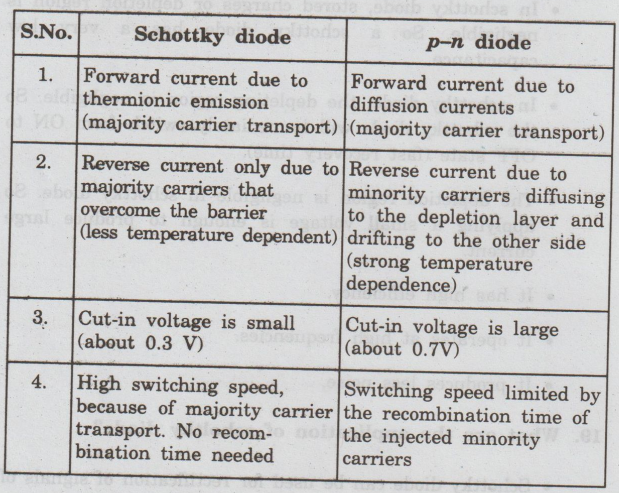
21.
What are the differences between schottky diode and p-n diode?
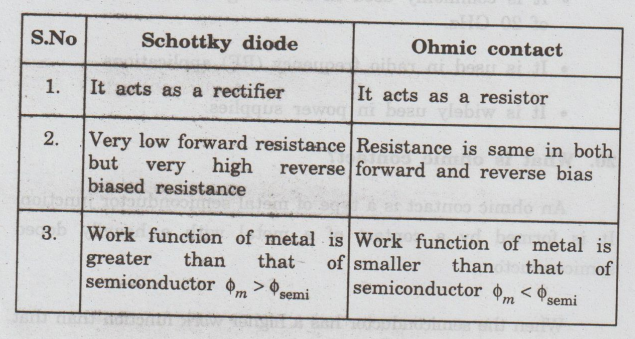
22.
What are the differences between schottky diode and ohmic contacts?
23.
What are the uses of ohmic contact?
The
use of ohmic contacts is to connect one semiconductor device to another, an IC,
or to connect an IC to its external terminals.
Physics for Electrical Engineering: Unit III: Semiconductors and Transport Physics : Tag: : Semiconductors and Transport Physics | Physics for Electrical Engineering - Additional Q and A
Physics for Electrical Engineering: Unit III: Semiconductors and Transport Physics
Under Subject
Physics for Electrical Engineering
PH3202 2nd Semester 2021 Regulation | 2nd Semester EEE Dept 2021 Regulation
Related Subjects
Professional English II
HS3251 2nd Semester 2021 Regulation | 2nd Semester Common to all Dept 2021 Regulation
Statistics and Numerical Methods
MA3251 2nd Semester 2021 Regulation M2 Engineering Mathematics 2 | 2nd Semester Common to all Dept 2021 Regulation
Engineering Graphics
GE3251 eg 2nd semester | 2021 Regulation | 2nd Semester Common to all Dept 2021 Regulation
Physics for Electrical Engineering
PH3202 2nd Semester 2021 Regulation | 2nd Semester EEE Dept 2021 Regulation
Basic Civil and Mechanical Engineering
BE3255 2nd Semester 2021 Regulation | 2nd Semester EEE Dept 2021 Regulation
Electric Circuit Analysis
EE3251 2nd Semester 2021 Regulation | 2nd Semester EEE Dept 2021 Regulation
Physics for Electronics Engineering
PH3254 - Physics II - 2nd Semester - ECE Department - 2021 Regulation | 2nd Semester ECE Dept 2021 Regulation
Electrical and Instrumentation Engineering
BE3254 - 2nd Semester - ECE Dept - 2021 Regulation | 2nd Semester ECE Dept 2021 Regulation
Circuit Analysis
EC3251 - 2nd Semester - ECE Dept - 2021 Regulation | 2nd Semester ECE Dept 2021 Regulation
Materials Science
PH3251 2nd semester Mechanical Dept | 2021 Regulation | 2nd Semester Mechanical Dept 2021 Regulation
Basic Electrical and Electronics Engineering
BE3251 2nd semester Mechanical Dept | 2021 Regulation | 2nd Semester Mechanical Dept 2021 Regulation
Physics for Civil Engineering
PH3201 2021 Regulation | 2nd Semester Civil Dept 2021 Regulation
Basic Electrical, Electronics and Instrumentation Engineering
BE3252 2021 Regulation | 2nd Semester Civil Dept 2021 Regulation
Physics for Information Science
PH3256 2nd Semester CSE Dept | 2021 Regulation | 2nd Semester CSE Dept 2021 Regulation
Basic Electrical and Electronics Engineering
BE3251 2nd Semester CSE Dept 2021 | Regulation | 2nd Semester CSE Dept 2021 Regulation
Programming in C
CS3251 2nd Semester CSE Dept 2021 | Regulation | 2nd Semester CSE Dept 2021 Regulation